






















Readiness work before a small bulldozer enters a site is often simplified to two things: the machine can arrive and it can start. In practice, what actually holds up the work sequence on site is often another category of issues: whether the work face is wide enough, whether the material is loose soil or needs ripping first, whether the blade type matches the dozing method, and whether transport vehicles and lifting conditions for mobilization have been secured. Laying out readiness items in process order makes omissions easier to spot than looking at a parameter table alone.
Below, using data for a 10,000 kg-class small bulldozer with rated power of 81 kW (125 HP), track shoe width of 450 mm, and ground pressure of 54.4 kPa, we explain which stages readiness checks should cover and which conditions are not covered by the data and require on-site or supplier confirmation.
First confirm what this machine is assigned to do
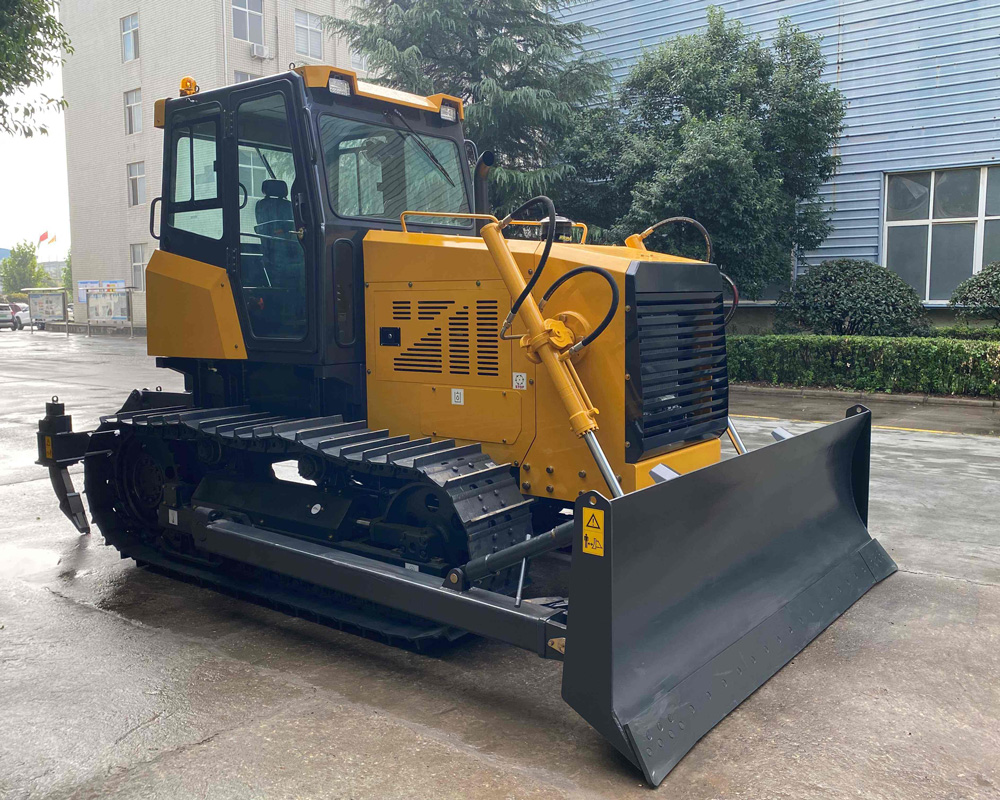
The data lists applicable directions including earthmoving, site grading, and material handling. The blade size is 2960×960 mm, maximum lift height is 830 mm, digging depth is 350 mm, and straight, curved, and coal blades are optional; the rear can be equipped with a fixed towing device or a three-shank ripper. The first step in readiness checking is not inspecting the machine but breaking down the site task against these directions:
- Whether dozing or leveling is primary determines the blade type and the organization of the dozing path;
- Whether the material is loose soil, undisturbed soil, or a hard layer that needs ripping first determines whether a ripper is needed;
- Whether there is also short-distance towing work determines whether a rear towing device should be included in the configuration;
- Whether the site is a new work face or a hardened surface determines whether ground pressure and track shoe width meet traffic conditions.
Without conclusions at this step, later checks easily become a formality. For example, for the same small-site grading, when the dozing distance is short and the material is loose, straight and curved blades are organized differently; if the material is compacted, the lack of a ripper will cause the dozing process to repeat.

Readiness checklist expanded by process stage
Dozing stage: path, material, and blade
Before dozing, what must be secured is path width and turning space. The data gives overall dimensions of 4400×2960×3030 mm and track shoe width of 450 mm; this set of data can be used to check entry passages, work face width, and passing conditions. Note that overall dimensions do not equal the minimum turning space required for work; the blade's lateral extension and deflection during dozing will take up extra width, so margin should be left on site.
Regarding materials, the data does not give dozing capacity classified by soil type, nor does it explain performance under different moisture content or density, so it cannot be used to judge whether a certain soil is suitable for direct dozing. During readiness, material type, looseness, and whether pre-ripping is needed should be listed as items to be confirmed, and if necessary verified through a trial dozing section.
Grading stage: blade height and ground pressure
The blade's maximum lift height of 830 mm and digging depth of 350 mm correspond to the blade's action range, not grading accuracy. The readiness focus for site grading should be: whether the work face has enough surplus material for dozing, whether layered leveling is needed, and whether the track ground pressure of 54.4 kPa matches the current ground bearing conditions. Ground pressure data can be used to compare with site bearing capacity data, but the data does not provide applicability conclusions for special ground such as soft foundations or wetlands; soft ground should be evaluated separately and general site experience should not be directly applied.
Ripping and towing stage: rear attachments
A fixed towing device or three-shank ripper is an optional configuration. During readiness, confirm: whether the site actually has a hard layer that needs ripping or material that needs towing; whether the selected rear attachment is ordered together with the machine configuration and whether it is installed upon arrival; and whether attachment changes need to be completed before entry. The data only states that they are optional and does not give specific values such as ripping depth or towing capacity, so ripping results or towing loads cannot be promised based on it; related capabilities need further confirmation from the supplier.

Mobilization stage: transport and lifting
Overall dimensions of 4400×2960×3030 mm and an operating weight of 10,000 kg are the basic data for arranging transport vehicles and loading/unloading plans. The readiness checklist should include: whether the transport vehicle's load capacity and flatbed dimensions are sufficient, whether the loading/unloading site is level, and whether lifting points are set as required by the manual. The data does not provide dimensional changes in transport condition, lifting weight distribution, or tie-down point locations; these are items that must be verified with the supplier or manual before mobilization and cannot be inferred from overall dimensions alone.
Readiness items corresponding to power and transmission conditions
The machine uses a Cummins 4BT3.9-C125 diesel engine with rated power of 81 kW/2300 r/min, maximum torque of 400 N·m, matched with a 4F+2R mechanical transmission, forward speed of 2.6–10.4 km/h, and reverse speed of 3.7–6.7 km/h. The corresponding practical items during readiness are:
- Whether the fuel grade matches on-site supply conditions; the data does not give tank capacity or fuel consumption per shift, so shift refueling arrangements need separate confirmation;
- The forward and reverse speed ranges can be used to estimate dozing cycle time, but the actual cycle is also affected by dozing distance, material, and operation, so shift output cannot be estimated from the speed table alone;
- Whether the mechanical transmission's control method is consistent with operator habits; personnel familiar with the equipment should be arranged to test-operate before entry.
The fuel consumption value in the data is ≤242 g/km·h, which differs from common fuel consumption expressions; it should not be directly converted to liters/hour or currency/hour, and procurement and use calculations should be based on official data provided by the supplier.
Several confirmations that are easily skipped but affect entry
| Confirmation item | Data basis | Requires on-site or supplier confirmation |
|---|---|---|
| Work face width and turning space | Overall dimensions 4400×2960×3030 mm | Actual width occupied after blade deflection, margin for dozing path |
| Ground bearing conditions | Ground pressure 54.4 kPa, track shoe width 450 mm | Site bearing capacity data, applicability to soft foundation or wetland |
| Blade type | Straight, curved, and coal blades optional | Selected according to material and dozing method, and arrival configuration confirmed |
| Rear attachment | Fixed towing device or three-shank ripper optional | Whether needed, whether installed at the same time, actual capability parameters |
| Transport and lifting | Operating weight 10,000 kg, overall dimensions as above | Vehicle load capacity, flatbed dimensions, lifting points and tie-down method |
| Fuel and shifts | 81 kW diesel engine, mechanical transmission | Tank capacity, actual fuel consumption per shift, on-site fuel supply arrangements |
The purpose of this table is not to replace the manual but to separate what the data can answer from what it cannot. What can be answered is used to arrange the site and transport in advance; what cannot be answered should be put into written confirmation before entry to avoid changing the configuration after arrival.
Completed readiness does not mean applicability is confirmed
The above checks assume the equipment arrives in the specified configuration. Applicability boundaries still need to be judged against actual working conditions: when the dozing distance is too long, the cycle efficiency of small equipment will be limited; for sites with high material density or high stone content, the data does not provide a conclusion on whether direct dozing is suitable; special conditions such as slope work and wetland work are also not specifically addressed in the data. These should not be glossed over with "it should work" during readiness but should be listed as trial operation or special confirmation items.
If on-site conditions differ significantly from the data description—for example, ground bearing is noticeably low, the transport passage width is close to the overall dimensions, or the material requires frequent ripping—then the equipment specifications or configuration direction should be re-evaluated rather than forced through with operational adjustments.
Site information recommended to prepare before inquiry
When asking a supplier for a quote, organizing the following information clearly is more helpful for getting a matching configuration proposal than simply asking "how much does a small bulldozer cost": material type and looseness, dozing distance and work face width, site bearing and whether it is soft foundation, whether ripping or towing is needed, transport vehicles and loading/unloading conditions, daily work shifts and fuel supply method, blade type preference, and whether rear attachments are purchased at the same time. For parts involving specific configurations, attachment capabilities, and transport plans, the supplier's written reply and manual should prevail; the parameters in this article are only used to illustrate the approach to readiness checking.