






















On heavy earthworks and quarry projects, equipment specifications tend to be pushed upward: if it can't dig, can't load fast enough, or can't stand stably on slopes, the first thought is whether the tonnage is insufficient. This judgment holds in some conditions, but in others, the constraints brought by large-tonnage equipment may outweigh the problems it solves. What really needs to be checked is: whether the material and loading rhythm match, whether the site can bear the load, whether the working range is sufficient, and whether transport access is possible—not just the tonnage number.
Tonnage determines class, not capability
Equipment with an operating weight of nearly 45 tons is indeed in a different magnitude from 20-plus-ton machines, but tonnage itself does not describe any specific operational performance. The same machine will have different actual rhythms in loose earthworks and hard rock quarries, and when matched with dump trucks of different specifications, waiting times and cycle counts will also differ. Large tonnage only indicates that the entire machine, undercarriage, hydraulics, and engine are at the same heavy-duty level; whether it suits a specific job site still requires item-by-item judgment based on site conditions.
Four types of prerequisites easily overlooked
Material and truck loading
Large-tonnage excavators are typically designed to match large dump trucks. If the on-site fleet is on the smaller side and bucket capacity does not match truck bed volume, there will be cases of incomplete bucket loads or multiple positioning attempts, and the loading rhythm may not be smoother than that of a medium-tonnage machine. Conversely, hard rock and quarry materials impose greater impact on the bucket and teeth, so equipment capability must be considered together with material hardness—a single tonnage figure cannot cover all materials.

Ground bearing and slopes
The heavier the machine, the more the load distribution per unit ground contact area needs verification. According to the data, equipment in this class has a ground pressure of 80.2 kPa, an undercarriage width of 3490 mm, and a gradeability of 70% (35°). These values indicate that its design targets relatively stable ground and sites with some slope, but whether the actual bearing capacity of soft foundations, backfill areas, or rainy-season sites is sufficient still requires separate judgment; the rated gradeability should not be interpreted as safe operation on any slope.
Working range
Maximum digging depth 7800 mm, maximum digging radius 12016 mm, and maximum dumping height 7615 mm—these figures determine whether the machine can reach the required position in one pass for deep pit excavation and high-bench loading. If the on-site bench height or dumping height exceeds this range, an extra rehandling step or parking position adjustment will be needed, and the actual rhythm will change accordingly. These range figures should be checked against construction drawings or bench layouts, not just whether it can dig.
Site access and relocation
Overall length 12090 mm, overall width 3490 mm, ground contact length during transport 6735 mm, and total track length 5335 mm—these dimensions determine transport vehicle selection and access conditions on entry roads. If temporary road width, turning radius, and bridge/culvert load limits are not confirmed in advance, the machine may be difficult to position even after arriving on site.

Matching needs with data from a 45-ton crawler excavator
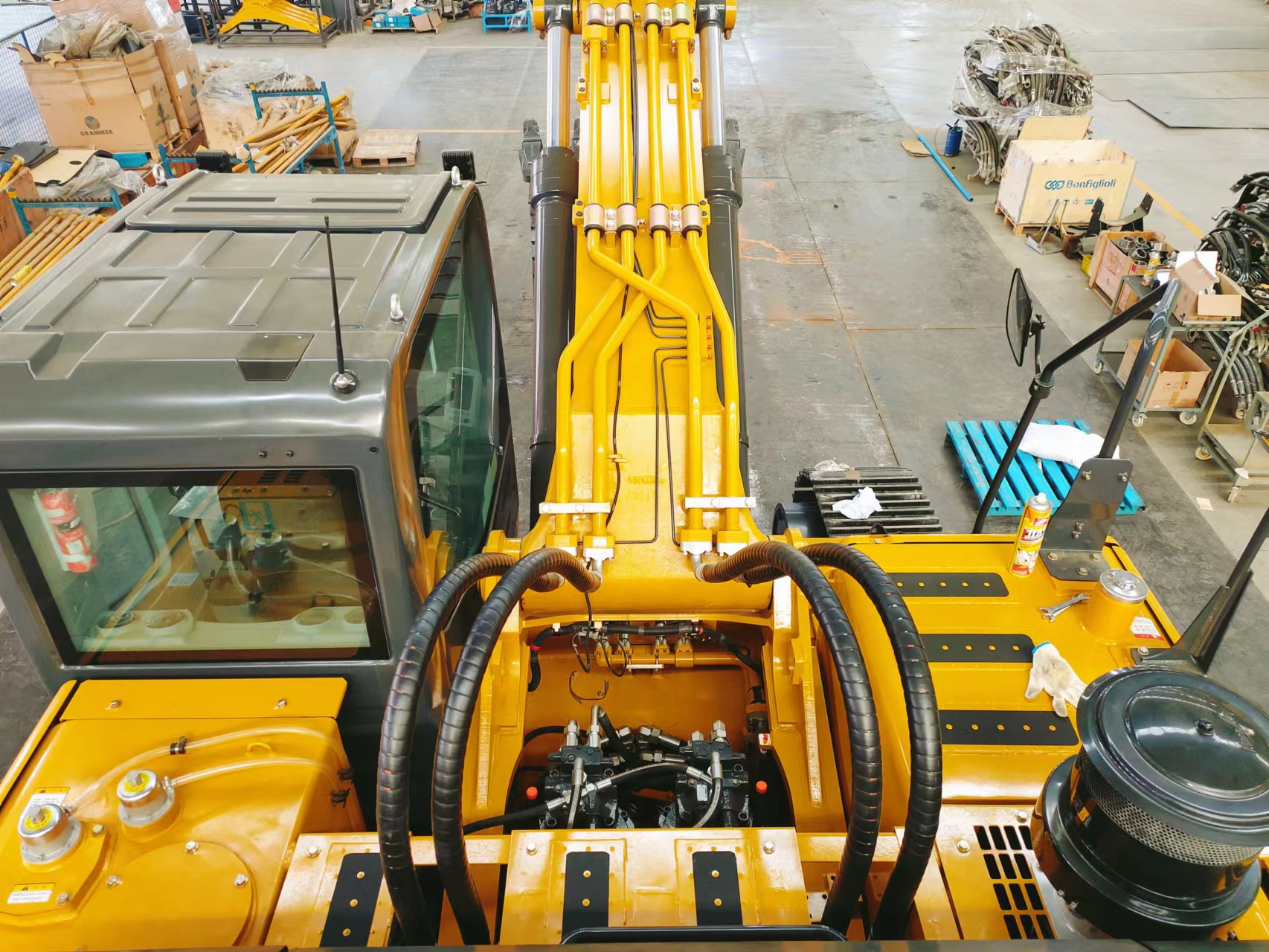
Taking a 45-ton crawler excavator from this site's product data as an example, it is possible to see which type of need each parameter corresponds to:
| Data field | Verified data | Corresponding need |
|---|---|---|
| Operating weight | 44900 kg | Heavy earthworks, continuous loading in quarries |
| Engine | Cummins QSM11, 6-cylinder in-line turbocharged and intercooled, displacement 11 L, rated power 250 kW/2000 rpm | Power reserve under sustained heavy load |
| Bucket capacity | 2.0–2.2 m³, bucket width 1350–1530 mm | Matching with dump truck bed volume |
| Digging force | Bucket 290 kN, arm 236 kN | Penetration capability in hard rock and compacted materials |
| Hydraulic system | Linde load-sensing system, 2× variable piston pumps + 1× gear pump, maximum flow 2×360+27 L/min | Control and power distribution for combined operations |
| Working range | Maximum digging depth 7800 mm, maximum digging radius 12016 mm, maximum dumping height 7615 mm | Deep pit excavation and high-bench loading |
| Travel and gradeability | Travel speed 3.2/5.3 km/h, gradeability 70% (35°), drawbar pull 330 kN | On-site relocation and slope passage |
| Fluid capacities | Fuel tank 650 L, hydraulic tank 350 L/system 406 L | Scheduling of refueling and maintenance intervals within shifts |
The purpose of this comparison table is not to prove that the equipment suits all scenarios, but to show that every purchasing judgment should be tied to the corresponding field. For example, if concerned about loading rhythm, first check bucket capacity against fleet bed volume; if concerned about hard rock penetration, first check digging force and tooth configuration; if concerned about slope passage, first check gradeability and ground conditions.
Conditions under which this equipment deserves serious consideration
- The material is mainly hard rock or compacted earthworks, requiring greater bucket digging force for penetration;
- The site is equipped with large-tonnage dump trucks, bucket capacity matches bed volume, and loading cycles are reasonable;
- Ground conditions on the working face are relatively stable, and slope gradients and road surface conditions are within the gradeability range stated in the data;
- Entry roads and transport vehicles can accommodate the machine's dimensions and weight;
- Project shifts are long, and fuel tank and hydraulic system capacities can support the established refueling and inspection schedule.
When not to simply scale up by tonnage
The following are conditional judgments, not conclusions about any type of job site. If the on-site fleet is mainly small to medium dump trucks, the working face is narrow, temporary road bearing capacity is limited, or the material is mainly loose earthworks and loading rhythm is not tight, then larger-tonnage equipment may not bring improved rhythm but rather relocation difficulties and poor coordination. In such cases, recalculate based on actual material, fleet, and site conditions rather than increasing tonnage first.
Items still to be confirmed before purchase
- Material: soil-to-rock ratio, rock hardness, whether crushing or ripping is needed, and whether the digging force in the data is sufficient.
- Truck loading: whether dump truck bed volume matches bucket capacity, and whether dumping height and bench layout are within the working range.
- Site and transport: ground bearing capacity, slope conditions, entry road width and load limits, and transport vehicle specifications.
- Shifts and refueling: daily operating hours, refueling arrangements, maintenance windows, and supply of wear parts.
- Configuration verification: whether bucket specifications, tooth type, and track shoe width match on-site materials; the actual product configuration sheet shall prevail.
Regarding the actual loading efficiency, fuel consumption, and construction returns of this machine under specific strata and specific fleet sizes, the available data contains no corresponding test or case data. These must be confirmed before purchase through configuration verification and on-site condition assessment, and should not be inferred directly from tonnage figures.
For further information on equipment in this class, please refer to the product data for the 45-ton crawler excavator. When requesting a quote, it is recommended to provide material type, workload, site and transport conditions, shift arrangements, and the required work equipment configuration.