






















When reviewing landfill compactor specifications, compaction width and gradeability are often treated as the most intuitive criteria: a larger width seems to mean higher efficiency, and a higher gradeability percentage seems to mean it can go anywhere. But what really needs to be answered on site are two other questions—whether the working strip can be covered in one pass, and whether ramps and soft foundations can be traversed stably. Understanding the boundaries of these two data points is more useful than memorizing the numbers.
Below, using the verified specifications of the C300H landfill compactor on this site as a reference, we explain the relationship between these two fields and landfill operation organization. The values mentioned in this article belong only to this model and cannot be extrapolated to other equipment.
Compaction width corresponds to lift organization, not single-pass throughput
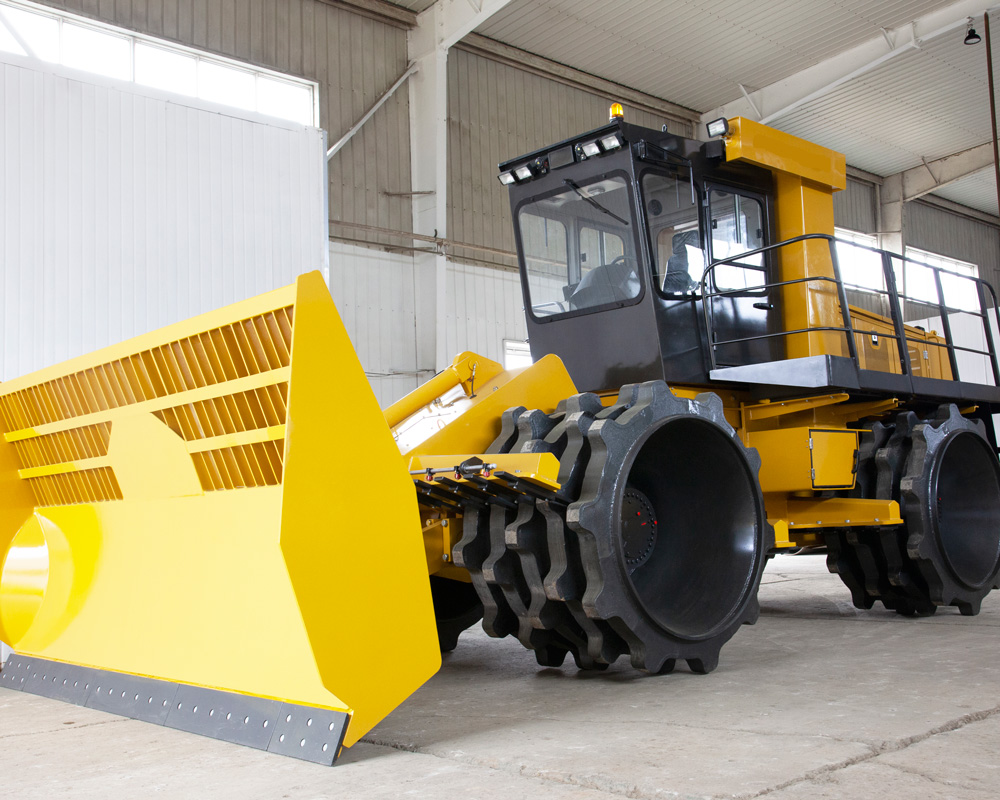
The C300H has a compaction width of 3430mm, a front roller width of 1195mm, a rear roller width of 970mm, and both front and rear roller diameters of 1620mm. This set of data first indicates the approximate lateral coverage of the four compaction wheels in a single pass.
For a landfill, this width must be considered together with the width of the daily working face, the layout of waste unloading points, and the connection of leveling routes. If the working strip is too narrow, the edge wheels of wide equipment may continuously press on the unleveled edge of the pile or temporary roads, which affects compaction uniformity and increases travel resistance; if the working face is wide enough, a single pass covers a wider area and reduces the number of back-and-forth route adjustments. This describes geometric coverage and does not constitute a promise of actual efficiency.

Therefore, when reading compaction width, the site questions should first be clarified:
- Is the width and shape of the daily unloading area stable, or does it change continuously as the pile advances?
- Are leveling and compaction completed continuously by the same machine, and will routes cross significantly?
- Is there enough space at the edge of the working face to prevent compaction wheels from continuously riding on the slope?
The specifications also give the number of roller teeth (front 50×2, rear 40×2) and 'high-strength wear-resistant cutting teeth,' and state that the compaction and spreading depth can reach more than 1 meter. The tooth arrangement affects crushing and mixing, and together with width determines the working range covered in a single pass. However, whether the compaction density meets requirements still depends on lift thickness, moisture status, number of passes, and waste composition. The specifications do not provide compaction performance data under these conditions, so this is a matter requiring on-site verification.
Gradeability of 100% must be read together with drive and ground conditions
The C300H's gradeability is rated at 100%, and it is equipped with four-wheel drive and a PR75-37 drive axle with rear-wheel proportional differential lock. These items should be understood together: the gradeability figure describes the machine's capability rating under specific conditions, while whether it can actually climb stably also depends on road surface adhesion, the softness of the waste pile, and load distribution.

Landfill slopes differ from ordinary roads—the surface is often loose waste or cover soil, bearing is uneven, and tires may sink locally. The function of the differential lock is to transmit power to the other side when one wheel slips, which is not the same as 'the ramp can definitely be climbed.' Dimensions such as 'minimum ground clearance 490mm' and 'front-rear axle distance 3500mm' indicate that clearance space on undulating piles and temporary roads needs to be reserved.
Therefore, gradeability should be used as a preliminary criterion to screen out obviously unsuitable sites, not as a promise of passage on any slope or under any load condition. Ramp gradient, slope surface material, wetness after rain, and whether operating at full load all need to be confirmed item by item before purchase.
Beyond these two data points, what else must be checked for landfill operations
Compaction width and gradeability are only part of the specification page. Other verified information for the C300H also corresponds to site questions:
| Specification field | Corresponding site question |
|---|---|
| Operating weight 29100kg, engine 192kW | Power basis for heavy compaction work; not a conclusion on fuel consumption or efficiency |
| Blade height 1880mm, extra-wide and extra-high design | Whether dozing, leveling, and compaction can be completed continuously by one machine |
| Fully enclosed cab, high-level air intake, and activated carbon filtration | Operating conditions in odor and dust environments |
| Stainless steel chemical tank and powered spray mechanism | Supporting arrangements for on-site sanitary protection |
| ROPS safety structure | Protection configuration against rollover and falling object risks |
| Centralized lubrication at 12 key working points | Organization of daily maintenance |
Each item in the table is a description of equipment specifications; whether it meets the needs of a specific landfill still depends on that site's operating procedures, protection requirements, and maintenance arrangements. For example, the actual effect of the sanitary spray system depends on chemicals and operating frequency, which are not given in the specifications; centralized lubrication reduces manual lubrication workload but does not mean the machine is maintenance-free.
Pre-purchase condition checklist
If you are evaluating this type of equipment for landfill operational needs, the questions can be organized into verifiable items:
- Material and lift: waste composition, daily intake, planned lift thickness, and number of compaction passes;
- Site conditions: working face width, pile slope, slope surface material, and bearing changes during the rainy season;
- Transport and relocation: overall length 8100mm, width 3800mm, height 3670mm; whether access roads and relocation methods match;
- Shifts and power: daily operating hours, fuel supply arrangements, and whether the emission level of the 192kW engine meets local requirements;
- Protection and maintenance: on-site sanitary protection procedures, who performs lubrication and inspections, and how spare parts are guaranteed.
Compaction width determines the coverage of a single pass, and gradeability provides a reference upper limit for passage conditions, but neither can replace verification of material, lift, and site bearing. Matching these conditions item by item with the equipment specifications and then deciding whether further confirmation is needed is closer to real selection logic than comparing a single value. For specific configuration and applicability, refer to the C300H information on this site's product page for further verification.