






















Earthmoving contractors often encounter two types of ground on the same project: one section is normal dry soil, backfill pushing, and grading; another is soft ground after rain, riverbank, or swamp edge. If only one mid-size dozer is to be kept, the most practical purchasing question is: with a standard version, it may sink in soft ground; with a super wetland version, traction efficiency and blade work on dry earthwork may not match. To answer this trade-off, first clarify which type of ground dominates the work area, then check which configurations in the equipment data truly correspond to that difference.
First Distinction: The Two Ground Types Require Different Things
Conventional earthmoving focuses on cutting, pushing, and backfill efficiency, as well as the machine's passability and structural durability on hard, compact ground. Wet, soft ground is more about pressure per unit area—the pressure the machine's weight transmits to the ground through the tracks. Lower ground pressure means shallower sinking under the same weight, but wider track shoes and a heavier machine also change flexibility on dry earthwork. The essence of the trade-off is: which ground type dominates the project, and whether the other type is only occasional.
Two Versions on the Same Platform Differ at the Ground Contact Area
The 178-hp mid-size crawler dozer associated with this site has multiple versions listed in public data, including standard and super wetland types, which can be compared side by side:
| Item | Standard Version | Super Wetland Version |
|---|---|---|
| Operating weight | 17000 kg | 16900 kg |
| Ground pressure | 58 kPa | 22 kPa |
| Track shoe width | 510 mm | 960 mm |
| Number of track shoes (one side) | 37 | 41 |
| Blade type | Angle/Straight/U-blade | Straight blade |
| Overall dimensions (mm) | 5140×3455×3024 | 5262×4150×3074 |
Two signals can be read from the table: the super wetland version widens the track shoes from 510 mm to 960 mm and reduces ground pressure from 58 kPa to 22 kPa; the operating weight differs by only 100 kg, indicating that the pressure reduction mainly comes from widening the ground contact area, not from weight reduction. For soft ground work, this is a directly corresponding configuration; for dry earthwork, wider track shoes mean a wider machine (4150 mm), and transport and turning space beyond the turning radius must be rechecked.

Application Scope of the Standard Version and Limits of the Wetland Version
The standard version is described in the data as intended for earthmoving, excavation, and backfill projects in highways, railways, mines, and airports. It comes standard with a straight blade, can be equipped with a three-shank ripper for breaking clay and frozen soil, and the blade can also be selected as angle or U-blade. These configurations are more suitable for work areas dominated by dry earthwork, backfill, and grading. The super wetland version data explicitly corresponds to swamps, soft wetlands, wetland improvement, and river channel improvement, with a straight blade. That is, if the project ground remains in a soft plastic state for long periods, the standard version's 58 kPa ground pressure will become the main limitation; if only a short wet, soft section is occasionally crossed, choosing the super wetland version specifically would incur the transport and site adaptability costs of wider tracks.
It should be noted that the data does not provide efficiency comparisons between the two versions under specific soil types, moisture content, or push distances, nor does it give the safe soft-ground depth for each. Therefore, it cannot be concluded that "a certain version can be used on any wetland" or that "the standard version cannot enter soft ground at all"; these can only be confirmed separately based on on-site bearing conditions.
Answer Three Site Questions First When Choosing
1. Is wet, soft ground normal or occasional?
If soft ground sections account for the majority of the workload and the machine needs to repeatedly push and turn within them, the ground contact configuration should prioritize low ground pressure; if it is only crossed during entry and exit, first assess whether padding, drainage, or adjusting the work sequence can solve it, without changing the machine version for this purpose.

2. Do transport and site access conditions allow wider tracks?
The super wetland version has an overall width of 4150 mm, versus 3455 mm for the standard version, a difference of about 700 mm. This affects trailer selection, rural road passage, site gates, and turning space. Before purchase, check width limits and turning radii along the actual transport route to avoid the machine being unable to enter the work area after arrival.
3. Do blade and ripper configurations match the main operations?
The data shows the standard version can be equipped with angle, straight, or U-blades and a three-shank ripper; the super wetland version lists a straight blade. If the project involves extensive breaking of clay or frozen soil or multi-directional pushing, confirm whether the selected version can be equipped with the corresponding work equipment according to the operation, rather than inferring complete configuration from the "version name" alone.
Power and Undercarriage Are Shared Between the Two Versions
Both versions are marked with a WP10 engine, rated power 131 kW/1850 rpm, corresponding to 178 hp; fuel tank capacity 315 L, hydraulic tank 112 L, ground clearance 400 mm, track center distance 1880 mm, and ground contact length 2635 mm. That is, the power and main undercarriage structure are the same, with differences concentrated in track shoe width, ground pressure, and the resulting overall dimensions. The transmission system is described in this site's data as a self-made gearbox and undercarriage system, which the data says has been market-validated, but no life or efficiency data under different ground conditions is given, so selection should not be based on this alone.
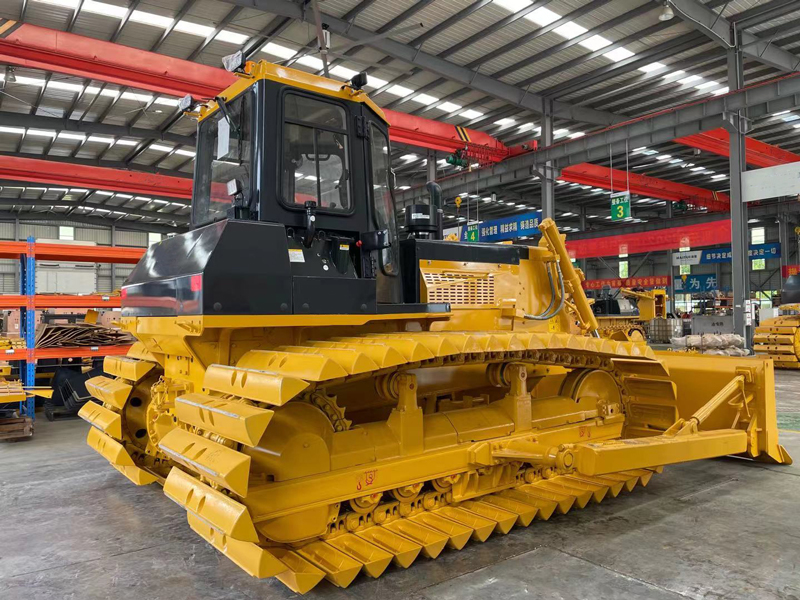
For maintenance, the data mentions that the fuel filter and air filter are arranged on the same side, lubrication points are exposed, and side covers can be opened; these are conveniences for daily inspection and cannot replace the maintenance items and intervals specified in the manual. Requirements for cleaning and inspecting tracks and track rollers after wetland operation should also be based on the accompanying documentation.
Conditions Recommended to Provide Together Before Inquiry
- Work area composition: proportions of dry earthwork, backfill, grading, and soft ground sections, and whether soft ground sections exist long-term.
- Material type: ordinary soil, clay, frozen soil, sand/gravel, or bulk material, and whether special blades for ripping or coal pushing are needed.
- Transport conditions: road width limits, trailer specifications, site gates, and turning space, especially if a wide-track version may be selected.
- Shift and continuous operation duration: shift length and whether night work is involved, used to check lighting and cab configuration.
- Site bearing and drainage: moisture state of soft ground sections and whether padding or drainage conditions are available.
- Configuration check: blade type, whether a ripper is included, cab protection requirements, and accompanying documentation and spare parts supply.
Returning to the initial question, the trade-off between earthwork and wetland for a mid-size dozer is not about choosing the "stronger" version, but first confirming which ground type dominates, then deciding whether to accept the transport and site costs of wider tracks. What the data supports is the difference between the two versions in ground pressure and track width; whether a specific project is suitable still requires item-by-item verification based on on-site soil type, moisture content, and passage conditions.