






















Excavators on mine stripping faces or pit slopes often face two overlapping constraints at the same time: the slope itself affects equipment stability and travel safety, while hard rock determines whether cutting proceeds smoothly. Treating a larger tonnage as a direct solution can easily overlook what parameter data can answer—which capabilities are supported by data, and which must be confirmed separately based on specific slope ratios, rock properties, and transportation conditions. This article uses the verified data of a 50-ton crawler excavator as a reference to outline the capability boundaries and selection checkpoints under steep slope and hard rock conditions.
First, distinguish the nature of the two types of problems
Steep slope issues mainly concern travel and parking: how steep the slope is, whether the slope surface is level, and whether there is soft overburden. These directly affect whether the equipment can safely reach the site and whether it can operate stably after arrival. Hard rock issues concern cutting and loading: whether the bucket digging force is sufficient to cut the rock layer in the working condition, and whether the bucket capacity and cycle time can match the transport vehicles. The two are not determined by the same set of parameters, and mixing them together can easily lead to incorrect conclusions.
According to the data, this machine has an operating weight of 49600 kg, a bucket digging force of 290 kN, an arm digging force of 236 kN, and a bucket capacity of 2.2–2.5 m³. These figures indicate the range of working intensity it can cover, but they cannot be directly equated with actual cutting performance under arbitrary hard rock conditions.
Under steep slope conditions, where are the boundaries with a basis
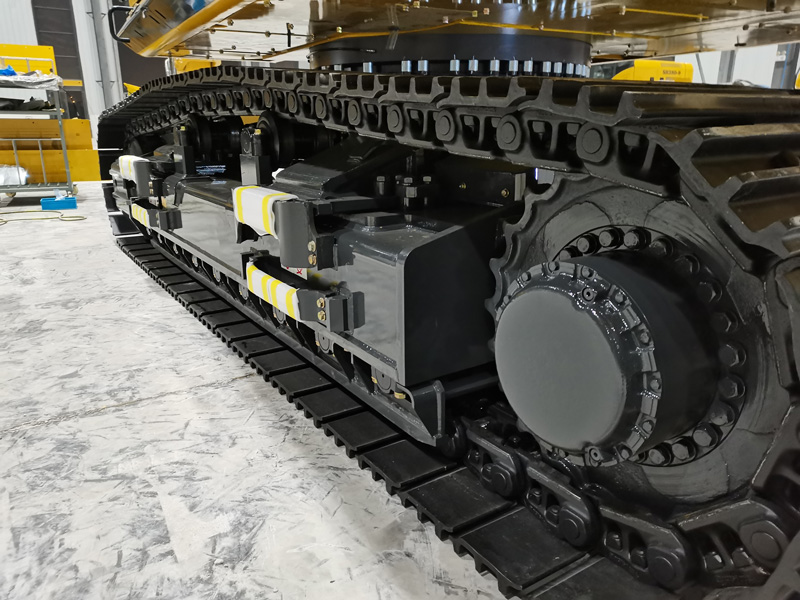
The data gives a gradeability of 70% (about 35°), travel speeds of 3.2/5.3 km/h, and ground pressure of 81.9 MPa. These are the starting points for judging slope adaptability. However, gradeability usually corresponds to specific test conditions. The adhesion state of the on-site slope surface, whether travel is loaded, slope length, and turning radius will all change the actual feasible range.

- When the slope surface is loose gravel or overburden, track adhesion decreases, and the gradeability value in the data cannot be directly applied; the allowable working slope ratio needs to be confirmed with the manufacturer according to actual slope surface conditions.
- Long-distance loaded climbing and short-distance unloaded transfer are two different working conditions. The former places significantly different demands on the travel motor and braking system, and the data does not distinguish between these two situations.
- The overall stability of the machine during slope operation also depends on bucket posture and swing position. The data does not provide the stable working range at different slope angles, which is an item to be confirmed.
In other words, the 70% gradeability can serve as a screening threshold, but it cannot be regarded as a permit for steep slope operation. Whether it can actually go up and how it should go up must be judged in combination with the slope treatment plan and the manufacturer's instructions on slope use.
Under hard rock conditions, how to judge the combination of digging force and bucket capacity
The core issue in hard rock excavation is whether the bucket can cut into the rock mass, how much can be loaded per cycle, and whether the loading pace can match the transport trucks. The 290 kN bucket digging force and 2.2–2.5 m³ bucket capacity in the data belong to the configuration of the same machine and need to be considered together: when the bucket capacity is at the upper limit, the force acting on a unit cutting surface is relatively reduced, and when hard rock layers are encountered, it may be necessary to reduce bucket capacity or combine with ripping pretreatment.
Regarding the hydraulic system, the data shows a load-sensing hydraulic system, with a maximum dual-pump flow of 2×380 L/min, an additional 27 L/min gear pump circuit, and a system pressure of 28.4 MPa. The role of load sensing is to let flow vary with operational demand and reduce unnecessary flow during combined actions. For hard rock loading, this means the operator can control action speed according to rock conditions rather than outputting full flow throughout. However, the data does not provide actual cycle times under different rock properties, nor does it provide fuel consumption data, so production or cost cannot be estimated from it.

| Site condition | Corresponding parameters in the data | Content still to be confirmed |
|---|---|---|
| Slope travel | Gradeability 70% (35°), travel speed 3.2/5.3 km/h | Actual slope surface adhesion state, allowable range for loaded climbing, slope surface preparation requirements |
| Hard rock cutting | Bucket digging force 290 kN, arm digging force 236 kN, bucket capacity 2.2–2.5 m³ | Cutability of the target rock type, whether ripping pretreatment is needed, recommendations for matching bucket capacity with rock properties |
| Loading coordination | Maximum digging radius 12016 mm, maximum dumping height 7615 mm | Transport vehicle body height and parking position, measured cycle time |
| Machine entry | Overall length 12090 mm, width 3490 mm, ground contact length during transport 6723 mm | Mine road width and turning radius, transport method and permits |
Continuous operation capability cannot be judged by power alone
The engine in the data is a Cummins QSM11, rated power 250 kW/2000 rpm, displacement 11 L, six-cylinder turbocharged and intercooled. These figures indicate the level of power reserve, but the continuity of continuous mining operations also involves heat dissipation, fuel replenishment, and hydraulic oil temperature management. The fuel tank capacity of 650 L, hydraulic oil tank of 350 L, and hydraulic system of 406 L determine the basis for the interval between single replenishments. How long it can actually last depends on load intensity and ambient temperature, and the data does not provide the corresponding continuous operation duration.
In addition, the data mentions three working modes for trading off between power output and hydraulic flow. Mode selection is an adjustment at the operational level and does not mean the equipment itself can adapt to arbitrary working conditions. The recommended use of specific modes under hard rock and slope conditions should be confirmed with the manufacturer or dealer.
Entry and supporting conditions that are easily overlooked
The overall length of 50-ton class equipment exceeds 12 m, the width is 3.49 m, and the ground contact length during transport is 6723 mm. The width of mine roads, curve radius, bridge load capacity, and loading/unloading sites all need to be checked in advance. If these conditions are not met, no matter how strong the equipment capability is, it cannot arrive as planned. In addition, wear consumption of bucket teeth and bucket wear parts under hard rock conditions is part of normal use. The data does not provide life data, so spare parts supply and replacement conditions should be confirmed separately during procurement.
If steep slopes and hard rock exist on site at the same time, it is recommended to separate the tasks for judgment: first confirm whether the slope can be safely traveled and used for parking operations, then confirm the cutting and loading configuration for the target rock type. Only when both conditions are met is it necessary to further compare tonnage and configuration; if one of them is not met, the construction plan or site preparation should be adjusted first rather than relying solely on increasing equipment specifications.
Checklist recommended before procurement
- Working equipment: bucket type, bucket capacity value, and bucket tooth configuration corresponding to the target rock type, and whether a ripper is needed.
- Strata and slope surface: actual slope ratio, slope surface material and adhesion state, rock hardness and joint development.
- Loading coordination: transport vehicle body height, parking position, and matching relationship with the maximum dumping height of 7615 mm.
- Transportation conditions: mine road width, turning radius, bridge load capacity, transport method, and related permits.
- Shifts and replenishment: daily work shifts, fuel replenishment arrangements, maintenance site, and spare parts supply.
- Power and configuration: engine power correction at target altitude and temperature, and hydraulic system oil temperature management requirements during continuous operation.
Among the above items, slope use limits, hard rock cutability, continuous operation duration, and spare parts life are all content not covered by the data and need to be confirmed item by item with the manufacturer or dealer before making a procurement decision.