






















Continuous dozing is not the same as one-off site leveling. Loaders have pauses while loading trucks, excavators wait while slewing, but bulldozers on long pushes often cut, push and return in one cycle, so the drivetrain and refueling rhythm directly determine how many passes can be completed in a shift. To judge whether a hydrostatic model fits, first break the work into push distance, material state, shift intensity and site bearing capacity, then check these against a specific model's specifications.
Break continuous dozing into four verifiable conditions
"Continuous" does not mean the machine never stops; it means the push path is long, the return trip also consumes working time, and the single shift is filled with dozing cycles. Such tasks can be broken down into the following four items:
- Push distance and cycle length: short-distance stockpiling and hundred-meter pushes place different demands on speed shifting and steering flexibility.
- Material state: loose earth, compacted bulk material and wet cohesive clay differ noticeably in penetration resistance and return-trip adhesion.
- Shift intensity: whether continuous operation of a dozen or more hours is required, and whether there is only one refueling window.
- Site bearing capacity: whether standard tracks can travel stably, or a wider ground contact area is needed.
These four items determine which direction to take on drivetrain type, fuel tank capacity and track configuration, rather than starting from the horsepower figure.
What hydrostatic drive corresponds to in these tasks
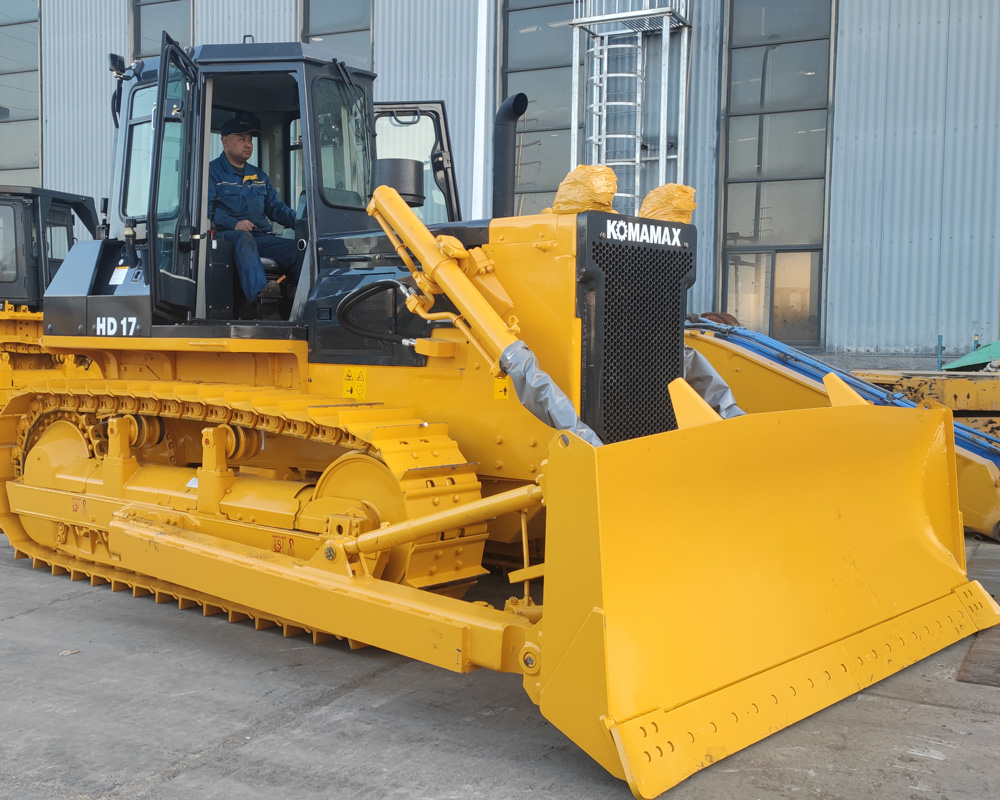
The DH17-G featured on this site is a 178HP hydrostatic bulldozer with a dual-circuit electric hydrostatic drive system, supporting stepless speed regulation with load steering and fixed steering. For continuous dozing, these configurations correspond directly to operating needs in cycle work: frequent fine steering adjustments during pushing, reversing in narrow work areas, and maintaining stable speed under changing loads are all scenarios where stepless speed regulation has a direct effect.

The load-adaptive function mentioned in the materials explains the logic of the equipment adjusting output with load; it does not mean the same dozing efficiency can be maintained in any material. Material density, moisture content and blade penetration angle still affect actual performance, and on-site verification with the target material should be carried out before purchase.
The machine also offers three power modes, selectable according to actual load. For continuous dozing tasks, this provides a means to adjust output rhythm to working conditions, but how to combine the modes should follow the onboard manual and cannot be inferred from the materials alone.
The relationship between fuel tank and continuous operation duration
The most easily overlooked aspect of continuous dozing is the refueling window. The DH17-G fuel tank capacity is 352L, and the materials state that at this power output it supports continuous operation for more than 14 hours. This figure corresponds to the conditions given in the materials; actual per-shift fuel consumption is affected by material, push distance, load mode and operating habits, and cannot be directly converted into endurance for any site.
For shift planning, a 352L tank means fewer refueling stops in most single-shift operations, but if the site lacks reliable refueling conditions or the work spans two shifts, advance calculation is still needed. The "15% increase in working range" in the materials is likewise a statement given under specific comparison conditions; it should be treated as an order-of-magnitude reference at purchase, not as an on-site commitment.

The correspondence between undercarriage and site bearing capacity
Continuous dozing requires the undercarriage to remain stable on repeatedly compacted ground. The standard DH17-G has a ground contact length of 2675mm, ground pressure of 65kPa (with ripper) or 77kPa (with drawbar), and track shoe widths of 510mm, 560mm or 610mm. Minimum ground clearance is 410mm for passability.
These figures show that the machine has an undercarriage basis for general earthwork, construction sites and road building, but they do not mean it can work directly on all soft-ground sites. For wet, soft foundations or muddy riverbanks, the super-wetland version of the same model gives a different set of ground contact parameters: ground pressure 30.5kPa, track shoe width 1100mm (standard) or 950mm, and ground contact length 2935mm. This shows that the differences between versions lie in the ground contact configuration, rather than simply being "the same model with a different shell."
Matching multi-version configurations to continuous dozing tasks
The DH17-G is available in standard, super-wetland, coal, sanitation, forestry and desert versions. The essence of version division is screening for operating conditions; different versions correspond to different blade and undercarriage configurations, and it should not be assumed that any version suits the same continuous dozing task.
| Version | Main operating focus in the materials | Points to verify for continuous dozing |
|---|---|---|
| Standard | General earthwork, construction sites, road building, mining and short-distance material transport | Push distance, material density, blade type |
| Super-wetland | Swamps, wetlands, riverbanks, soft foundations, water conservancy projects | Site bearing capacity, ground pressure, return route |
| Coal | Coal yards, ports, power plants, bulk material storage | Bulk material push distance, blade capacity and wear resistance requirements |
| Sanitation | Landfill sites, municipal waste treatment stations | Site slopes, sealed undercarriage and protective configuration |
The table lists only the operating focuses explicitly stated in the materials and does not mean these versions have all been verified for the task in this article. If a continuous dozing task involves both general earthwork and wetland sections, the main version should be determined by the section with the largest share, then the other section checked against the version's applicable scope.
Impact of control and maintenance conditions on continuous operation
Long-duration dozing places practical demands on operator comfort and maintenance accessibility. The DH17-G uses a single joystick to control travel and work equipment; the cab has a six-sided integrated structure, and the materials state that noise at the operator's ear can be reduced to 78dB, with rear air conditioning efficiency improved by 15%. These configurations address operator fatigue and cab environment issues during long shifts, but comfort features cannot replace on-site work organization.
On maintenance, the materials mention an externally mounted work valve, track rollers, side-opening guards, engine compartment lights and a modular structure. For continuous dozing tasks, these designs affect the accessibility of daily inspection and servicing. Specific inspection items, intervals and disassembly steps should follow the onboard manual; this article does not give maintenance intervals or repair operation recommendations.
Items still to confirm before purchase
- The actual length of the push distance and cycle route, and whether frequent steering is required.
- The density, moisture content and adhesion tendency of the target material, and whether on-site soil samples are needed for verification.
- Single-shift duration and on-site refueling conditions, and whether the 352L tank meets the shift plan.
- Site bearing capacity, whether standard track ground pressure is within an acceptable range, and whether a super-wetland configuration is needed.
- Blade type selection: straight-tilt or semi-U blade, corresponding to different pushing and stockpiling needs.
- Whether attachments such as rippers or winches are essential for this task; different configurations in the materials correspond to different working quality.
When requesting a quote, provide material type, work volume, push distance, site bearing capacity, shift schedule and key configuration requirements so that the version and attachment combination can be checked. There is no single "most suitable" answer for continuous dozing tasks; whether a hydrostatic model is worth considering depends on whether the above conditions match the drivetrain, refueling and undercarriage configuration.