






















When matching a machine to high-volume truck loading work, the most common mistake is treating tonnage as the sole basis for judgment. Two machines with similar operating weights may differ noticeably in continuous loading rhythm because of differences in hydraulic flow, bucket capacity range and undercarriage design. The value of machine specifications is not to deliver a conclusion about "how much it can load," but to help you clearly separate three things: the conditions a machine was designed for, which fields relate to loading, and which conclusions the specifications cannot provide.
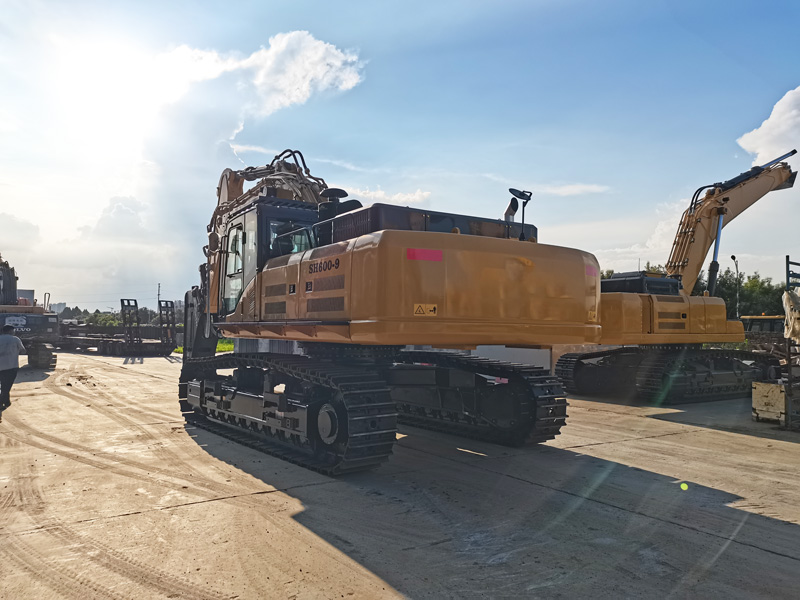
The following uses the published parameters of a 55–60 t crawler excavator from this site as an example to explain the reading order and the boundaries of judgment. All figures come from that product's specifications; they do not represent other models and do not constitute a commitment regarding actual loading efficiency.
First, be clear: loading capability is not a question one parameter can answer
High-volume loading usually means high-frequency cyclic work in front of dump trucks or crusher feed openings. What readers really need to judge is three things: how much material one bucket can take, how fast one cycle is, and whether the machine can repeat that cycle stably over a long period. These three correspond to three parts of the specifications—the working equipment, the hydraulic and power systems, and the undercarriage and travel system. Looking at any one alone gives only a partial impression.
Read the machine specifications in this order
Step 1: Power and hydraulics—answering "can the cycle be fast?"
This model is equipped with a Cummins QSM11-C400 engine with rated power of 298 kW / 1800 rpm; the specifications describe it as a six-cylinder in-line, turbocharged and intercooled unit with 10.8 L displacement. The hydraulic system uses negative flow control, with maximum operating flow of 874 L/min, travel circuit pressure of 34.3 MPa, swing circuit pressure of 28.4 MPa and pilot system pressure of 4.9 MPa.

For loading work, this set of fields explains action response and oil supply capability for combined operations: whether flow keeps up when boom, arm, bucket and swing move simultaneously directly affects how each cycle connects. Negative flow control here is a system-type description indicating the control method of the hydraulic pump; it cannot be used to infer specific fuel consumption or speed values.
Step 2: Working equipment—answering "what range does single-bucket material pickup fall in?"
The specifications give bucket capacity of 2.5–3.5 m³ and bucket width of 1968 mm; bucket digging force is 328 kN and arm digging force is 271 kN. Maximum digging height is 10252 mm, maximum dump height is 7150 mm, maximum digging depth is 7114 mm and maximum digging radius is 11406 mm.
Capacity is a range rather than a single value, which deserves attention in loading scenarios: material density, lump size and the actual bucket configuration all affect the load per bucket. Digging force relates to whether the machine can cut into compacted clay or broken rock. Loading height and dump height must be checked together with the matched dump truck's body height and feed opening height; the specifications only give machine-side values.

Step 3: Undercarriage and travel—answering "do the site and relocation support continuous operation?"
This model has an operating weight of 55900 kg, ground pressure of 85.3 kPa, traction force of 349 kN, gradeability of 70% (35°), travel speed of 3.55 / 6.1 km/h, track shoe width of 600 mm, 9 track rollers and 2 carrier rollers per side, and ground contact length of 4414 mm during transport.
Loading points often involve soft soil, slopes or temporary roads. Ground pressure and track shoe width are the entry point for judging ground-bearing compatibility; gradeability is an upper-limit description given by the specifications, and actual passability also depends on road surface material, moisture condition and load distribution. These are the parts that specifications cannot replace on-site survey for.
Map the fields to the loading stages
| Loading stage | Corresponding specification fields | What the specifications can answer | What still needs confirmation |
|---|---|---|---|
| Material pickup and penetration | Bucket/arm digging force, bucket capacity range | Design capability level | Actual material density and lump size |
| Cycle connection | Maximum operating flow, swing speed 10.4 rpm, swing pressure | System oil supply and swing configuration | Operator coordination and site layout |
| Dump matching | Maximum dump height 7150 mm, maximum digging radius 11406 mm | Machine-side working range | Matched vehicle dimensions and parking position |
| Site and relocation | Ground pressure, track shoe width, gradeability, transport dimensions | Design boundaries | Actual ground bearing and transport route |
The purpose of this table is not to calculate loading volume but to remind you: the "what still needs confirmation" on the right side of each row is not in the machine specifications and must be verified separately against project conditions. Without that information, any conclusion that a machine is "suitable for high-volume loading" is only an inference.
What the specifications do not provide and should be asked before purchase
- Actual cycle time and hourly loading volume under different materials; the specifications provide no test data.
- Fuel consumption performance; the specifications only give fuel tank capacity of 630 L and hydraulic tank/system capacity of 490 / 610 L, with no fuel consumption per unit of work.
- Matching performance with dump trucks of a specific tonnage, which must be arranged separately according to body height, parking position and site swing space.
- Power correction and configuration adjustments for high-altitude, extreme cold or high-dust environments; the specifications do not cover these.
- The actual delivered bucket configuration (how capacity is determined within the 2.5–3.5 m³ range) and the accompanying wear-part list.
Conditions to state together when requesting a quote
If you are considering equipment of this class for loading work, it is recommended to provide the following when requesting a quote: main material type and density, average daily and peak loading volumes, the tonnage and body height of matched vehicles, working face dimensions and swing space, ground bearing and slope conditions, shift arrangements, transport route and width/height limits, and specific configuration requirements for the working equipment and bucket. The more complete this information is, the more solid the basis for configuration verification.
The purpose of machine specifications is to narrow the scope of judgment, not to replace verification of site conditions. Whether machines of similar tonnage can all handle the same loading task depends on the conditions above that are not reflected in the specifications.