






















After an earthmoving crew moves in, a common arrangement is this: the bulldozer first pushes topsoil, then grades the site, and when it hits a hard layer it hooks on a ripper and breaks it up, while also pushing loose material stockpiles. This approach saves effort in process handoffs, but when the equipment is placed in different materials and sites, whether the configuration actually matches is often not checked item by item. Pushing, rough grading, ripping and passing over soft wet ground are tasks with different boundaries. Using one machine for all of them is possible, provided the conditions each task places on the whole machine are understood first.
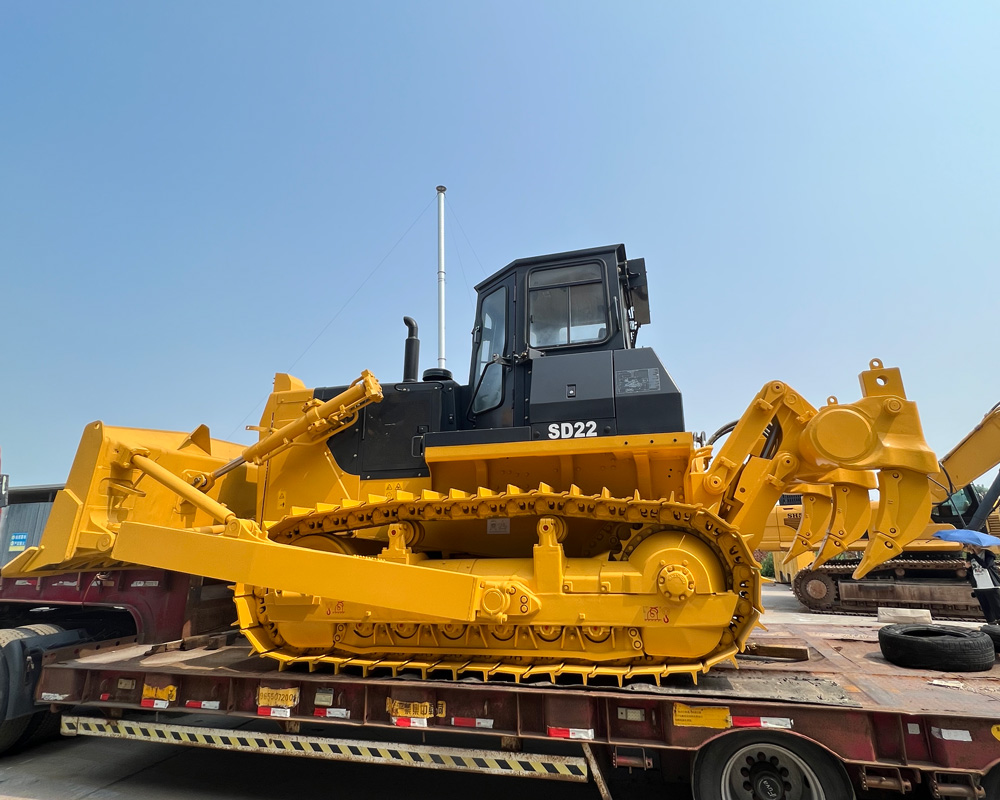
The following uses public information on a 235 hp medium crawler dozer (SD22 series) as a reference to explain the bulldozer's division of labor on earthmoving sites, the relationship between configuration and task, and the information to confirm before purchase. This article does not cover specific project cases and only analyzes conditions.
First, clarify which type of work the bulldozer is undertaking
The bulldozer's role on an earthmoving site can be roughly divided into four categories, each with different key considerations:
- Short-distance pushing: pushing stripped soil and loose material from the working face to a designated location or collection point, with attention to whether push distance, material density and blade capacity match.
- Rough grading: rough leveling on an excavation face or fill area to create a working surface for subsequent processes, with attention to blade width, lift height and operator visibility.
- Ripping hard soil and weathered rock: loosening hard layers where blasting is not possible or not advisable, with attention to whether a ripper is fitted, ripping depth and undercarriage impact resistance.
- Travel over soft wet ground: working on ground with high moisture content, with attention to ground pressure and track shoe width configuration.
These four task types cannot always be handled simultaneously by the same standard-configuration machine. The SD22 series in the information divides the machine into standard, coal, rock, forestry and other versions, which is precisely the result of adjusting the same power platform for different operating conditions.

Material and site determine configuration, not the reverse
General earthmoving and loose material pushing
The standard SD22 has an operating weight of 23,450 kg, rated power of 175 kW (235 hp), ground pressure of 66 kPa, and offers straight, angle, U and semi-U blades, with blade widths covering 3,725 to 4,635 mm. For general road projects, earthmoving excavation and ordinary loose material handling, this configuration corresponds to conventional pushing and rough grading tasks. If the material is loose bulk material such as coal, the coal version widens the blade to 4,200 mm, reduces ground pressure to 57.5 kPa and has an operating weight of 24,000 kg. This is an adjustment made to reduce compaction of loose material and increase the volume pushed per pass, rather than simply changing the blade on the standard version.
Stone and hard layers
The rock version has an operating weight of 23,600 kg and ground pressure of 66 kPa. The information states it is equipped with high-strength wear-resistant rock blades and reinforced push arms, aimed at quarries, mountain road reconstruction and hard soil ripping. It should be noted that these statements only indicate that this version has corresponding reinforcement in tooling and structure, and cannot be used to infer that it can directly replace blasting or crushing processes under any rock type, any slope or any push distance. Whether the rock version is suitable still depends on the rock blade specifications it offers, the on-site stone particle size and working face conditions.
Soft wet ground
The information mentions that the SD22 series includes a wetland-type bulldozer, but the parameter table provided corresponds to the standard, coal and rock versions and does not list the specific track shoe width and ground pressure of the wetland type. Therefore, this article cannot determine the ground pressure value of the wetland type, nor can it apply the standard version's 66 kPa ground pressure to wetland conditions. If the site is soft foundation, paddy field or muddy ground after rain, the parameters and configuration list of the wetland type need to be requested separately before making a judgment.
| Version direction | Corresponding differences in the information | Operating orientation described |
|---|---|---|
| Standard version | 23,450 kg, 66 kPa, multiple blade types available | General earthmoving, road projects, loose material pushing |
| Coal version | 24,000 kg, 57.5 kPa, coal blade 4,200 mm | Stockpiling and transfer of loose bulk materials such as coal |
| Rock version | 23,600 kg, 66 kPa, rock blade and reinforced push arms | Quarries, hard soil ripping and other heavy-duty tooling conditions |
The differences in the table indicate the orientation differences of each version in tooling and ground conditions, not a ranking of actual productivity among versions.

The three things most easily overlooked when treated as an all-round machine
First, treating push distance as a fixed value
The information gives forward speeds of 0–3.6, 0–6.5 and 0–11.2 km/h in three gears, reverse speeds of 0–4.3, 0–7.7 and 0–13.2 km/h, and a fuel tank of 450 L. These parameters indicate gear ranges and fuel tank size, but cannot be converted into shift output at a specific haul distance. As push distance lengthens, the proportion of reverse travel increases, and the economically reasonable push range needs to be evaluated separately according to the site layout. It is not advisable to apply the same machine to all push distances.
Second, treating the ripper as able to break all hard layers
The information lists single-shank and three-shank rippers, with single-shank loosening depth of 695 mm and three-shank depth of 666 mm, and ripper lift height of 515 mm for single-shank and 555 mm for three-shank. These are structural parameters, not a commitment to break a certain rock type. Whether a hard layer can be loosened depends on rock type, joints, moisture state and whether work is done in layers. Before purchase, buyers should confirm with the supplier the ripper's experience matching the target material and conduct small-scale trial work on site.
Third, ignoring the different blade requirements of rough grading and pushing
The blade lift height is 1,210 mm and blade depth is 540 mm (standard version). These data determine the amplitude of cutting and lifting actions. Rough grading places more emphasis on blade width and operator visibility, while pushing places more emphasis on volume pushed per pass, and the two do not consistently point to the same choice among straight, U and angle blades. The information offers multiple blade types as options. Which one to choose depends on whether the main process is pushing or leveling, rather than treating all options as standard equipment.
Under what conditions this class of equipment can be considered
According to the information, the parameter combination of this 235 hp medium crawler dozer corresponds to medium-scale earthmoving scenarios: requiring continuous pushing and rough grading, with materials mainly earth and ordinary loose material, and a working face that allows crawler equipment to travel normally. Its optional blade types and ripper provide room to adjust among pushing, leveling and light-to-medium ripping. The hexagonal cab can be optionally fitted with FOPS/ROPS protective structures, which also addresses the operating environment requirements of long working hours.
Conversely, if the site is mainly narrow-space work, frequent relocation or sensitive to ground disturbance, this machine's dimensions of 5,495 × 3,725 × 3,402 mm and operating weight of more than 20 tonnes will themselves constitute limitations. If the material is hard rock and continuous rock breaking is required, blasting, crushing or more specialized tooling solutions should also be included in the comparison, rather than requiring the bulldozer to complete the work alone.
Conditions to confirm with the supplier before purchase
- Material and process: whether the main pushed material is earth, loose material or stone, the approximate push distance range, and whether ripping and rough grading also need to be covered.
- Site and bearing capacity: ground bearing conditions, whether there are soft foundation or soft wet sections, and if wetland work is required, request wetland-type parameters rather than using standard version values.
- Blade and tooling: which of straight, angle, U and semi-U blades corresponds to the main process, whether a ripper is needed, and how the ripper matches the target material.
- Protection and operation: whether FOPS/ROPS protective structures are needed, and shift arrangements and lighting configuration requirements for night work.
- Transport and site access: whether the machine dimensions and weight can pass through access roads and unloading areas, and who is responsible for the transport plan.
- Maintenance conditions: whether daily inspection conditions are available on site; specific maintenance items and intervals are subject to the accompanying manual.
Write these conditions clearly first, then discuss versions and configurations. Only then will the bulldozer not be treated as an all-round machine that can take on any job. Its value lies in doing certain types of work solidly, not in covering all operations on the site.