






















If an earthworks site includes general dozing, rough site leveling and localized hard-soil ripping, a medium bulldozer is often assigned to switch back and forth among these tasks. The problem is usually not whether a single machine can do one job, but whether preparation conditions have been checked clearly by work stage before mobilization. Only after arriving on site do people discover that the blade type does not match, the track width is unsuitable for the ground, or the ripper is not matched—and then work-stage continuity is interrupted.
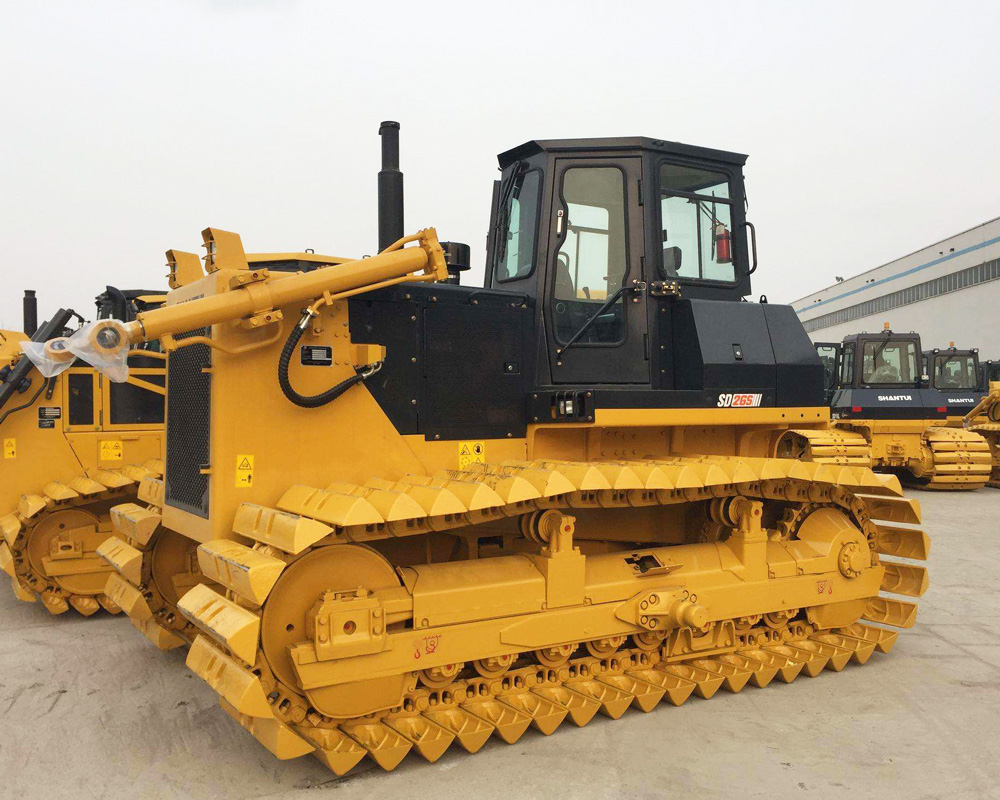
The following uses verified data for a 260 hp-class medium bulldozer as a reference to explain what should be confirmed item by item before multi-stage work, which parameters can support judgment, and which items still need supplier confirmation. All content is conditional analysis and does not mean any specific project has adopted this equipment.
Break down the work stages first: what kinds of work will this machine do
Multi-stage earthworks can usually be divided into three types of tasks: general earthmoving and loose-material pushing, rough site leveling, and loosening/ripping when clay, frozen soil or gravel strata are encountered. The three task types impose different requirements on the whole machine: dozing depends on traction and blade capacity, rough leveling depends on blade width and operator visibility, and ripping depends on ripper configuration and power reserve. The first step in readiness confirmation is to write down the material, distance and site conditions for each of these three task types, and then compare them with the equipment data.
- General dozing: whether the material is ordinary soil or loose material, and the approximate one-way dozing distance
- Rough site leveling: leveling area, allowable leveling accuracy, and whether there are slopes
- Hard-soil ripping: stratum type, required loosening depth, and whether a multi-shank or single-shank ripper is needed
Blade and ripper: configure by work stage, not by standard assumptions
The model data shows that the standard configuration is a straight tilt blade with a capacity of 4.6 m³, blade width of 3725 mm, height of 1315 mm, maximum lift height of 1210 mm, and maximum digging depth of 540 mm. The straight tilt blade is suitable for general cutting and dozing, but if rough leveling accounts for a high proportion of the work, the angle blade, U-blade and semi-U blade listed in the data are optional configurations and must be confirmed before ordering; do not assume the standard configuration covers all work stages.

For hard-soil ripping, the data provides an adjustable-penetration-angle multi-shank ripper with a maximum ripping depth of 666 mm, maximum lift height of 555 mm, ripper width of 2000 mm, shank spacing of 930 mm, and three-shank ripper weight of 2600 kg. These figures help judge whether the ripper can cover the planned ripping depth, but whether it can be used in a specific stratum still depends on material hardness and on-site testing; the data itself does not constitute a suitability commitment.
Undercarriage and ground-contact conditions: track configuration must match the site
The model has an operating weight of 23450 kg, ground pressure of 66 kPa, ground contact length of 2872 mm, track gauge of 2000 mm, and track shoe widths available in three specifications: 560, 610 and 660 mm. The ground pressure value is derived at a specific track shoe width. Whether to choose wide or narrow shoes must be judged together with site bearing capacity and traction requirements. Soft, wet ground usually favors wider track shoes to reduce ground pressure, but the data does not give conversion results for how much it is reduced or whether site bearing capacity is met; these are matters requiring supplier confirmation.
The travel system uses semi-rigid suspension, which the data says expands track ground contact area and improves traction. The effect of this structure on continuous dozing needs to be evaluated together with dozing distance and material density; suitability cannot be inferred from the structure name alone. Forward and reverse speeds both have three gears, at 3.8, 6.9 and 11.8 km/h respectively, which can serve as a reference for arranging work-stage rhythm.

Power and transmission: stable output supports continuous operation, but fuel consumption and efficiency need on-site verification
The data shows that this model is equipped with a WP12G280E304 engine, China-III emissions, rated speed 1900 r/min, gross power 206 kW (277 hp), net power 194 kW (260 hp), and maximum torque 1250 N·m @ 1200–1300 r/min. It is matched with a power-shift transmission, torque converter and two-stage straight-tooth final drive. This information explains the composition of the power train and can be used to judge whether the basic conditions for continuous heavy-load operation exist, but the data does not provide fuel consumption figures or efficiency comparisons. If operating costs need to be calculated before purchase, they should be requested separately or verified on site.
The cooling system uses a mechanical fan, which the data says can maintain stable operation at full load and in high-temperature environments. This statement is a description in the product data; actual performance is still affected by ambient temperature, continuous operating duration and radiator cleanliness. Radiator cleaning and coolant checks should therefore be included in pre-mobilization items during preparation.
Pre-mobilization readiness checklist
In work sequence, confirmation items can be divided into three points: before mobilization, before work-stage changeover, and daily inspection. The checklist below lists only inspection directions supported by the data; specific intervals and methods should follow the accompanying manual.
| Point | Check item | Basis and items to confirm |
|---|---|---|
| Before mobilization | Whether the blade type covers rough leveling and dozing | Standard straight tilt blade; angle/U-blade/semi-U blade are optional and must be confirmed at ordering |
| Before mobilization | Whether ripper shank count and ripping depth meet the ripping task | Three-shank ripper, maximum ripping depth 666 mm; stratum suitability must be judged on site |
| Before mobilization | Whether track shoe width matches site bearing capacity | 560/610/660 mm optional; ground pressure conversion requires supplier confirmation |
| Before work-stage changeover | Operational checks after switching between blade and ripper | Right-side servo-controlled work equipment; check hydraulics and connections per the manual |
| Daily | Engine hood opening inspection, fluids and filters | Large opening engine hood facilitates inspection; intervals per the manual |
| Daily | Track tension and undercarriage inspection | Data mentions automatic track tensioning technology; specific inspection methods per the manual |
Site information to prepare before requesting a quote
When requesting a quote from a supplier, reporting only the equipment category and horsepower often fails to yield accurate configuration recommendations. It is advisable to prepare the following information:
- Material types and approximate proportions: shares of ordinary soil, loose material, clay, frozen soil and gravel
- Work volume and dozing distance for each work stage, to judge blade capacity and travel gear arrangements
- Site bearing capacity and slope conditions, to determine track shoe width and whether other undercarriage configurations are needed
- Transport conditions: overall transport dimensions and weight limits; the data lists machine length 5462 mm and operating weight 23450 kg, which must be checked against the transport plan
- Shift arrangements and continuous operating duration, to assess cooling and maintenance windows
- Power form confirmation: this model is fuel-powered; the data does not cover electric configurations, so it should not be quoted as an electric bulldozer solution
Items still requiring supplier confirmation
The data covers the main performance parameters and configuration options, but the following items lack clear figures and should be confirmed item by item before purchase: actual ground pressure corresponding to different track shoe widths; supply status and mounting interfaces for optional blades and rippers; specific differences between the standard model in this article and versions such as forestry, wetland, desert, sanitation and rock types; and maintenance intervals and inspection methods in the accompanying manual. The above content is insufficient in the data and cannot be inferred on the user's behalf.
Readiness confirmation for multi-stage earthworks is essentially translating work-stage requirements into checkable configuration items. Whether a medium bulldozer is suitable depends on whether the blade, ripper and track combination can cover the site's main work stages, not on any single parameter alone. The more specific the readiness checklist, the fewer work-stage interruptions caused by configuration gaps after mobilization.