






















When selecting a mid-size excavator, power data and bucket capacity are often treated as the main comparison items. But what repeatedly happens on job sites is this: single-bucket digging is not slow, yet after several shifts the rhythm cannot be sustained. The problem is often not the paper power rating, but the links that jointly determine continuous operation: power reserve, hydraulic system, undercarriage structure and truck-loading rhythm.
Whether power is sufficient and whether it can be maintained are two different things
Rated engine power describes output at a specific speed. During continuous operation, the machine faces long high-load cycles, climbing to retrieve material, frequent swinging and dumping, and ambient temperature changes. When power reserve is insufficient or cooling conditions are constrained, the operator may feel at some stage that "there is power but it cannot be delivered," but this cannot be attributed directly to the engine; it is only one of the links that need to be checked.
Therefore, when reading mid-size excavator data, power should be read together with digging force, system pressure and working range, rather than ranked in isolation.
What the data for a 33-ton crawler excavator can show
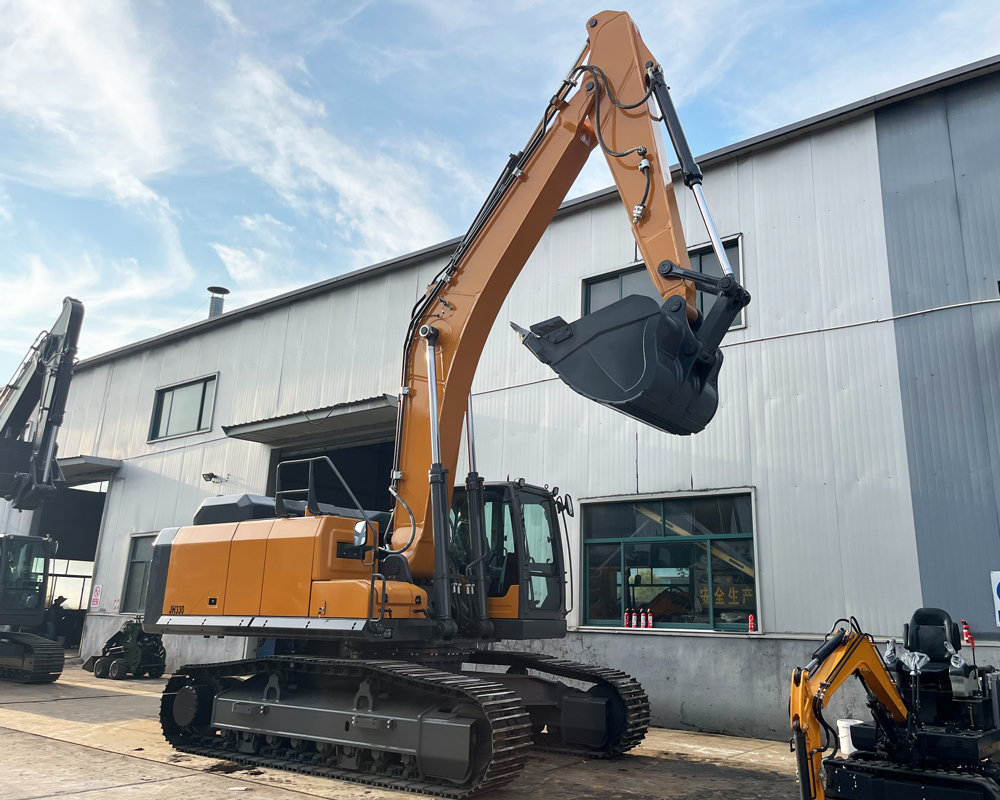
Taking the 33-ton crawler excavator associated with this article as an example, the data provided includes:

| Item | Data value |
|---|---|
| Machine category | 33-ton heavy-duty crawler excavator |
| Engine | 6CTA8.3, rated power 194kW / 2200rpm (263.3HP) |
| Bucket capacity | 1.6 cubic meters |
| Maximum bucket digging force | 244kN |
| Maximum arm digging force | 200kN |
| System pressure | 35MPa |
| Swing speed | 0–11rpm |
| Maximum gradeability | 35° |
| Maximum digging radius / depth / dumping height | 10709mm / 6437mm / 7625mm |
| Minimum ground clearance / wheelbase | 470mm / 3800mm |
These data indicate that it is aimed at scenarios such as heavy earthmoving, open-pit mining, infrastructure foundations, water conservancy projects and port loading and unloading. The 1.6 cubic meter bucket capacity combined with 244kN bucket digging force corresponds to material retrieval and truck loading at medium-to-large scale; the 7625mm dumping height and 10709mm digging radius relate to whether it can cover the body height of common dump trucks and the width of the working face.
But the data also reminds us: whether stable output can be maintained under high-load cycles also depends on cooling, hydraulic oil temperature, operating method and maintenance status. These fields are not on the parameter table and are confirmation items that need to be listed separately before purchase and use.
Limits easily underestimated in continuous operation
Truck-loading rhythm and swing coordination
The 0–11rpm swing speed combined with a working radius of about 10.7 meters means that the round-trip time for one bucket from material retrieval to dumping has a basic range. If the dump truck is parked far away and site dispatching is not smooth, the excavator will idle while waiting no matter how powerful it is. Continuous operation limits sometimes come from supporting vehicles and site organization, not from the machine itself.

Changes in strata and materials
The digging force given in the data corresponds to capability under specific conditions. For hard rock, frozen soil or material layers containing large amounts of boulders, it is necessary to assess whether ripping or breaking processes are needed first; digging force data alone cannot directly lead to the conclusion that "continuous excavation is possible in any stratum." This point should be verified separately according to the specific material.
Climbing and site travel
The 35° gradeability and 470mm minimum ground clearance indicate that it has a certain degree of off-road passability. However, slope length, slope surface adhesion conditions and the degree of muddiness in the rainy season will all change actual performance. Long-distance heavy-load uphill travel tests the undercarriage and transmission, and the data does not provide quantitative evidence for this; it should be verified against actual site conditions before purchase.
Undercarriage and stress points
The data mentions that the structure is reinforced at key stress points and that the undercarriage and working equipment are designed for continuous heavy loads. Such descriptions indicate the design direction, but cannot be equated with a durability commitment under specific working conditions. For continuous operation projects, track tension, track rollers and pin wear should be included in daily inspections and carried out according to the manual.
A commonly overlooked judgment bias
Treating power parameters as the entirety of continuous operation capability is a common bias in mid-size excavator selection. Power and digging force answer "whether this bucket can dig and whether it can be lifted"; continuous operation must also answer "whether cooling can hold up, whether hydraulic oil temperature will rise, whether the truck-loading link will be blocked, and whether undercarriage wear is within a controllable range." These two groups of questions need to be verified separately before purchase.
Items recommended to confirm one by one before purchase
- Working equipment configuration: Whether the bucket and arm match the actual material, and whether ripping or breaking attachments are needed separately (the data does not list attachment details; confirm with the supplier).
- Stratum conditions: Material hardness, stone content and whether pretreatment is needed cannot be judged solely by digging force values.
- Transport conditions: The overall dimensions are 11015×3200×3168mm; the transport method, road width and weight limits and site access route need to be verified in advance.
- Shift arrangement: Daily operating hours, continuous high-load periods and ambient temperature, used to assess cooling and maintenance intervals.
- Supporting vehicles: Dump truck capacity and parking distance determine whether the dumping height and swing angle can form a smooth cycle.
- Maintenance basis: Inspection items and intervals for the hydraulic system, undercarriage and engine are subject to the accompanying manual.
When requesting a quotation, it is recommended to also provide the material type, workload, site and transport conditions, shift arrangement and clear key configuration requirements, so that the other party can give a well-founded configuration recommendation rather than merely comparing power figures.