






















Large dozers in the same series are often split into standard, rock, desert, sanitation, coal, and other versions, which buyers can easily mistake for different levels of configuration. The real decision point is the material: whether you are pushing ordinary earth, weathered rock stripping, or rocky soil and crushed hard rock, the blade loading pattern, undercarriage wear rate, and ripping needs all differ. Version selection should first answer "what will it push, and how will the undercarriage wear," then narrow down to specific configurations.
The following comparison is based on differences between the standard and rock versions in the SD32 series listed on this site. The parameters involved only explain version differences and do not mean every version in the series has all configurations.
First Identify the Job: The Material Being Pushed Determines the Loading Pattern
Large dozers on earth and rock sites generally handle three types of tasks: general earthmoving and rough grading, stockpile pushing after stripping rocky soil or weathered rock, and heavy-duty pushing in quarry operations. The difference lies not in the push distance itself but in the form of resistance encountered as the blade cuts in and pushes.
- General earth and loose material: resistance is relatively uniform; the blade and push arms experience continuous pushing, and the undercarriage mainly experiences travel wear.
- Rocky soil and weathered rock stripping: the material contains hard lumps, causing concentrated local loading on the blade edge and body, and impact on the push arm assembly.
- Heavy-duty pushing in quarries: continuous pushing of coarse material wears the blade quickly, and the undercarriage travels on crushed stone, so the track and track roller areas wear more noticeably.
These three types of work have no absolute boundaries, and the same site may switch between stripping and pushing. The value of version assessment is to identify the material type that dominates over the long term and tilt the blade and undercarriage configuration toward it.
Where the Standard and Rock Versions Actually Differ
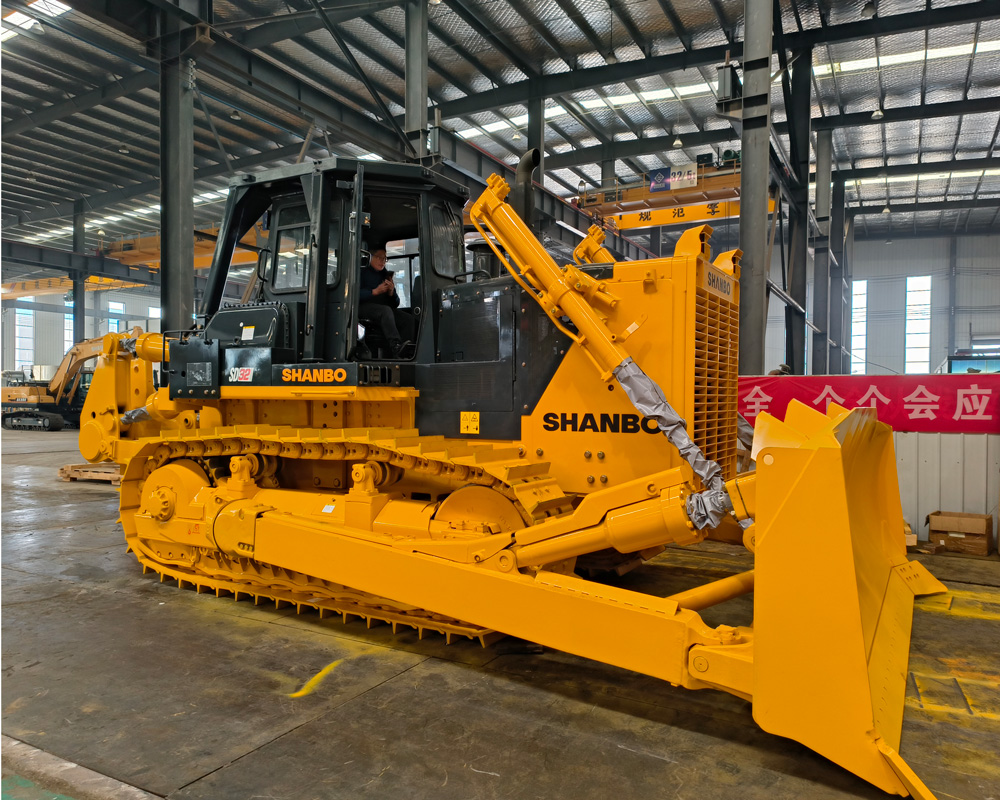
According to the SD32 series information on this site, the standard and rock versions have similar basic machine parameters; the differences are concentrated in the work equipment and structural reinforcement, not the power level.

| Comparison Item | Standard Version | Rock Version |
|---|---|---|
| Operating weight | 40200 kg (with single-shank ripper and ROPS) | 40900 kg (with single-shank ripper and ROPS) |
| Rated power | 258/2000, 257/2000 kW/rpm | 258/2000, 257/2000 kW/rpm |
| Ground pressure | 97.7 kPa | 99.4 kPa |
| Blade type | Straight, angle, semi-U, plus coal and sanitation blades | Rock straight, rock angle, rock semi-U |
| Drawbar | Optional | Listed as none |
The most noteworthy point in the table is not the numerical difference but the blade type breakdown. The rock version is equipped with thickened, high-wear-resistant rock blades and reinforced push arm assemblies, which directly address the concentrated wear that rocky materials cause on the edge and push arms. The standard version offers straight, angle, semi-U, and other choices for general earthmoving, loose material pushing, and site grading. In other words, the division between standard and rock versions is not about "can it push" but about "what is more cost-effective to push over the long term."
The ground pressure difference is small and cannot be used to infer that the rock version is better or worse on soft ground or slopes. Track shoe widths of 560, 610, 660, and 710 mm are available for both standard and rock versions; the actual choice should be confirmed separately based on site bearing capacity and transport conditions.
Assess Undercarriage Wear by the Travel Surface, Not Just the Blade
Wear in rock conditions is not limited to the blade. The information notes that the SD32 series uses a mature high-strength undercarriage system, with long track ground contact length and high ground clearance to ensure stable travel and off-road capability. When traveling continuously on crushed stone or blocky ground, the track shoes, track rollers, and track frame experience a different kind of wear that does not disappear just because rock blades are fitted.
Therefore, version assessment can be broken into two questions:

- Do the blade and push arms contact hard lumps over the long term? If so, the rock version's thickened blades and reinforced push arms better match this wear.
- Is the travel surface crushed stone, blocky rock, or uneven stripping ground over the long term? If so, track shoe width, track rollers, and track frame inspection intervals should be considered in advance. However, these fall under operation and maintenance; specific inspection intervals and replacement criteria should refer to the manual and on-site wear records, as the information does not provide fixed values.
If the material is mainly general earth with only occasional rocks, the standard version's straight or semi-U blade usually covers it, and there is no need to choose the rock version for occasional conditions. Conversely, if coarse material is pushed in a quarry over the long term, the wear rate of standard blades becomes an ongoing cost, and the rock version's configuration direction is better justified.
Match the Ripper and Blade to the Sequence of Operations
The SD32 series offers single-shank and three-shank rippers, with maximum ripping depth of 1250 mm for single-shank and 842 mm for three-shank, and ripper lift height of 955 mm for single-shank and 883 mm for three-shank. The ripper loosens hard layers before pushing, and it and the blade are two separate operations.
If the site has weathered rock or hard compacted soil, ripping before pushing can reduce the impact of the blade cutting directly into hard layers, so the ripper configuration and blade version should be considered together. If the material is already loose stripping material, the ripper may only be used for local hard interlayers, and its configuration priority should be lowered. The information does not provide ripping efficiency or applicable hardness ranges for different materials; this needs to be confirmed separately based on on-site trial pushing or material descriptions.
Other Versions Follow the Same Logic: Filter by Site Characteristics
The SD32 series also lists desert and sanitation versions. The desert version targets high-temperature, high-wind, and heavy-dust environments, with a high-mounted dust-proof intake filter and enhanced radiator; the sanitation version targets landfill and similar sites. What these versions share is not more power but a configuration tilted toward the persistent constraints of a specific site.
This shows the general method for version selection: first identify the condition that lasts longest and has the greatest impact on equipment wear or site adaptability, then see which version's configuration addresses it. Do not choose a version simply because its name sounds more "heavy-duty," and do not treat one version's configuration as standard across the series.
Items to Verify Before Purchase
Version selection for large dozers ultimately comes down to quotation and technical confirmation. The following conditions should be provided when requesting a quote:
- Material type and approximate composition: general earth, rocky soil, weathered rock stripping, or coarse loose material, and whether large hard lumps are present.
- Workload and usage intensity: approximate shifts per day, duration of continuous pushing, and whether construction runs day and night.
- Site and travel surface conditions: ground bearing capacity, whether the surface is crushed stone or uneven, and whether slope work is required.
- Blade and ripper requirements: whether pushing is primary or hard layers need loosening first, and whether the blade form is straight, angle, or semi-U.
- Track shoe width and transport conditions: overall dimensions are 8650 × 4130 × 3760 mm; transport route and site access must be verified in advance.
- Power and emissions requirements: the information lists a China III engine; specific configuration should be confirmed according to local emissions and fuel supply conditions.
Among these conditions, material composition and travel surface wear are the parts that current information cannot replace on-site judgment for. The version direction can be narrowed down by material first, but the final configuration still requires on-site trial pushing, wear records, and manufacturer technical confirmation; do not place an order based on the version name alone.
To learn about specific configurations and pricing for this series, provide the above material, workload, site, and transport conditions so they can be matched to a standard or rock version work equipment combination.