






















The challenge of subgrade compaction tasks usually isn't "buying a roller," but rather a mismatch between layer goals and equipment conditions: if the layer is too thick, vibration energy cannot reach the bottom; if the work area is too narrow, a wide drum cannot maneuver; if the material is too fine or too wet, vibration parameters need to be reselected. This article breaks down such tasks in the order of "layer goals—site constraints—equipment conditions," then uses verified data from a 26-ton-class single-drum vibratory roller to explain the judgment basis, and finally lists items beyond the data that still require on-site confirmation.
Define Layer Goals First, Then Discuss Equipment
Subgrade compaction must first answer three questions: what is the compacted thickness per layer, what type of fill material is used, and what state must be achieved after compaction. These three determine how much vibration energy is needed, how many passes are required, and how wide a drum is needed to cover the work area. Equipment is only the execution means; when layer goals are unclear, switching to a larger machine will not solve the problem of insufficient density at the bottom of the layer.
Take common layered fill organization as an example (this is condition analysis, not a project case): larger layer thickness and coarser fill typically rely more on higher exciting force and lower vibration frequency; thinner layers close to pavement structural layers place more emphasis on the coordination of frequency and travel speed. Specific values must be determined by test sections and compaction testing; equipment data cannot replace this step.
Site Constraints Determine Which Parameters Truly Matter
Only by listing site conditions item by item can we judge which parameters are hard constraints and which are merely references:

- Work area width and turning space: determines whether drum width matches and whether turning radius can meet U-turn and passing requirements.
- Fill type and moisture state: affects whether vibration or static compaction is more suitable, and whether dual-amplitude switching is needed.
- Layer thickness and target number of passes: affects single-shift coverage area, which in turn affects equipment specifications and shift arrangements.
- Access roads and ramps: determines whether gradeability and overall transport dimensions are feasible.
- Coordination with other processes: the pace of paving, watering, and testing determines whether the roller operates continuously or intermittently.
Among these conditions, only the first four can partially correspond to equipment parameters; coordination pace is a construction organization issue and cannot be answered by equipment data.
Data Correspondence for 26-Ton-Class Single-Drum Equipment
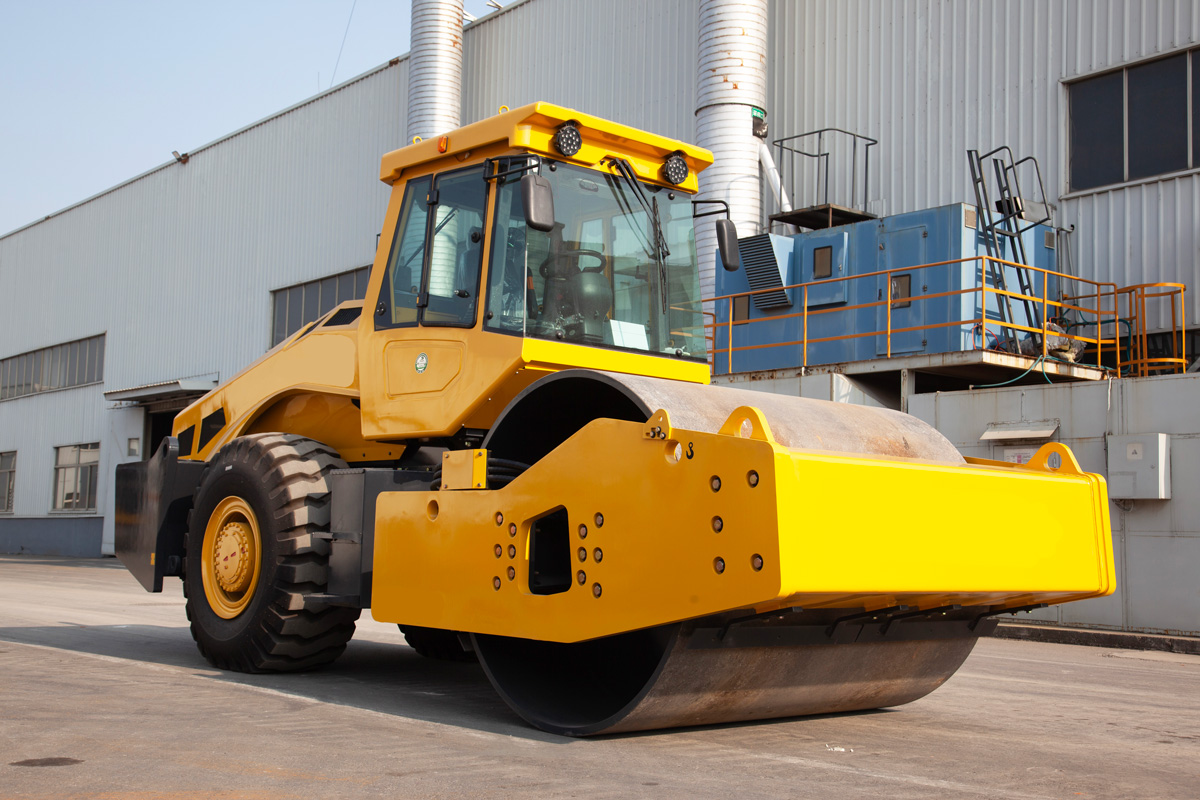
Taking the S267H single-drum vibratory roller from this site as an example, its verified parameters can be compared item by item against the above constraints:
| Layer and Site Conditions | Corresponding Parameter | Data Value |
|---|---|---|
| Larger layer thickness, higher vibration energy required | Exciting force | 420/290 kN |
| Switching between thin and thick layers | Dual amplitude | 2.0/1.0 mm |
| Adjusting vibration state when material changes | Dual frequency | 29/34 Hz |
| Work area coverage width | Drum width | 2180 mm |
| Ramp access and site transfer | Gradeability | 35% |
| Turning space in work area | Turning radius | 7200 mm |
| Overall transport and site layout | Dimensions | 6750×2400×3300 mm |
This equipment has an operating weight of 26 tons, static linear load of 584 N/cm, drum diameter of 1650 mm, speed range of 0–9 km/h, and is powered by a 147 kW Shangchai engine with emissions compliant with Tier 4/China Stage IV. These parameters collectively indicate that it is intended for medium-to-heavy layered compaction tasks such as road construction and foundation compaction, rather than fine compaction of thin pavement layers. With a drum width of 2.18 meters and a turning radius of 7.2 meters, it is more suitable for fill sections with certain width and depth; turning and edge/corner handling in narrow sites require separate arrangement of small equipment or manual assistance.

The Relationships Between Parameters Are More Useful Than Individual Values
Exciting force, amplitude, and frequency are a set of linked conditions. The 420 kN exciting force corresponds to 2.0 mm amplitude and 29 Hz, while 290 kN corresponds to 1.0 mm and 34 Hz. The two states lean toward deep compaction of thick layers and surface compaction of thin layers, respectively. Which one to choose depends on layer thickness and fill material, not on which value is larger. Construction sites need to switch based on test section results and cannot default to using the high exciting force setting throughout.
The relationship between the 0–9 km/h speed range and vibration frequency also needs on-site matching: traveling too fast reduces the number of vibrations per unit area and affects compaction uniformity. The data does not provide the correspondence between recommended travel speed and number of passes; this part must be determined through test sections.
Applicability Boundaries and Supporting Conditions
Based on the data, this equipment is suitable for layered operations such as subgrade filling and foundation compaction, but the following points cannot be answered by the data and need to be confirmed before purchase or entry:
- The specific type and moisture content range of the fill material, and whether it is suitable for vibratory compaction.
- The design-required degree of compaction and testing methods, and the corresponding layer thickness and number of passes.
- Whether the minimum work area width meets the U-turn requirement for a 7.2-meter turning radius.
- Whether transport roads and bridges/culverts have weight limits that can bear the transfer of a 26-ton complete machine.
- Whether emission standards meet the local environmental requirements of the project.
In addition, the primary compaction target of a single-drum vibratory roller is subgrade and foundation materials; when used for asphalt surface layers, the equipment type must be separately evaluated, and this solution cannot be directly applied.
Information to Prepare Before Inquiry
If inquiring about such equipment or comparing solutions, it is recommended to prepare: layer thickness and number of layers, fill type and moisture conditions, compaction degree requirements and testing methods, planned compaction area per shift, work area width and ramp conditions, transport method and weight limits, local emission requirements, and whether dual-amplitude and dual-frequency switching are needed. Drum width, exciting force settings, and gradeability are key configuration items and should be checked item by item during inquiry, rather than compared only by tonnage.