






















When you turn to a landfill compactor data page, you often see crushing width and compaction capacity listed next to each other. The former is a millimeter-level dimension, the latter a value in tons per cubic meter; both look like “capability indicators,” but treating them as the same kind of thing when selecting equipment can lead you astray. The real questions to answer are: how wide a working face can this machine cover per pass at the landfill, and to what degree can it compact the waste? Each question requires its own set of site conditions to be coordinated.
First, distinguish what each field answers
Crushing width describes the lateral width covered by the compaction wheels (or crushing mechanism) in one pass. It directly affects the division of working strips, the number of round trips, and how edge and corner supplementary compaction is organized; it is “working width” information. Compaction capacity, in tons per cubic meter, expresses the density range the material can reach under compaction; it is “compaction result” information.
The two cannot be converted into each other: a wider width does not mean better compaction, and strong compaction capacity does not mean fast coverage. What a landfill really cares about is whether, under a given layer thickness and work organization, the waste layer can be compacted to the design density while the working face advances fast enough to keep up with the tipping pace.

Apply combined judgment to the landfill operation flow
A landfill day usually consists of tipping, spreading, compaction, and covering. The compactor’s position in this flow determines how the two fields should be used:
- If the tipping face is narrow and the working strip advances frequently, crushing width determines the number of round trips and turning organization. Too narrow a width increases compaction passes; too wide a width requires checking whether edges, corners, and slopes can be covered.
- If the layer is thick and waste composition is complex, the density range corresponding to compaction capacity determines whether the layer thickness can be compacted properly; overly thick layers may need to be handled in lifts on this type of equipment.
- After combining the two, also consider shift organization: compaction passes, working strip width, and coordination with spreading equipment jointly affect site pace; no single field alone yields a complete conclusion.
Using the published parameters of one compactor on this site as an example
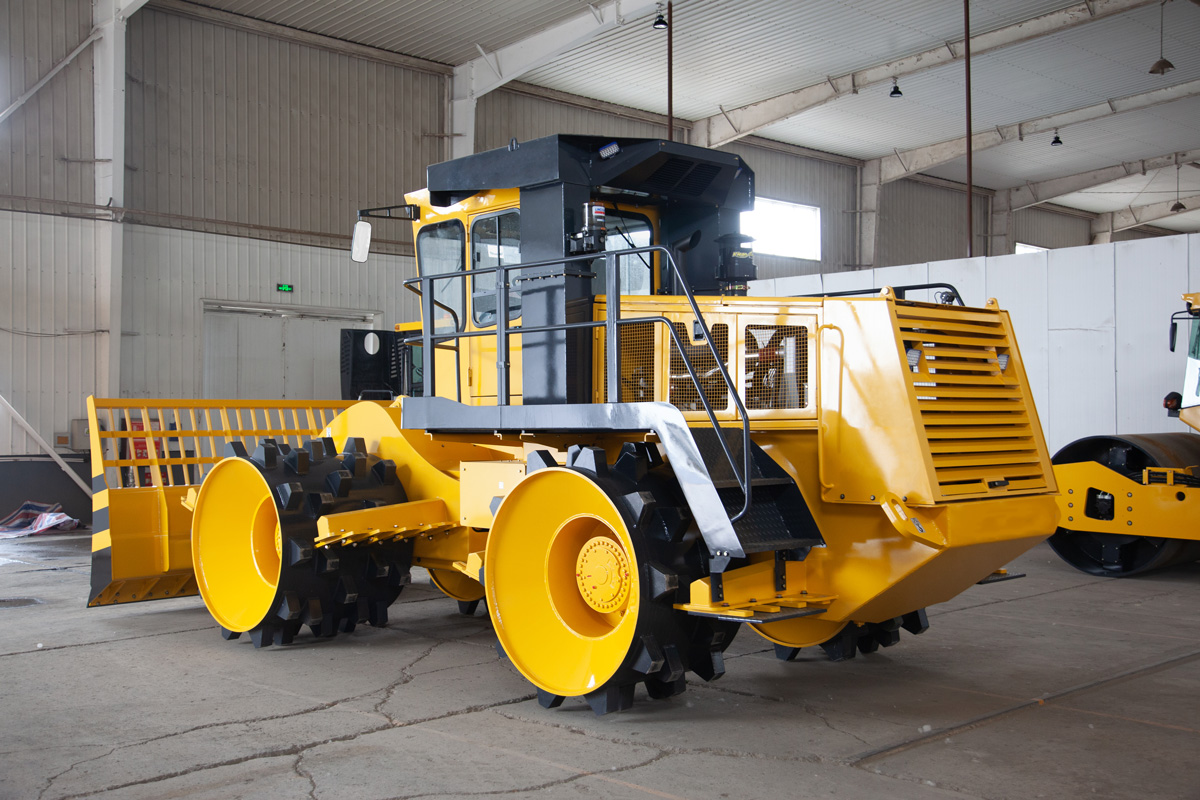
The C230H in this site’s landfill compactor catalog provides key fields that can serve as a reference for reading such pages:
| Field | Published value | Corresponding site question |
|---|---|---|
| Crushing width | 3430 mm | Single-pass working width; affects working strip division and round trips |
| Compaction capacity | 0.35 to 0.9 t/m³ | Compressible density range; requires coordination with layer thickness and pass organization |
| Operating weight | 23000 kg | Check together with compaction capacity and site bearing conditions |
| Engine power | 192 kW (262 HP), Tier 3 | Power conditions for climbing, continuous operation, and slope access |
| Minimum ground clearance | 490 mm | Related to waste surface unevenness, soft ground, and access conditions |
| Blade height | 1880 mm | Height reference for spreading and pushing operations |
From this table, the logic of combined judgment can be read: a 3430 mm crushing width corresponds to a working strip about 3.4 meters wide, and working face division and round-trip routes should be arranged according to this width; a compaction capacity of 0.35 to 0.9 t/m³ indicates the density range it can cover, but whether the upper end of the range can be reached depends on layer thickness, waste composition, compaction passes, and operating speed. These are not given in the published data and need to be confirmed by on-site trial compaction according to actual layers. The 23000 kg operating weight is one source of compaction effect, and it also means that site bearing capacity and soft-ground access must be evaluated in advance.

What is not written on the data page but must be clarified before purchase
The above parameters only indicate the basic magnitude of the equipment; actual landfill operating conditions still need to be checked item by item:
- Layer organization: the daily tipping layer thickness range, how daily compaction passes are organized, and whether density is tested after compaction. The density range in the published data needs to be compared with on-site trial compaction results.
- Site bearing and slopes: soft-ground sections of the landfill body, slope gradients, and access routes. The 490 mm ground clearance and overall dimensions are only references; actual access must be judged in combination with site road conditions.
- Protective configuration: landfills involve leachate, sharp objects, and dusty environments. The protection form of the compaction wheels, cab protection, and cleaning and maintenance arrangements should be based on product data and the manual; this article does not infer specific configurations from them.
- Maintenance inspection: inspection items and intervals for compaction wheels, crushing teeth, chassis, and cooling system should refer to the accompanying manual; the data page does not give maintenance intervals.
- Transport and relocation: overall dimensions are 8100×3500×3670 mm and maximum speed is 11 km/h; relocation methods and site entry routes need to be arranged separately according to actual road conditions.
Suggested judgment sequence
When reading such data pages, first use crushing width to define the working strip, then use compaction capacity to determine the approximate range of layer thickness and passes, then use operating weight and ground clearance to check site bearing and access, and finally use engine power and speed to verify climbing and relocation conditions. Once all four steps align, proceed to the inquiry stage for price, delivery, and after-sales terms.
It should be noted that compaction effect is closely related to waste composition, moisture content, layer thickness, and work organization; the density range in the published data does not mean it can be achieved under any working condition. Slope access, soft-ground bearing, and protective configuration also depend on site conditions. For parts not covered by the published data, confirm item by item with the supplier during inquiry.
Conditions to provide during inquiry
When preparing an inquiry for a landfill compactor, it is recommended to provide: daily throughput and work shifts, waste composition and layer thickness, required compaction density and testing method, site bearing and slope conditions, entry and exit transport routes, whether specific protection or crushing wheel configurations are needed, and requirements for power and emission standards. The more specific these conditions are, the better the supplier can judge whether the selected configuration matches, rather than merely quoting a model.