






















For low-emission sites considering a pure electric dozer, zero emissions is only one entry condition. What really determines whether it can work is whether the site has the conditions to supply power, whether the battery can be recharged between shifts, and whether thermal management can hold up during continuous operation. This article focuses on a 272 HP pure electric medium dozer and breaks down "can it be used" into several prerequisites that can be checked one by one, to avoid mistaking an environmental label for construction capability.
First define the work objective: electric is not the goal; completing the push volume is
Pure electric dozers are typically deployed in urban municipal earthworks, environmental protection projects, green mines, and low-noise demolition scenarios. For buyers, the goal remains completing earthmoving processes such as pushing, leveling, and scarifying, with additional emission and noise restrictions. Therefore, the selection sequence should be reversed: first confirm the workload and processes, then see whether the electric solution has the conditions to support them.
If the site's power conditions are not secured and electric equipment is chosen solely because of the words "low emission," subsequent recharging can easily become a bottleneck. This is more worth discussing first than comparing motor power.
Power supply and recharging are the first hard constraints
Verified data shows that the machine is equipped with a 614.2V, 690Ah, 423.94kWh lithium iron phosphate battery pack, supports 2×300kW battery interfaces, 2×250A DC fast charging, and 2×400kW DC discharge, and also has an auxiliary power supply for battery heating and low-voltage circuit stability.
These figures describe interfaces and battery specifications, not "how long it takes to fully charge" or "how many shifts it can run." Before actual use, at least the following must be confirmed:

- Whether the site can provide power capacity and interface conditions matching the 2×250A DC fast charging;
- Whether charging positions are arranged near the work face or require equipment travel, and whether the travel distance affects shift scheduling;
- Whether multiple electric machines will recharge simultaneously, and whether the distribution capacity is sufficient;
- Whether stable low-voltage power is available for the battery heating auxiliary power supply in low-temperature environments.
The data does not provide battery life, charging time, or energy consumption corresponding to battery capacity. These cannot be directly derived from battery parameters and can only be requested from the supplier as verification items during inquiry.
Shift organization should revolve around recharging, not copy diesel machines
Diesel dozers refuel quickly and can operate continuously, which is their natural advantage. If an electric dozer follows the same shift arrangement, recharging windows and work windows will conflict. A more realistic approach is to first map out the work segments and recharging segments within a day, then see whether the battery and charging interfaces can connect.
Under assumed conditions, for example, single-shift operation with the work face close to the charging position, recharging arrangements are relatively easy to coordinate; if there are two shifts and the work face moves continuously as construction progresses, the charging position also needs to be adjusted accordingly. Such arrangements are on-site organizational issues, and the data provides no ready answers; they need to be considered together with construction organization during the planning stage.
What work requirements do power and hydraulic configurations correspond to
The machine uses a 200kW (272HP) permanent magnet synchronous motor drive with a stable torque of 200Nm. The travel motor controller supports 210kW power and 800AAC current, and the data states that it can maintain power output under heavy-load conditions. The hydraulic system is independently driven by a 50kW (68HP) permanent magnet synchronous hydraulic motor with 280Nm torque, equipped with a 100+65+25 triple gear pump and a standard working pressure of 30MPa, used for dozing, lifting, and scarifying operations.
For buyers, these configurations indicate that the machine has the power and hydraulic foundation of a medium dozer, but pushing capability also depends on the blade, tracks, material density, and push distance. The data does not provide these matching parameters, so push efficiency cannot be judged directly from motor power, nor can it be concluded that it is an equivalent replacement for a diesel machine of the same horsepower.

The relationship between thermal management and continuous operation
The continuous operation capability of electric equipment is directly related to thermal management. The machine integrates an 8kW compressor TMS cooling system, a 2.5kW fresh air cooling system, and a 10kW electronically controlled air conditioner. The liquid cooling system uses a 45kW plate-fin radiator and a 400W PWM water pump. The data states that this can keep the battery and motor working at suitable temperatures.
This is a design-level configuration description and does not mean continuous full-load operation is possible at any ambient temperature. Actual performance under high temperature, high dust, or long-term heavy-load pushing conditions remains to be verified and should be confirmed with the supplier based on specific site environments.
Safety and monitoring configurations correspond to on-site management needs
The machine is equipped with a CAN communication insulation monitor with 2500Vac withstand voltage and 10ms leakage detection response, together with high-voltage shielded cables and metal waterproof connectors; for monitoring, there is a 128GB dashcam, a 4G remote monitoring TBOX module, a 7-inch LCD screen, and 2 starlight night-vision cameras forming a 360° view, plus an audible and visual alarm system.
For low-emission sites, these configurations help manage high-voltage safety and equipment status on site, but the actual functional scope of remote monitoring, data usage, and maintenance responsibilities are not elaborated in the data and should be confirmed item by item before purchase.
Which site conditions are more suitable for prioritizing electric solutions
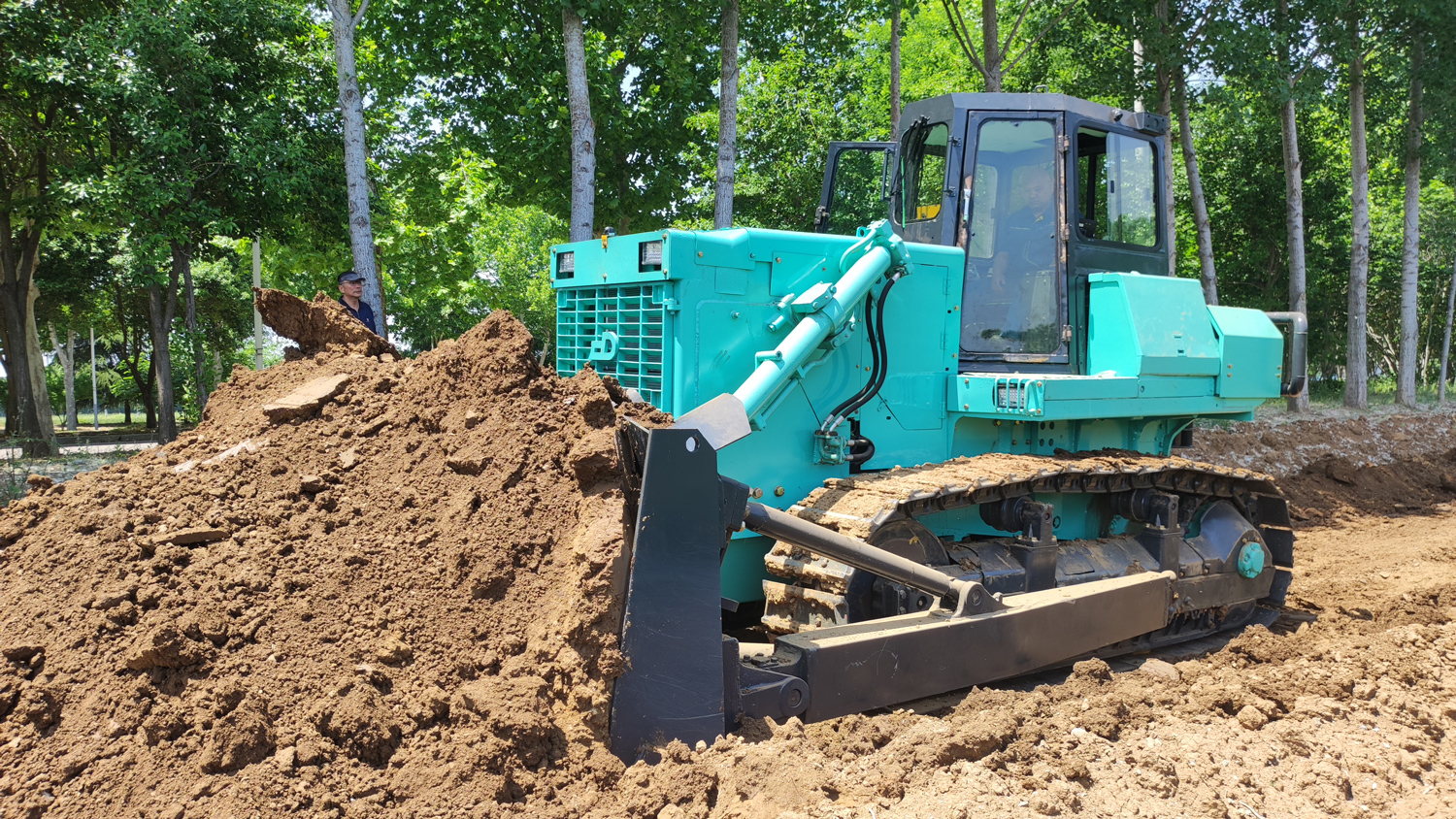
Based on verified data, the machine's application scenarios are described as urban municipal construction, environmental protection projects, green mines, low-noise demolition projects, and rental and government-supported green low-carbon projects. Combining these scenarios, several types of situations more suitable for priority evaluation can be summarized:
- The work area has clear restrictions on exhaust emissions and noise;
- The site has relatively fixed power supply conditions or can coordinate charging facilities;
- The work face has a limited movement range, and recharging positions can easily cover it;
- Dedicated personnel are responsible for high-voltage safety and equipment status management.
Conversely, if on-site power supply relies entirely on temporary generators, the work face moves frequently over large areas, or there are no conditions to arrange recharging windows, these constraints should first be assessed to see whether they can be resolved before discussing whether to use electric equipment. This is not a rejection of electric solutions but a clarification of the prerequisites.
Items to implement before maintenance and procurement
The data mentions that the power and hydraulic sections use a modular design, which can simplify daily maintenance and shorten downtime, but it does not provide maintenance intervals, disassembly steps, or spare parts lists. Maintenance work should refer to the accompanying manual and be performed by qualified personnel.
Before requesting a quote, it is recommended to prepare information according to the following checklist:
- Material type, push distance, and average daily earthwork volume;
- Site power supply capacity, charging position locations, and whether mobile operation is needed;
- Shift arrangements and recharging windows;
- Configuration requirements for key work equipment such as blades and tracks;
- Ambient temperature, dust conditions, and high-voltage safety management arrangements;
- Transport dimensions and site access road conditions.
Whether a pure electric dozer can truly be used on a low-emission site is not answered in the specification table but in whether the prerequisites of power supply, recharging, and shift organization are implemented one by one. Clarifying these conditions first and then discussing specific configurations is more prudent than deciding on the equipment first.