






















Hard-soil excavation and routine earthmoving truck loading are often placed on the same equipment procurement list, but their constraints differ: hard soil places more emphasis on penetration resistance and the breaking and digging capacity per unit time, while regular earthwork places more emphasis on cycle rhythm and truck loading coordination. A medium crawler excavator sits in an intermediate position—it is neither a supplementary role for a small excavator nor suitable for being judged directly against the standards of a large mining machine. To determine whether a 23.2-tonne crawler excavator can cover these two types of tasks, it is necessary to break down the fields in its data related to cutting, hydraulics and travel and examine them separately.
First distinguish the constraint differences between the two types of tasks
For hard soil, compacted soil or cemented material containing gravel, the bucket needs a relatively large penetration force during excavation, and the arm also bears a relatively high load during retraction; if the material needs to be broken or loosened, the matching of the work attachment must also be considered. Regular earthwork, backfilling and bulk material loading rely more on the coordination of swing, dumping and travel, and the single-cut resistance is usually lower than that of hard soil.
This does not mean the same machine must choose one of the two. The actual judgment should answer three questions: whether the material needs pre-loosening or breaking; the matching height between the loading target and the transport vehicle; and whether the site bearing capacity and transfer distance are within the machine's travel conditions. When the data does not provide the specific soil type and site bearing data, only a conditional analysis can be made, and a direct conclusion of "suitable for hard soil" or "not suitable for hard soil" cannot be drawn.
What the power and digging force data can indicate
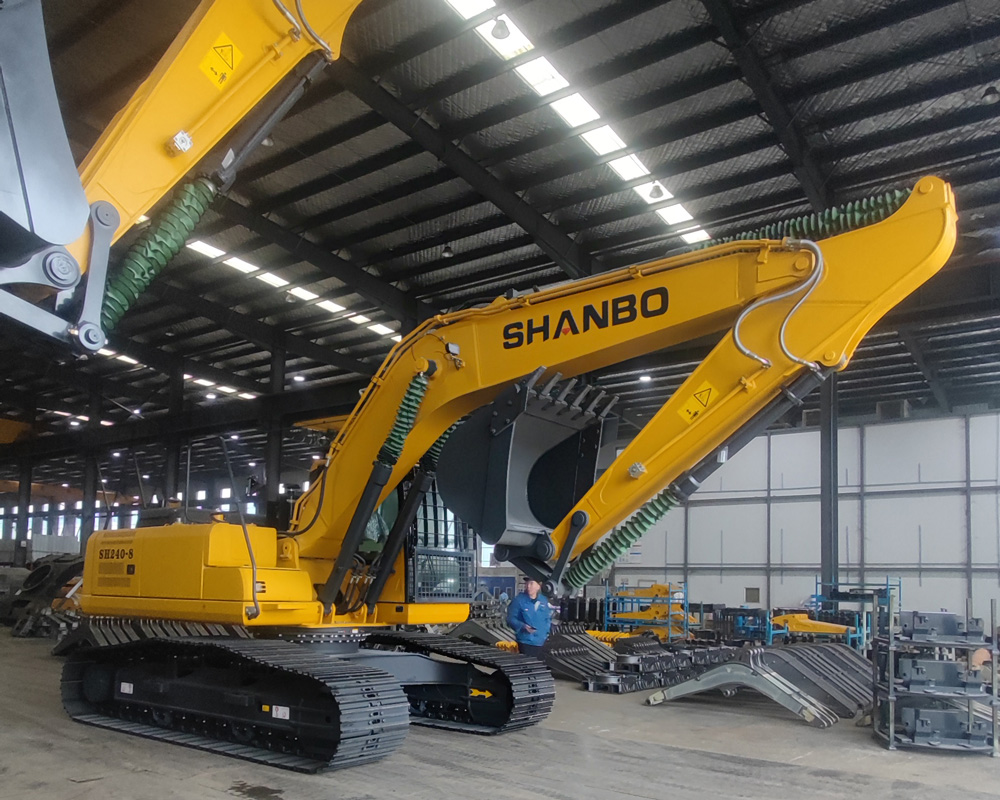
The SH240-8 covered in this article is a 23.2-tonne crawler excavator with an operating weight of 23,200 kg, equipped with a 6-cylinder turbocharged engine with a displacement of 6.7 L, rated power of 133 kW/2000 rpm, and maximum torque of 708 N·m/1500 rpm. The standard bucket capacity is 1.2 m³, and the bucket width is 1,254 mm. The bucket digging force is 146 kN, and the arm digging force is 107 kN.

The selection implications of these values are: within the range of medium crawler excavators, its engine power and hydraulic system provide the basic power reserve for continuous digging and loading cycles; the bucket digging force is higher than the arm digging force in the same data, indicating that cutting penetration is mainly borne by the bucket end, while the arm participates more in retraction and leveling. Under hard-soil conditions, the penetration effect actually achievable also depends on the condition of the bucket teeth, the cutting angle and the operating method. The data does not provide test data for specific soil types, so 146 kN cannot be directly converted into the excavation efficiency for a certain type of hard soil.
Hydraulic configuration and combined operations
This model uses variable piston main pumps with a maximum working flow of 2×224 L/min, a travel circuit pressure of 34.3 MPa, a swing circuit pressure of 25.5 MPa, and a control circuit pressure of 3.9 MPa. The significance of a load-sensing hydraulic system is that it distributes flow according to the demand of the movements, making combined operations of digging, swinging and traveling easier to coordinate. For hard-soil excavation, whether the hydraulic system can maintain smooth movement under relatively high resistance is closer to the user experience than simply looking at flow figures; for regular earthmoving truck loading, the coordination rhythm of swing and dumping is more critical. The data does not provide cycle times under different materials. If there are loading rhythm requirements before purchase, the supplier should be asked for descriptions of the corresponding working conditions or a trial machine should be arranged for verification.
The correspondence between undercarriage, travel and site
This model has a track length of 4,460 mm, an overall track width of 2,800 mm, a track shoe width of 600 mm, 9 lower rollers and 2 carrier rollers on each side, and a ground pressure of 49.8 kPa; the two travel speed ranges are 3.1 km/h and 5.1 km/h, the maximum traction force is 214 kN, and the gradeability is 35° (70%). The site issues corresponding to these parameters are: whether the machine can travel stably and be positioned on muddy, soft or relatively steep sites.

The ground pressure of 49.8 kPa indicates that the machine has design consideration for distributing load on general earthwork sites, but it is not a guaranteed value for soft-ground trafficability. Whether steel plates, replacement fill or adjusted travel routes are needed for soft soil, backfill or sites after rain still must be confirmed according to measured bearing capacity and slope. The gradeability of 35° is the upper limit given in the overall machine data; in actual operation, slope surface adhesion conditions, load status and operating restrictions should also be considered, and it cannot be directly used as the basis for saying any ramp is passable.
Working range and truck loading coordination
This model has a maximum digging height of 10,095 mm, a maximum dumping height of 7,190 mm, a maximum digging depth of 6,490 mm, a maximum horizontal digging reach of 9,860 mm, and a minimum swing radius of 2,970 mm. For regular earthmoving truck loading, the dumping height needs to match the height of the transport vehicle's cargo bed; for foundation pits or trenches after hard-soil excavation, the digging depth and horizontal reach determine the positioning and the coverage of one excavation pass.
It is necessary to distinguish between "can dig to" and "can load efficiently": the working range covering a certain height does not mean that a stable loading rhythm can still be maintained at that height. The tonnage of the transport vehicle, parking position, swing angle and site layout all affect actual coordination. The data does not provide combination variants with different boom lengths or different work attachments. Before purchase, it should be verified whether the boom length, bucket capacity and working range of the supplied configuration are consistent with the above fields.
What else must be additionally verified under hard-soil conditions
- Material properties: whether the hard soil is undisturbed clay, compacted backfill or a cemented layer containing gravel, and whether a breaker or loosening attachment needs to be configured;
- Work attachment matching: whether the bucket teeth and bucket type of the standard 1.2 m³ bucket are suitable for hard soil, and whether wear parts need to be replaced;
- Hydraulic attachment interface: if a breaker is planned, confirm whether the hydraulic flow and pressure match the attachment requirements;
- Site and transport: whether the overall transport dimensions and weight are within the permitted range of access roads, bridges and transport vehicles;
- Shifts and continuous operation: the continuous operation capability corresponding to the 330 L fuel tank and 250 L hydraulic oil tank needs to be judged in combination with on-site refueling arrangements.
These items do not have uniform answers, and material properties and attachment matching in particular need to be verified against site data. When such information is lacking, this model can only be regarded as a candidate that "can cover some hard-soil and regular earthwork tasks," not as a conclusion.
Applicable boundaries and matters to confirm before purchase
Based on the verified data, a 23.2-tonne crawler excavator has the basic conditions in terms of power reserve, bucket digging force and hydraulic flow to undertake medium-scale earthwork excavation and loading, and its working range can also cover general foundation pits, trenches and bulk material handling. Its boundaries are: the excavation efficiency of hard soil or rock-like materials depends on whether pre-loosening and breaking are needed and on the bucket tooth configuration; the trafficability of soft ground and ramps cannot be inferred solely from ground pressure and gradeability angle; and whether it is suitable for large-volume, high-intensity loading also depends on transport vehicle matching and site organization.
When requesting a quotation, it is recommended to provide: material type and whether breaking is needed, average daily or single-shift workload, loading target and cargo bed height, site bearing capacity and slope, transport road restrictions, power form requirements, and attachment configurations such as buckets and breakers. Other equipment such as bulldozers and rollers appear only at the level of coordinated operations and do not change the scope of judgment in this article, which focuses on medium crawler excavators. Prices, delivery times, fuel consumption and actual productivity not covered by the data are outside the conclusions of this article and need to be verified separately.