






















Earthworks on tight sites are usually not about simply comparing which machine is bigger; the goal is to complete pushing, rough grading and material stockpiling within limited space without damaging existing ground or disrupting adjacent operations. Such tasks often appear in minor municipal works, farmland improvement, site leveling and some auxiliary mining operations, where access routes are narrow, the work face is segmented and earthwork volumes are discontinuous. Equipment selection therefore needs to start by breaking down the constraints clearly.
Based on verified information for a small crawler dozer, this article explains how to plan operations under such conditions, which parameters correspond to which requirements, and which conclusions still need to be confirmed against the actual site.
Start with the site: several constraints in earthworks on tight sites
Consider a scenario where the work face is limited in width and needs to be advanced in sections: the machine must be able to turn and reverse within the work face while maintaining trafficability on soft or backfilled ground. The following constraints commonly arise:
- The relationship between overall machine dimensions and the width of access routes and the work face;
- Ground bearing conditions and the requirements they place on crawler ground pressure;
- Whether the blade type is adequate when push distances are short and material types vary;
- Discontinuous earthwork volumes mean the machine must handle pushing, grading and material stockpiling together.
These constraints do not point to a single fixed answer, but they determine which conditions the equipment should prioritize. The following content is a conditions analysis, not an actual customer case.
Dimensions and work face: overall size must first pass the access route test
On tight sites, whether the machine can enter the site is often a more immediate problem than how much soil it can push. Verified information shows that this small dozer has overall dimensions of 4400×2960×3030mm and a track shoe width of 450mm. For sites with restricted access such as minor municipal works or farmland improvement, the overall width and length need to be checked item by item against the access road and work face boundaries.

Note that suitable dimensions only indicate the basic conditions for entry; turning radius, clearance at both ends of the blade and the sequencing of sectional operations still need to be confirmed against the site layout. The information does not provide data such as minimum turning radius, so it cannot be inferred that the machine can operate flexibly on any tight site.
Ground bearing and crawler ground pressure
On soft ground, backfill or sites after rain, whether the machine can travel stably depends on ground pressure and track configuration. The information gives a ground pressure of 54.4kPa and a track shoe width of 450mm. This value can serve as one reference item for comparison with site bearing conditions, but it cannot replace judgment of actual soil type, moisture content and surface strength.
If the site surface is extremely soft or contains hidden trenches or voids, trafficability cannot be judged from the ground pressure value alone; a site survey is needed to verify whether wider track shoes should be used or the work sequence adjusted. The information does not list optional track shoe specifications, so this should be listed as an item to confirm before requesting a quotation.
Pushing and grading: which tasks the blade and transmission configuration correspond to
Earthworks on tight sites usually involve short push distances, but materials may range from loose soil to construction waste and from backfill to bulk materials. The information shows that the machine's blade dimensions are 2960×960mm, with a maximum lift height of 830mm and a maximum digging depth of 350mm. Straight, curved and coal blades are optional, and a fixed towing device or three-shank ripper can be selected at the rear.

The differences between straight and curved blades in pushing and material retention are a matter of configuration choice. The information only lists the options and does not give the working efficiency or applicable material range for each blade. Therefore, the blade type should be confirmed based on material looseness, push distance and whether grading is also required; it should not be decided solely by blade width.
For transmission, the information gives a 4F+2R mechanical gearbox, forward speeds of 2.6–10.4km/h and reverse speeds of 3.7–6.7km/h. A mechanical transmission is relatively direct and suits short-distance work arrangements with frequent process changes and frequent forward-reverse switching, but actual shift efficiency still depends on operator coordination and site organization.
Power and traction: matching points for mid-small earthworks
The machine has an operating weight of 10000kg, a maximum traction force of 95kN, an engine rated power of 81kW (125HP)/2300r/min and a maximum torque of 400N·m. For mid-small earthworks, these figures indicate a positioning between light and medium pushing, suitable for site leveling, material stockpiling and short-distance pushing; it should not be tasked according to the standards of continuous heavy-load pushing in large mines.
Fuel consumption is stated as ≤242g/km·h, a reference value under specific test conditions. Actual fuel consumption is affected by material, push distance, operating method and shift organization, and this value cannot be used to directly estimate construction costs or payback periods.
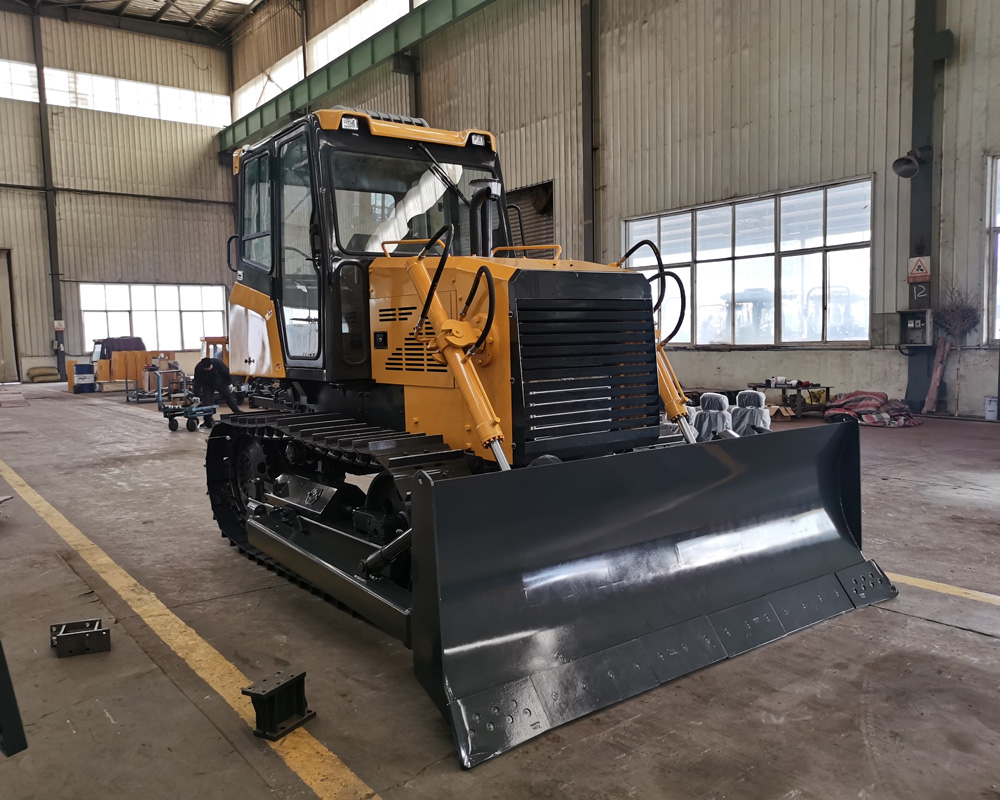
Pre-mobilization checklist
Before deciding whether to mobilize this machine, it is recommended to check in the following order:
- Whether the width of access routes and the work face can accommodate the overall dimensions and clearance at both ends of the blade;
- Whether ground bearing conditions match the ground pressure, and whether there are extremely soft or void areas;
- Whether the material type corresponds to the optional blade types, and whether a rear ripper or towing device is needed;
- Whether push distances and earthwork volumes fall within the mid-small task range, and whether coordination with other equipment is required;
- Whether on-site fuel supply and emission requirements are met, given the diesel engine;
- Whether transport method, access roads and unloading areas are available.
Application boundaries and items to be confirmed
The information for this small dozer supports its use for mid-small earthworks in municipal engineering, farmland improvement, site leveling and mining operations, but the following points still need to be confirmed before purchase or mobilization:
- The information does not provide site-adaptability data such as minimum turning radius or climbing ability; actual maneuverability on tight sites needs on-site verification;
- The specific specifications and supply status of optional blades and track shoes are not listed in the information;
- Values such as fuel consumption and working efficiency cannot be directly applied to a specific project;
- If the site involves wetlands, extremely soft foundations or steep slopes, a separate assessment should be made as to whether it exceeds the machine's applicable range.
When requesting a quotation, it is recommended to provide: material type and condition, work face dimensions and access conditions, ground bearing conditions, planned workload and shift arrangements, whether specific blades or rear attachments are needed, and transport and mobilization constraints. This information helps determine whether the model matches the specific task, rather than deciding solely on overall machine parameters.