






















In procurement discussions for medium crawler excavators, two opposing views often emerge: one argues that sufficient working range is enough, while the other emphasizes that loading pace cannot be compromised. These two views actually point to different issues—coverage determines whether the machine can reach the work, while loading coordination determines whether it can do the work smoothly. The 15-ton class happens to sit at the boundary between the two; if configuration trade-offs are judged based on only one of them, it is easy to leave a gap in the other.
First distinguish two objectives: reaching and keeping up
Working coverage corresponds to geometric conditions: maximum digging depth, maximum digging radius, maximum dump height, and minimum swing radius. These fields answer whether the soil at a given position can be dug and dumped to the designated location. Loading coordination corresponds to cycle conditions: whether each stage of a working cycle—digging, swinging, and dumping—can keep up with the pace of transport vehicles, involving bucket capacity, swing speed, hydraulic response, and site layout.
Both requirements exist simultaneously on the same machine model, but the order of judgment differs. Coverage is a threshold condition; if not met, the model is eliminated outright. Loading coordination is an efficiency condition, compared among models that meet the threshold. Treating it as a vague "is the capability sufficient" mixes geometric constraints with pace constraints.
What the data for a 15-ton crawler excavator can answer
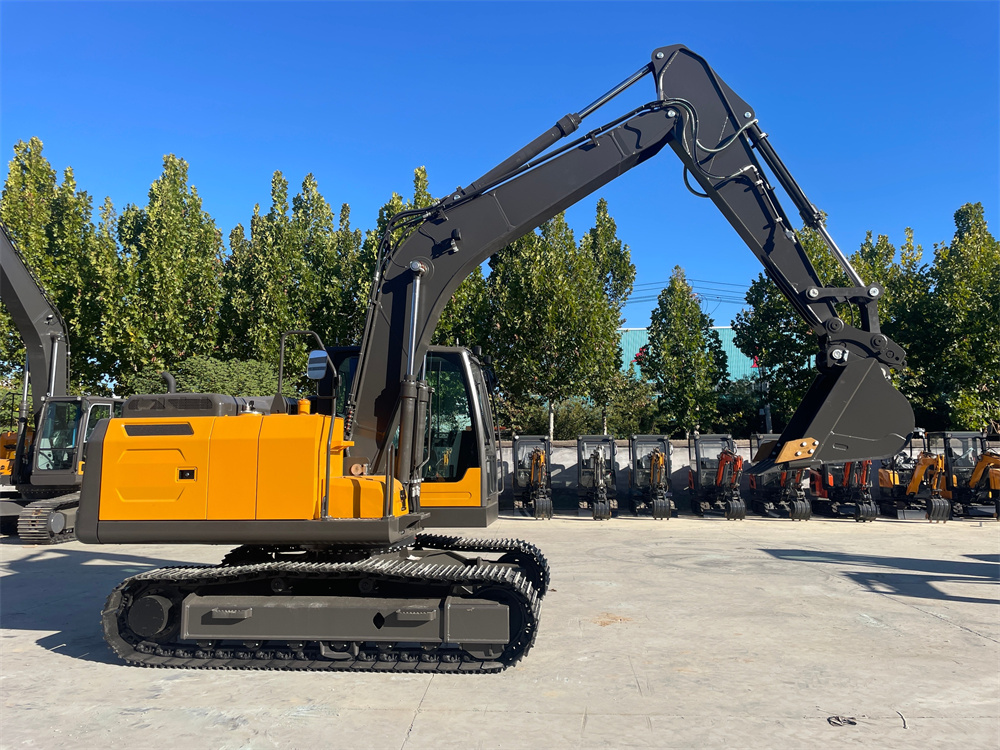
Taking the public parameters of this site's 15-ton medium crawler excavator as an example, the working range fields are relatively complete: maximum digging height 8627 mm, maximum dump height 6025 mm, maximum digging depth 5343 mm, maximum vertical digging depth 4790 mm, maximum digging radius 8198 mm, minimum swing radius 2770 mm, overall dimensions 7737×2500×2847 mm, and tail swing radius 2389 mm. These values can be used to check whether trench depth, dump height, and swing space fall within the machine's geometric capabilities.

Loading-related fields are concentrated in another group: bucket capacity 0.6 m³, swing speed 0–12 rpm, maximum arm digging force 55 kN, maximum bucket digging force 91 kN, and system pressure 32 MPa. On the power side, it has a WP 4.1N engine with rated power 110 kW (148 hp) at 2000 rpm. The data also mentions dual-pump confluence technology used to increase oil flow to each cylinder to shorten cycle time.
What can be directly mapped to loading judgments includes the match between bucket capacity and vehicle payload, the relationship between dump height and truck sideboard height, and the coordination between swing speed and vehicle repositioning pace. The data does not provide cycle time, hourly loading volume, or fuel consumption for this model under specific materials; these can only be verified separately under actual configuration and site conditions and cannot be directly derived from the parameter table.
Where the boundary between coverage and loading coordination lies
Comparing the two types of requirements in one table makes the boundary clearer. The table below only organizes fields already available in this model's data and does not represent conclusions for any specific working condition.

| Judgment item | Data field | Corresponding working issue |
|---|---|---|
| Vertical coverage | Maximum digging depth 5343 mm, maximum vertical digging depth 4790 mm | Whether trenches and foundation pits can be excavated to depth in one pass |
| Horizontal coverage | Maximum digging radius 8198 mm, minimum swing radius 2770 mm | Distance between machine position and excavation face; swing interference in narrow sites |
| Dumping conditions | Maximum dump height 6025 mm, maximum digging height 8627 mm | Whether dumping can clear truck sideboards or stockpile height |
| Per-bucket match | Bucket capacity 0.6 m³ | Number of buckets matched to transport vehicle payload |
| Cycle pace | Swing speed 0–12 rpm, dual-pump confluence | Margin for coordinating swing with vehicle repositioning |
| Digging force conditions | Bucket 91 kN, arm 55 kN | Effect of material density on penetration |
As the table shows, most coverage fields are fixed geometric quantities, and judgments are relatively direct; loading coordination fields provide only conditions, not results. How large a vehicle a 0.6 m³ bucket should match and how many buckets fill it depend on material loosening factors and actual vehicle payload; the data does not provide these conversion relationships.
When coverage takes priority and when loading pace deserves closer verification
If the working face is mainly trenches, foundation pits, or localized deep excavation, or if machine positions are constrained by surrounding buildings or pipelines, geometric field constraints are tighter. The maximum digging depth of 5343 mm and minimum swing radius of 2770 mm are two direct thresholds; if they are not met, there is no room to discuss loading pace. Conversely, if the excavation face is open, transport vehicles cycle frequently, and earthwork volume is concentrated, bucket capacity, swing speed, and hydraulic response deserve item-by-item verification.
There is also a category where both tighten simultaneously: narrow site, considerable depth, and continuous output required. Under such conditions, the parameter table alone cannot determine trade-offs; the excavation outline, vehicle positioning, and swing space need to be drawn on the same plan view for review. The data can provide the machine's boundary values but cannot replace site layout.
Verification items for configuration and supporting conditions that cannot be omitted
- Working equipment: The 0.6 m³ bucket capacity is the configuration given in the data. Whether other bucket types or attachments such as breakers are fitted must be confirmed separately according to actual materials and processes; the data does not cover these combinations.
- Material conditions: The maximum bucket digging force of 91 kN and arm digging force of 55 kN are data values. Whether the machine can penetrate a specific stratum also depends on material density, moisture content, and operating method; the data does not provide applicability conclusions by material classification.
- Site and transport: Overall dimensions 7737×2500×2847 mm, track gauge 2000 mm, and minimum ground clearance 380 mm. Access road width, turning radius, and transport vehicle load capacity need to be checked against these dimensions.
- Power and altitude: The data mentions turbocharging technology for high-altitude adaptability but does not provide specific altitude limits or power derating data. Plateau projects should list this as an item to be confirmed.
- Shifts and refueling: The 110 kW engine and large-capacity fuel tank statements are part of the data. Actual continuous operating duration and refueling intervals still need to be calculated according to on-site shift arrangements; the data does not provide fuel consumption values.
- Maintenance conditions: The engine oil filter, pilot filter, fuel filter, and water separator are located at ground level, which is a maintenance convenience description. Specific maintenance intervals and inspection items should refer to the accompanying manual and should not be replaced by empirical values.
Reading the data as a pre-inquiry conditions checklist
Returning to the initial disagreement: coverage and loading coordination are not an either-or choice but two sequential judgments. First use geometric fields to screen out solutions that cannot reach the work, then use bucket capacity, swing, and hydraulic conditions to compare how well they can keep up. The data for this 15-ton crawler excavator provides verifiable values for both, but does not provide applicability conclusions by working condition, nor does it give data on efficiency, fuel consumption, or returns.
Therefore, if this equipment is to be included in solution discussions, the following should be provided together at inquiry: excavation outline and depth, dump location and vehicle payload, material type and density, site plan and transport width/height limits, shift arrangements and workload, whether other working equipment or attachments are needed, and the altitude and climate conditions of the project location. Only after these conditions are complete is there a basis for discussing the trade-off between coverage and loading coordination; lacking any one of them, only conditional judgments can be given, and they cannot replace on-site verification. The product's public data page can serve as a starting point for parameter verification: 15-ton crawler excavator.