






















Before earthmoving begins, the most common problem is not insufficient horsepower but a mismatch between the machine version and site conditions: the site has dry hard clay, but a wide-track version designed for soft ground is delivered; the job requires pushing loose material, but a cutting blade is supplied; the ground bearing capacity is poor, but ground pressure was not calculated in advance. By the time the machine arrives on site, the cost of adjustment far exceeds the half-day spent verifying before start-up.
The following uses public data for a 178 hp mid-size crawler dozer as a reference and follows the pre-start verification sequence. It is a multi-version platform, with versions listed in the data including standard, coal, extended, super-wetland, sanitation, desert, and forestry logging. This makes it suitable for illustrating how to match “same platform, different working conditions” item by item. All values in this article come from that product data and are examples only; they do not represent all machines in the same class.
Step 1: Determine the material first, then the blade
The essence of dozer work is pushing material from point A to point B. Different materials require different blade shapes and capacities. The machine in the data can be equipped with a straight blade, angle blade, U-blade, coal blade, rock blade, sanitation blade, and others.
- General earthmoving and grading: a straight blade provides direct cutting and pushing. In the data, the standard straight blade is 3455 mm wide, 1149 mm high, with 540 mm blade depth.
- Trench and slope shaping: an angle blade can be adjusted in angle and is suitable for pushing material to one side. In the data, the angle blade is 4011 mm wide and 1040 mm high.
- Coal and bulk materials: a coal blade has a larger capacity. The SD16C coal version blade is 4150 mm wide and 960 mm high, intended for bulk material pushing at power plants, port stockyards, and similar sites.
When verifying, do not look only at blade width; also check whether blade depth and lift height match the cut-and-fill depth. Insufficient blade depth makes it difficult to penetrate hard soil; insufficient lift height makes it easy to drag soil when crossing high ridges.

Step 2: Use ground pressure to judge whether the site can be entered
This is the item most easily skipped before a crawler dozer starts work. For the same machine, changing the track shoe width makes a large difference in ground pressure. The comparison of three versions in the data illustrates the point directly:
| Version | Operating weight | Track shoe width | Ground pressure |
|---|---|---|---|
| Standard | 17000 kg | 510 mm | 58 kPa |
| Coal | 17500 kg | 510 mm | 55 kPa |
| Super-wetland | 16900 kg | 960 mm | 22 kPa |
The standard version at 58 kPa is suitable for general earthmoving and harder ground; the super-wetland version reduces ground pressure to 22 kPa through 960 mm wide tracks, for swamps, soft wetlands, and river improvement. If the site is a soft foundation during the rainy season or a backfill area with high moisture content, bringing in the standard version first is likely to cause sinking and slipping. Conversely, on dry hard ground, the steering resistance and wear caused by wide tracks also need consideration. Whether the ground bearing capacity is sufficient should be based on on-site soil type, moisture content, and measured bearing capacity; the ground pressure in the data is only one machine-side input.
Step 3: Match undercarriage and passability to site morphology
The data shows that this series uses a self-made undercarriage, with a ground contact length of 2635 mm, ground clearance of 400 mm, and 37 track shoes per side (41 for the super-wetland version). A longer ground contact length helps stable pushing, and higher ground clearance helps cross uneven ground. However, these are common descriptions at the platform level. Whether a specific version is suitable for rocky ground, slopes, or muddy sections still needs to be verified against site terrain. The data does not provide slope capability, wading depth, or similar figures; such conditions should be listed as items to be confirmed and must not be assumed applicable.

Step 4: Plan attachments together with the work sequence
The machine in the data can be equipped with a three-shank ripper, with a ripper lift height of 570 mm, used for breaking clay and frozen soil. If the work sequence includes “ripping first, then pushing,” the attachment should be included in the site entry plan together with the main machine, rather than added after the machine arrives. Likewise, whether devices such as a drawbar are needed should be confirmed according to the actual work sequence.
In addition, versions such as the coal and sanitation versions correspond to bulk material pushing and specific site operations; they should not be considered universal just because the name includes “version.” The version name indicates the configuration direction, not that the version has all working-condition capabilities.
Step 5: State power and transmission only as described in the data, without extrapolation
According to the data, this series is equipped with a WP10 electronically controlled engine, rated power 131 kW / 1850 rpm, meeting China’s National Stage IV emission standard for non-road machinery, with the transmission matched to the engine power curve. Note: an electronically controlled engine is not the same as a pure electric machine; this site also has a pure electric dozer, and the two must not be confused. The data does not provide fuel consumption, endurance, or operating efficiency figures; these should not be treated as established conclusions during procurement. Suppliers can be asked during inquiry to provide documentation for the corresponding version.
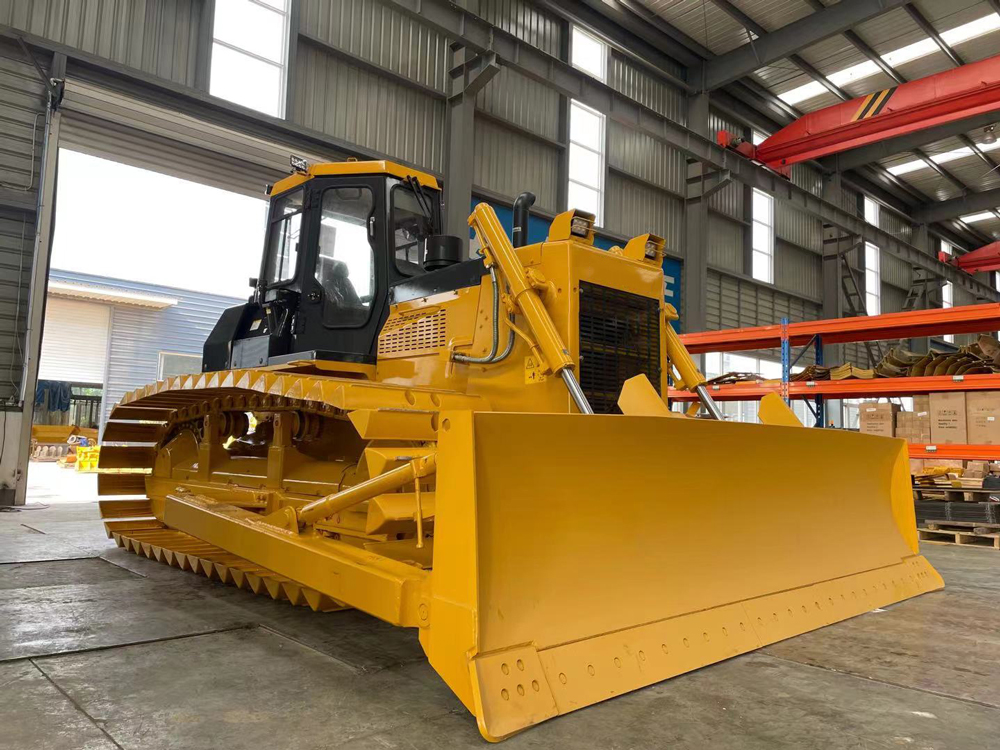
Step 6: Base maintenance verification on the manual
The data mentions that this series uses corrugated tube protection for wiring harnesses, side covers can be opened for daily inspection, the fuel filter and air filter are arranged on the same side, and lubrication points such as the fan shaft and equalizer beam are exposed. These are structural convenience descriptions. Specific maintenance intervals, filter replacement intervals, and lubrication requirements should be based on the accompanying manual and the supplier’s technical documents; maintenance intervals must not be inferred from structural descriptions.
Checklist to complete before start-up
- Material type and condition: general earth, clay, frozen soil, bulk material, or soft soil; whether ripping is needed first.
- Ground bearing capacity: whether a low-ground-pressure version is needed, and whether the effect of wide tracks on steering and wear is acceptable.
- Blade: straight, angle, U-blade, or special blade, determined by pushing direction and material.
- Undercarriage and passability: terrain undulation, slope, and wading conditions; confirm in writing with the supplier for items not covered by the data.
- Attachments: whether rippers, drawbars, and similar items enter the site together with the main machine.
- Power form: fuel or pure electric; if an electric option is considered, power supply and recharging conditions must be verified separately.
- Transport and site entry: whether overall dimensions and weight meet transport and site road conditions.
When requesting a quote, it is advisable to provide material type and volume, ground bearing capacity and moisture conditions, pushing distance, work shifts, whether ripping or a special blade is needed, and transport road restrictions. Only then can the supplier determine which version should be matched, rather than quoting only a model number.