






















On earthmoving loading sites, buyers or operators often compare equipment horizontally by bucket capacity: 1 cubic meter versus 1.2 cubic meters, and the larger one seems to load faster. But in actual cycles, bucket capacity only answers “how much can be loaded at once,” not “how long a cycle takes, whether the material can fill the bucket, or whether the dump position is suitable.” If you focus only on the bucket capacity number, it is easy to treat two machines with similar paper specifications as equally efficient and overlook the conditions that truly affect loading rhythm. This article takes a 21-ton class mid-size crawler excavator as the subject to explain how loading capability should be broken down and judged.
Bucket capacity is only one multiplier in the cycle
Loading can be roughly understood as a repeated cycle: penetrate the pile, dig and fill, lift and swing, position and dump, and return for the next bucket. Bucket capacity affects the load per bucket, but the time of this cycle is jointly determined by whether cutting is smooth, whether hydraulic movements are responsive, and whether the swing and dump positions match. With the same bucket capacity, if cutting is difficult, hydraulic response is slow, or dump height is insufficient, the time per bucket will be extended and the loading rhythm will drop. Conversely, a machine with a slightly smaller bucket but a smoother cycle may not necessarily load less per unit time.
Therefore, to judge whether a mid-size crawler excavator is suitable for loading tasks, one should look at three stages: “can it fill the bucket—does it load quickly—does it dump smoothly,” rather than first comparing bucket capacity numbers.
Can it fill the bucket: bucket capacity and digging force must match
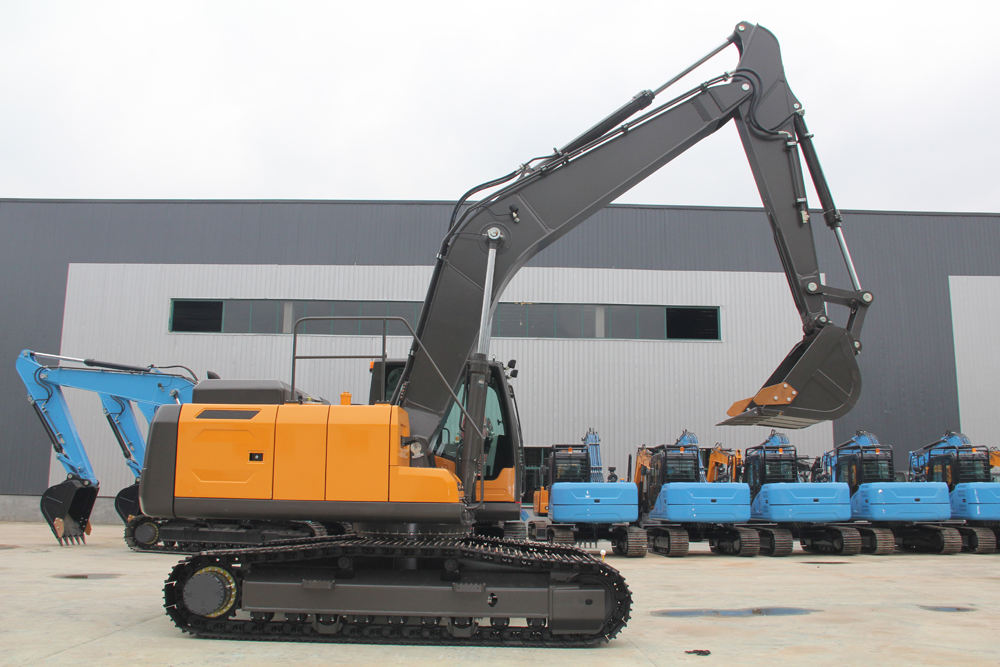
Taking the SH200 associated with this article as an example, its standard bucket capacity is 1 cubic meter, maximum bucket digging force is 140 kN, arm digging force is 99 kN, and system pressure is 32 MPa. The significance of this set of data is not whether the values are high or low, but that it shows “bucket capacity and digging force are provided as a matched set”: the 1 cubic meter bucket has corresponding cutting and rock-breaking capability support in conventional earthmoving. If the on-site material is harder, contains more crushed stone, or has cemented layers, bucket capacity alone cannot guarantee that every bucket is full; cutting resistance will directly lengthen the digging stage.

It should be noted that the data does not provide the actual fill factor or cycle time of this model under different materials, so it cannot be used to infer its loading output in a certain type of soil layer. Whether it is suitable under hard soil, frozen soil, or large block stone conditions still needs to be confirmed separately based on material conditions.
Does it load quickly: hydraulic response and swing rhythm
In the loading cycle, boom, arm, bucket, and swing are continuously coordinated movements. The data shows that this model adopts dual-pump confluence technology to increase oil supply flow to the boom, arm, and bucket; swing speed is 11–13 rpm. These two items correspond to two links in the cycle: whether oil supply is sufficient during combined movements determines whether penetration and lifting are continuous; swing speed determines the transfer time per bucket. In addition, electronic throttle control and auto idle (the engine enters idle after 5 seconds of no operation) are mainly used to reduce idle fuel consumption and noise, belonging to operational management configurations and cannot be directly converted into loading efficiency improvement.
In other words, hydraulic and swing data can help judge whether the machine has corresponding configurations for “movement continuity,” but the specific loading pace of a fleet also depends on operator skill, truck coordination, and site layout; the data itself does not provide an efficiency commitment.

Does it dump smoothly: working range determines matching with transport vehicles
Loading is not just digging; it also requires delivering material above the truck bed. This model has a maximum digging radius of 9850 mm, maximum digging height of 9410 mm, maximum dump height of 6730 mm, and maximum digging depth of 6480 mm. Dump height and digging radius jointly determine whether it can cover the dump truck bed without significantly moving the machine body, and whether it can balance the distance between the material pickup point and the dump point. If the pickup face and transport route are arranged far apart, or high-position dumping is required, these range parameters affect whether frequent machine repositioning is needed more directly than bucket capacity.
At the same time, overall dimensions of 9590×2980×3185 mm, tail swing radius of 2880 mm, minimum ground clearance of 470 mm, and maximum gradeability of 30° relate to the machine's positioning and transfer within the loading work face. When the site is narrow or has obvious slopes, whether the body can be positioned and whether tail swing is limited by slopes or temporary facilities need to be checked against the site layout before entry.
What other conditions matter for continuous operation
Loading is often not single-bucket work but continuous operation by shift. The model data mentions a large-capacity fuel tank, built-in tool box, maintenance filters arranged at ground-accessible positions, as well as a enclosed cab, shock-absorbing seat, and heating and air conditioning. These configurations correspond to refueling, maintenance convenience, and driver fatigue management during long operations; they are supporting conditions and are not equivalent to efficiency conclusions. During procurement, shift duration, refueling or energy replenishment arrangements, and daily inspection items should be included in the evaluation; specific maintenance intervals and inspection requirements should be based on the accompanying manual.
Working condition information to confirm with suppliers before purchase
If this type of 21-ton class crawler excavator is to be used for loading tasks, ordering based only on bucket capacity and power can easily leave blind spots. It is recommended to provide the following conditions during inquiry so the supplier can judge the degree of matching based on the specific configuration:
- Material type and condition: conventional earthmoving, soil with stones, cemented layers, or crushed material, which directly affects cutting and bucket-filling judgment.
- Transport vehicle specifications and parking method: bed height and relative position to the pickup face, used to check whether dump height and digging radius are sufficient.
- Work face conditions: site width, slope, bearing capacity, and transfer route, corresponding to overall dimensions, gradeability, and tail swing radius.
- Shift and workload: planned daily loading volume and continuous operation duration, used to evaluate refueling and maintenance arrangements.
- Work equipment configuration: whether different bucket capacities or attachments are needed; attachments are only confirmed separately as supporting conditions of the overall machine solution.
- Power and key configurations: engine, hydraulic, and control configurations are subject to the actual supply data of this model; different batches may vary.
In summary, bucket capacity is suitable as a starting point for loading capability, not a conclusion. Only by matching digging force, hydraulic and swing configurations, dump height, and working range item by item with on-site materials, vehicles, and site conditions can one judge whether a mid-size crawler excavator is suitable for a specific loading task; material adaptability and output levels not covered by the data should be left as items to be confirmed in technical communication with the supplier.
Product page: 21-ton class crawler excavator