






















An earthworks contract section rarely involves only one task. The same bulldozer may be dozing backfill soil in the morning, rough grading a site in the afternoon, entering soft wet areas during the rainy season, and having to rip frozen soil or hard gravel first. If procurement focuses only on the main task at hand, later tasks often have to be covered by adjusting the construction organization or mobilizing additional equipment. Conversely, more configuration is not always better; extra features that are not used on this project only add procurement and maintenance burden. What really needs to be determined is which task differences can be covered by the same machine platform with different work equipment, and which must be considered separately from the start based on site and material.
List the tasks first, then decide which task to configure for
Breaking down the work within the contract section and recording it is more useful than broadly writing "earthworks." At minimum, the following items need to be clarified:
- The type and condition of the dozed material: conventional backfill soil, clay, frozen soil, gravel or stripped material;
- The dozing distance and whether repeated rough grading is needed, and to what level of grading accuracy;
- Site bearing conditions, including whether there are special ground conditions such as soft foundations in the rainy season, wetlands or desert;
- Whether hard layers need to be broken, and the approximate ratio of ripping work to dozing work;
- The equipment entry route and transport restrictions, which determine whether the machine dimensions can be positioned smoothly.
The purpose of this list is not to select a single "largest requirement," but to see which tasks can share one machine and which will constrain each other. Dozing and rough grading can usually share the same undercarriage and blade; the difference between wetland passage and conventional dry-ground dozing often lies in the track ground-contact configuration and the machine version, and cannot be solved by changing the blade alone.
Conditions under which the same machine platform covers multiple tasks
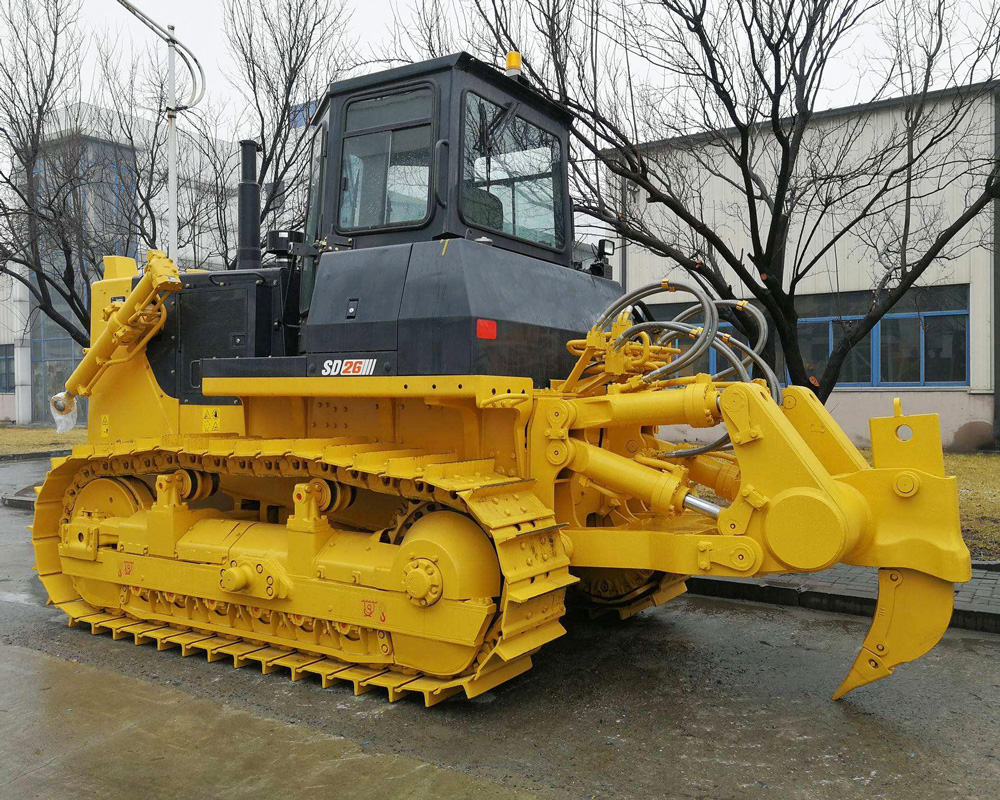
Using data for a 260 hp-class medium bulldozer as an example, the approach of "common platform, differentiated versions" becomes clear. The series has an operating weight of 23,450 kg, maximum theoretical drawbar pull of 460 kN, ground pressure of 66 kPa, ground contact length of 2,872 mm, and track shoe widths available in 560, 610 and 660 mm. These data indicate that it belongs to the medium heavy-duty dozing class. Power comes from an engine with rated power of 206 kW (277 hp) and net power of 194 kW (260 hp), matched with a power shift transmission and torque converter.

For multi-task scenarios, what deserves more attention is the version breakdown listed in the data: standard, forestry, wetland, desert, sanitation and rock versions. This shows that the same power platform can correspond to different site and material conditions through differentiated undercarriage and work equipment configurations. Note, however, that a version name itself is not equal to a specific configuration list. Whether a given version has a certain type of track shoe, protection or blade still needs to be confirmed item by item according to the detailed data for that version, and cannot be inferred from the series introduction.
Dozing and rough grading: blade and undercarriage are the common foundation
According to the data, the machine is equipped as standard with a straight tilt blade with a width of 3,725 mm, height of 1,315 mm, capacity of 4.6 m³, maximum lift height of 1,210 mm and maximum digging depth of 540 mm. For tasks where dozing and rough grading coexist, the straight tilt blade is a workable starting point; the data also lists optional angle blades, U-blades and semi-U blades for diversified construction needs. If the contract section involves long dozing distances and loose materials, the choice of blade form will directly affect how each pass is organized, and this item should be confirmed with the supplier at the inquiry stage together with the available options and corresponding working conditions.
The travel section uses a semi-rigid suspension structure, which the data states keeps the track rollers in contact with the track and increases the actual ground contact area. For a multi-task site, this means the same undercarriage must handle both heavy-duty dry-ground dozing and passage over softer ground, making the choice of ground-contact configuration more sensitive than for a single task.

Hard layers and frozen soil: the ripper is a task-matched attachment, not a universal capability
The data lists an adjustable-penetration-angle multi-shank ripper with a three-shank structure, weight of 2,600 kg, maximum ripping depth of 666 mm, maximum lift height of 555 mm, ripper width of 2,000 mm and shank spacing of 930 mm, used for breaking clay, frozen soil and hard gravel strata. If the ripping task accounts for a small share of the contract section, it is more prudent to decide on the ripper as an optional item based on the actual frequency of hard layers than to equip the full set by default. It should be noted that ripping performance depends on the specific condition of the stratum; the data does not provide conclusions on working capability by material classification, and whether the requirement can actually be met should be judged in combination with the on-site stratum.
Several constraints easily overlooked when making multi-task trade-offs
| Constraint | Why it affects multi-task machine configuration | Items to confirm |
|---|---|---|
| Wetland and soft-foundation passage | Once the same machine enters soft ground, ground pressure and track configuration directly determine whether work can proceed | Track shoe width, ground-contact parameters and applicable ground conditions of the wetland version |
| Transport and entry | Machine dimensions and weight determine the transfer method, and multi-task contract sections often require multiple transfers | Machine length, width and transport plan, and whether work equipment needs to be removed |
| Continuous operating duration | Continuous multi-task construction places higher demands on cooling and structural durability | Cooling system configuration and operating instructions under high-temperature full-load conditions |
| Maintenance accessibility | Frequent task switching leaves limited inspection windows | Engine hood opening method, centralized lubrication and layout of daily inspection points |
The first item in the table is the most easily underestimated. The data shows that a wetland version exists in the series, but the series introduction does not give the specific track and ground-contact parameters of the wetland version, so it cannot be directly said that the standard version can replace the wetland version for entering soft-foundation areas. If the contract section does include wetland or rainy-season soft-foundation work, the wetland version should be verified as a separate condition rather than adjusted after the equipment arrives.
Judgments supported by the data and parts that cannot be inferred
Based on the verified data, this 260 hp-class bulldozer has the foundation for shared use across multiple tasks: medium-to-heavy operating weight, a mature power shift transmission, optional multiple blades and rippers, and a version series differentiated by site. These features correspond to the approach of "one platform configured by task," not "one machine can do every working condition."
The data does not provide productivity, fuel consumption comparisons or applicable terrain conclusions for different versions under specific materials, nor does it include customer use cases. Therefore, whether a multi-task contract section is suitable for coverage by one machine ultimately depends on the time share of each task, the frequency of site switching and transport conditions. These conditions should be submitted together with the task list at the inquiry stage so that the supplier can match them item by item by version. Safety warning lights, reverse buzzer, braking system and optional rollover protection structure are configuration items listed in the data, and whether they are standard on a specific version still needs to be confirmed.
Conditions to submit before inquiry
- The material type, condition and approximate share of work volume for each task;
- Dozing distance, rough grading accuracy requirements and whether ripping or breaking is needed;
- Site bearing conditions, including whether wetlands, soft foundations, desert or sanitation scenarios are involved;
- Transfer routes and transport restrictions, and whether machine dimensions can meet them;
- Shift arrangements and continuous operating duration, used to check cooling and reliability configuration;
- Specific options for blade form, track shoe width, ripper and protection configuration.
Listing these conditions clearly by task and then matching them to the machine version and work equipment makes it easier to leave room for adjustment in later construction than locking in a single task first and adding configuration afterward.