






















When discussing loading with crawler excavators, a common simplification is that "the larger the tonnage, the more it can load." This has some reference value at the rough screening stage, but it easily becomes inaccurate in specific projects: machines of similar 30-tonne-class size with different bucket capacities, digging forces and dump heights will show different actual loading rhythms when facing loose soil versus hard rock. Tonnage class describes the weight range the machine falls into; loading capacity describes how much the machine can dig, how high it can lift and where it can place material in one working cycle. The two are related, but they are not the same thing.
What tonnage class answers and what loading capacity answers
Tonnage class is essentially a specification coordinate. It helps buyers place the machine within a certain range for transport, ground bearing and matching truck beds, but it does not indicate how much the bucket can hold, whether the digging force is sufficient to penetrate the current material, or whether the dump height can cover the side of a dump truck bed. Loading capacity must be viewed along the chain of "material—bucket—truck bed—site": whether the material is easy to penetrate and fill, whether bucket capacity matches truck bed volume, and whether dump height and swing radius allow a smooth cycle. Therefore, to judge whether a crawler excavator is suitable for a loading task, tonnage must be considered together with these factors.
What the data for a 37-tonne-class machine shows
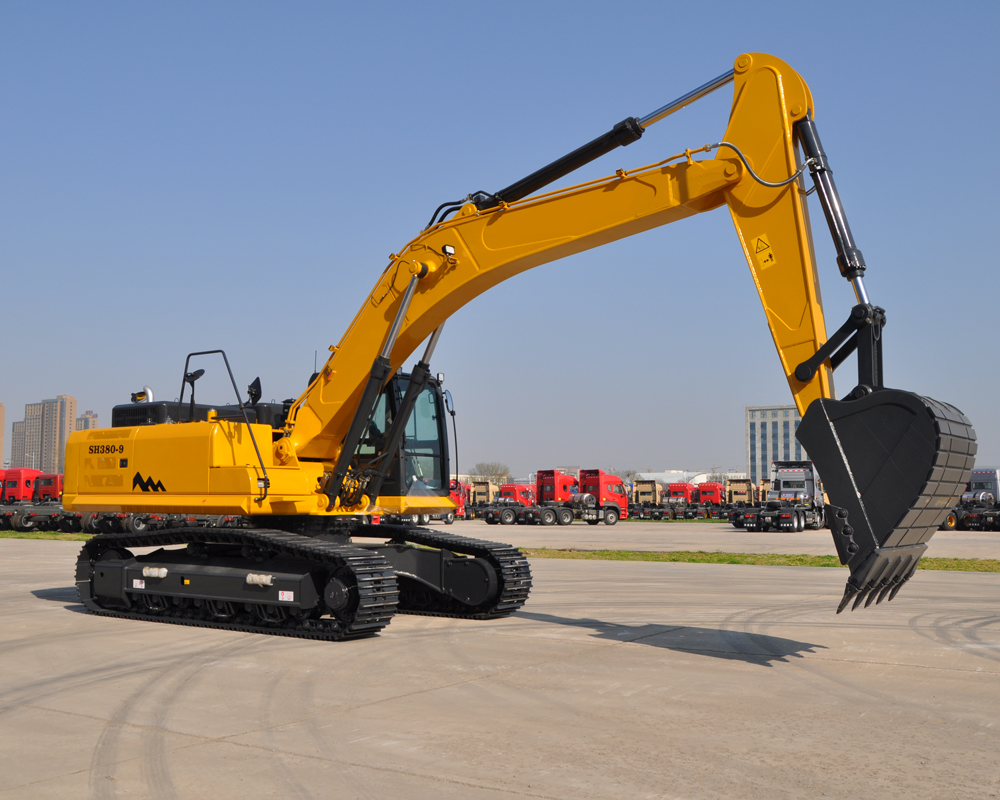
Taking the 37-tonne-class crawler excavator on this site as an example: operating weight 37000kg, rated engine power 242kW, bucket capacity 1.62–1.82m³, bucket digging force 230kN, arm digging force 190kN, maximum dump height 7182mm, maximum digging radius 11051mm, maximum digging depth 7240mm. Only when these figures are put together do they form a relatively complete loading capacity profile: bucket capacity gives the theoretical load per bucket, digging force reflects the ability to penetrate material, and dump height and digging radius determine its positional relationship with the truck bed and stockpile. The single figure of 37000kg alone cannot support any of the above.
This also explains why two machines with similar tonnage may perform differently in loading. Falling within the same tonnage class only means the overall weight and undercarriage scale are close; whether bucket capacity is 1.62m³ or 1.82m³, whether digging force is 230kN or another level, and whether dump height is sufficient are the variables that directly affect the loading cycle.

Breaking the loading task into verifiable conditions
If the work objective is mainly loading dump trucks, the requirements can be sorted in the following order and then matched item by item against the machine data:
- Material type: loose soil, hard soil or rock material requiring breaking determines the requirements for digging force and bucket type;
- Truck bed volume and side height: the matching relationship between bucket capacity and truck bed volume, and whether maximum dump height can cover the side, affect whether the cycle is smooth;
- Working face layout: digging radius, swing radius and tail swing radius determine machine positioning and truck parking positions;
- Site and relocation: overall width, transport dimensions and ground pressure affect entry and machine movement arrangements;
- Shift organization: the ratio of transport vehicles determines whether a single machine becomes a waiting point or bottleneck.
Of these conditions, only some can be read directly from product data; the others—such as specific truck bed volume, on-site road width and actual material density—need to be supplemented by the buyer. Keeping the two types of information separate prevents replacing all judgment with the single number of tonnage.
Loading judgments corresponding to verified parameters
Still taking this 37-tonne-class model as an example, matching the data item by item with the above conditions:

| Data item | Verified value | Corresponding loading judgment |
|---|---|---|
| Operating weight | 37000kg | Belongs to the 37-tonne class, used to frame transport and site discussions, not directly representing loading capacity |
| Bucket capacity | 1.62–1.82m³ | Determines theoretical load per bucket and must be judged together with truck bed volume |
| Bucket/arm digging force | 230kN / 190kN | Reflects the ability to penetrate material; hard material and loose soil cannot be treated as equivalent |
| Maximum dump height | 7182mm | Determines whether it can cover the side height of the target truck bed |
| Maximum digging radius | 11051mm | Affects the layout space for machine positioning and truck parking |
| Overall width/track shoe width | 3200mm / 600mm | Entry road and working face width need to be checked against these |
| Ground pressure | 62kPa | Site bearing conditions need separate confirmation of whether they match |
The conclusion that can be drawn directly from the table is that this machine has clear values for bucket capacity range, digging force, dump height and working range, which can be compared with specific truck beds, materials and sites. What cannot be drawn directly is its actual loading efficiency, loading volume per unit time or fuel consumption level at a certain job site. These depend on material condition, vehicle dispatch, operator skill and site organization, which the data itself does not provide.
Where the dividing line in loading capacity falls when tonnage is similar
For machines of the same tonnage class, differences in loading capacity usually fall in three places. First is the match between bucket capacity and truck bed: if bucket capacity is too small, the number of times the truck bed is not fully loaded increases; if too large, material may spill or waiting may occur with sticky material or a small truck bed. Second is the match between digging force and material: loose soil requires low digging force, while hard soil and gravelly material require higher force; whether the 230kN level is sufficient must be judged in light of the material. Third is working range and site layout: values such as maximum dump height 7182mm and maximum digging radius 11051mm determine whether the machine can complete the "dig—swing—dump" cycle from a given position without frequent repositioning.
Checking these three items separately makes it easier to find the real limiting point than simply comparing tonnage. Conversely, if a machine is selected by tonnage alone, gaps may be left in bucket capacity or dump height, or extra transport and site costs may be paid for a machine size that is not needed.
Items still to confirm before purchase
The available data can support a specification-level comparison of this 37-tonne-class crawler excavator, but it is not enough to judge that it will certainly be suitable for a specific project. Before purchase, it is recommended to further confirm:
- The actual material composition and condition, and whether other bucket types need to be configured;
- The truck bed volume and side height of the matching dump trucks, and check the match between the 1.62–1.82m³ bucket capacity and the 7182mm dump height;
- Entry road width, turning radius and transport vehicle conditions, compared with the 3200mm overall width and transport dimensions;
- Ground bearing conditions of the working face, and confirm whether there are corresponding conditions for the 62kPa ground pressure;
- Shift arrangements and the ratio of vehicle numbers, to clarify the position of a single machine in the transport chain;
- Whether the power and hydraulic configuration match local fuel, altitude and usage habits.
It should be noted that the above scenario analysis is based on machine data and general operating logic, not on the actual usage records of any customer, and does not constitute a commitment to loading efficiency or construction results. Tonnage class is one of the starting points for selection; loading capacity must be supported jointly by bucket capacity, digging force, dump height, truck bed matching and site organization. Checking these variables together is the reliable way to judge whether a crawler excavator is suitable for a loading task.