






















Dam rockfill placement and port land reclamation share a common feature: thick lift layers, large particle sizes and high single-shift compaction volumes. On such work faces, compaction equipment must answer two questions at once—whether the exciting force can penetrate to the bottom of the layer, and whether the drum width can keep pace with the paving rhythm. If a medium-sized roller is specified based on conventional roadbed experience, the usual result is more passes, forced reduction of layer thickness, and a slowdown of the entire fill cycle. This article addresses this constraint, explaining the conditions under which a super-heavy single-drum vibratory roller enters the plan, and what must be verified before mobilization.
Look at the operating conditions first, not the tonnage
The compaction difficulty in rockfill placement comes mainly from the material itself: there are large voids between rock blocks, requiring sufficient static linear load and centrifugal force to force fines into the voids and densify the skeleton. The greater the layer thickness, the higher the requirement for single-pass compaction depth; the harder and more uniform the material, the more it relies on vibration energy rather than dead weight alone. Under such conditions, machine weight, static linear load and centrifugal force are three interrelated judgment items, and none should be considered in isolation.
Another easily overlooked factor is work-face organization. Dam filling is often advanced in layers and sections, with wide paving widths and equipment traveling back and forth; drum width directly affects the effective area covered per pass and also affects coordination with paving, watering and quality inspection. Turning radius affects the room for adjustment at dam-face edges and section joints.

Which requirements this equipment's data corresponds to
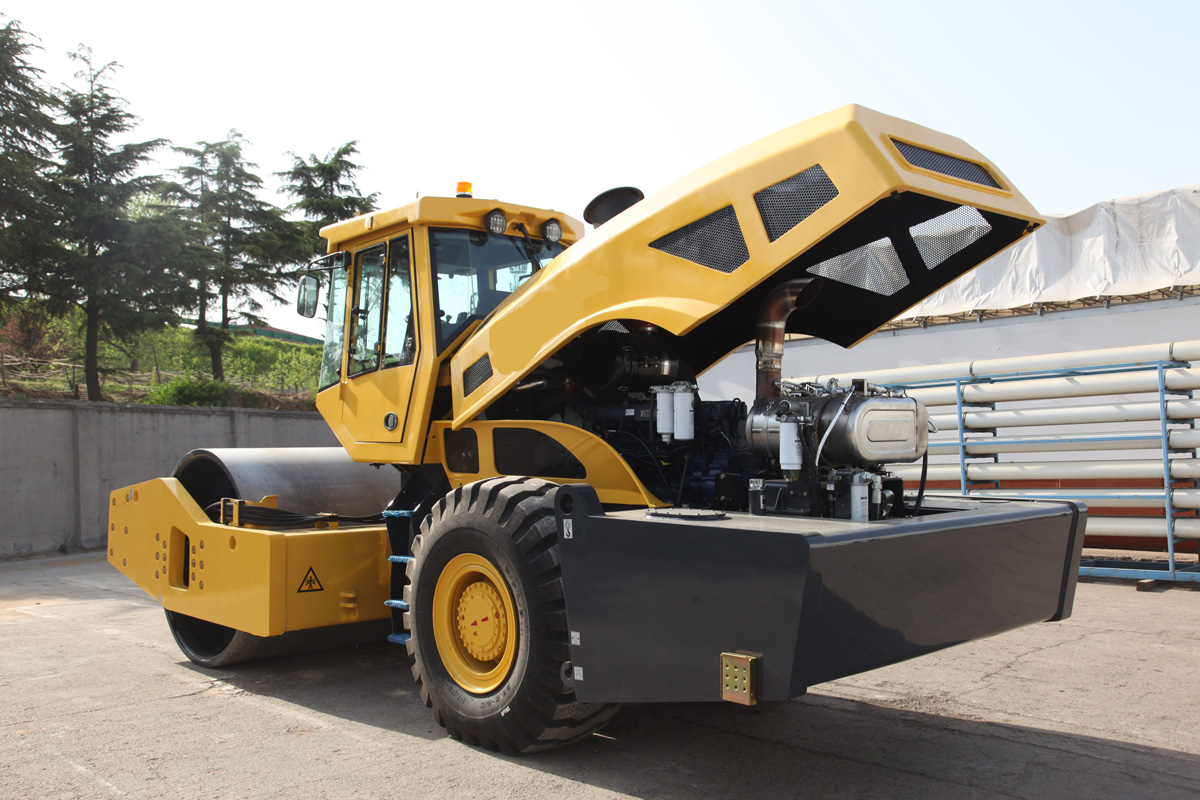
The S367HD referenced in this article is a 36-tonne-class single-drum vibratory roller, and its verified data corresponds to the operating conditions above:
- Operating weight 36,000 kg, static linear load 1021 N/cm: dead weight and static linear load determine the initial densification capability in the static compaction stage, suitable for preliminary stabilization of thick rockfill layers before vibration.
- Centrifugal force 805 kN (with an additional 550 kN setting under dual amplitude): the excitation force level corresponds to energy transfer at greater depth, which is the main reason for considering equipment of this class for thick-layer filling.
- Drum width 2350 mm, diameter 1700 mm: a wide drum increases the area covered per pass, and a large-diameter drum helps passage over uneven rockfill surfaces.
- Dual frequency 28/32 Hz, dual amplitude 1.9/1.0 mm: different combinations can be used for high-impact thick-layer work and surface finishing, leaving adjustment room for layered operations.
- Rated engine power 276 kW, Tier 3 / China III: provides power reserve for sustained high-load vibration; the emission stage must be checked against the access requirements of the project region.
- Gradeability 45%, turning radius 7575 mm, speed range 0–9 km/h: these figures relate to travel on dam-face ramps and turning on the work face, but actual usability still depends on surface adhesion, ramp width and site organization.
It should be noted that the above are data from product materials and do not mean that a certain compaction effect has been achieved in a specific project. The number of passes, layer thickness and final density must be determined by on-site compaction trials.

When this class is worth considering
Based on the data, a conditional judgment can be given: when the fill material is mainly large-particle rockfill, stone spoil or coarse aggregate, the design lift is relatively thick, and the work-face width is sufficient for the 2350 mm drum to exploit its coverage advantage, the parameter configuration of super-heavy single-drum equipment matches the requirement. Conversely, if the lift is thin, the material is finer, the work face is narrow or relocation is frequent, the high weight and wide drum will instead increase organizational difficulty.
A little conditional reasoning can be made (the following is a hypothetical scenario, not an actual case): if a fill section needs to complete a large volume of layered compaction within a limited schedule, and existing medium-sized equipment must repeatedly reduce layer thickness to meet the standard, then assigning thick-layer compaction to equipment with higher excitation force and higher static linear load, and assigning edges and joints to more maneuverable models, is a common division of labor. However, whether such a division works still depends on on-site trial data and the number of matched machines.
Items still to be verified before mobilization
- Transport and relocation: overall dimensions 6980 × 2690 × 3300 mm fall within the scope of oversize transport; road width and height limits, bridge and culvert load capacity, and the access route must be verified.
- Site bearing capacity: the passability of 36-tonne-class equipment on soft dam foundations or temporary roads must be judged in light of foundation treatment; the materials do not provide ground contact pressure data.
- Power and emissions: fuel supply arrangements for the 276 kW engine, and whether Tier 3 / China III meets the emission access requirements of the project location.
- Supporting processes: watering, paving thickness control and compaction pass records must match the pace of the compaction equipment.
- Safety and operation: specific operating requirements for dam-face edge work and ramp travel should be based on the equipment manual and the project safety plan.
Conditions to provide when requesting a quotation
If you are preparing to request a quotation for such a fill task, it is advisable to state at one time: the fill material type and maximum particle size, design layer thickness and compaction degree requirements, estimated compaction volume and schedule, work-face width and ramp conditions, access transport route restrictions, operating hours per shift and fuel supply method, and whether a specific emission stage is required. For the roller, the steel drum or tire configuration and vibration parameter requirements should also be specified, so that the supplier can judge whether equipment of this class matches, rather than quoting on tonnage alone.
Product page for reference: 36-tonne-class single-drum vibratory roller.