






















Treating landfill compaction as roadbed compaction is a common deviation in equipment selection. Both involve "compaction," but the materials differ: roadbeds deal with graded soil or granular material, while landfills face municipal solid waste with mixed composition and fluctuating moisture content. Roadbeds aim to achieve specified compaction degree, whereas landfills must also handle crushing, volume reduction, and pile stability. If the configuration approach is directly transferred from rollers, the equipment often fails to match the working conditions.
Key Differences Between Landfill Operations and Roadbed Compaction
The comparison table below lists the differences between the two types of operations by site conditions, helping identify which requirements are unique to landfills.
| Comparison Item | Roadbed Compaction | Landfill Compaction |
|---|---|---|
| Material | Soil, granular material, relatively controllable gradation | Mainly municipal solid waste, highly variable composition and moisture |
| Operational Goal | Achieve design compaction degree | Crushing, volume reduction, and compaction in parallel |
| Lift Organization | Layered rolling by lift thickness | Lift organization based on spreading and pushing rhythm |
| Site Conditions | Roadbed working surface relatively stable | Pile surface soft and uneven, uneven bearing |
| Equipment Focus | Steel drum or tire configuration, vibration parameters | Compaction wheel structure, ground clearance, protection |
This table illustrates general differences between the two operation types and does not represent the specific performance of any machine. Landfill compactors typically use toothed compaction wheels, combining crushing action during rolling with compaction; roadbed rollers mainly rely on steel drum vibration or tire kneading. Conflating the two leads to wrong trade-offs in compaction wheel type, passability, and protective configuration.

Deriving Equipment Conditions from Operational Goals
Before purchasing equipment for a landfill, the site tasks can be broken down into verifiable conditions: daily waste intake determines the working face width and shift arrangements the equipment must cover; spreading and pushing methods determine the coordination rhythm between the compactor and equipment such as bulldozers; pile surface bearing conditions determine the required ground contact and passability; and the leachate, gas, and dust environment determine the focus of protection and cleaning maintenance.
Not all of these conditions can be directly concluded from product literature. The literature provides inherent equipment parameters; whether they match still requires confirmation based on actual lift thickness, waste composition, and haul roads. A more practical approach to selection is: first use the literature to screen equipment meeting the basic capability range, then verify site conditions item by item.
What Requirements Do the Data of a 26-Ton Landfill Compactor Correspond To?
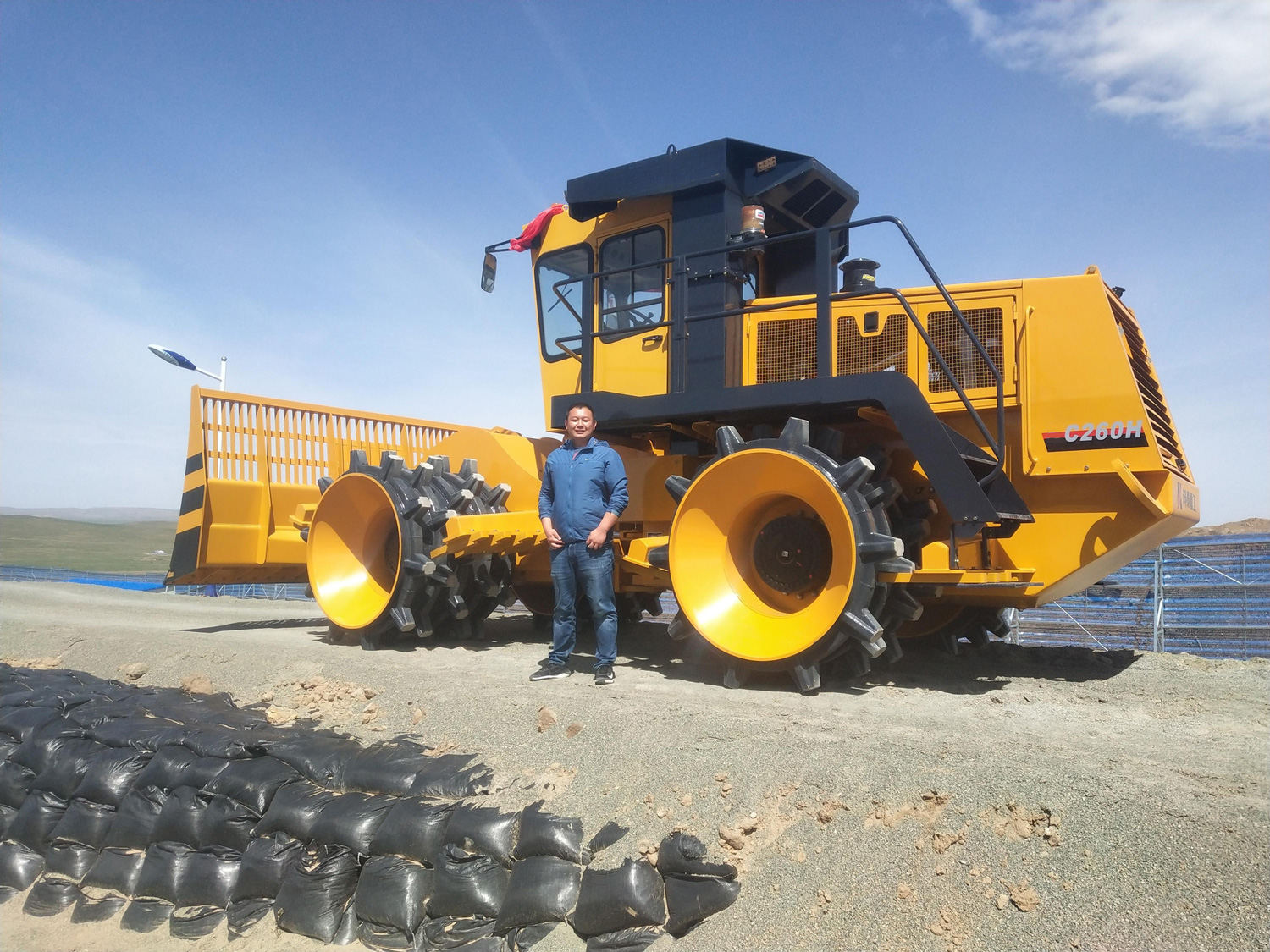
Take the C260H from this site's product literature as an example. It is a 26-ton heavy-duty landfill compactor with an operating weight of 26,000 kg, powered by a 262 HP (192 kW) Shangchai Tier 3 engine, and overall dimensions of 8,100 × 3,800 × 3,670 mm. Several fields in the literature can be directly mapped to landfill operational requirements:

- Crushing width 3,430 mm: corresponds to the working face width covered in a single pass, related to daily waste volume and working face organization.
- Compaction capability 0.35–1.0+ t/m³: given as a range with "+", indicating that compaction results depend on material and operation method and should not be interpreted as a fixed value under any conditions.
- Ground clearance 490 mm, blade height 1,880 mm: correspond to passability margin under uneven and soft pile surface conditions.
- Maximum speed 11 km/h: corresponds to on-site travel speed; specific applicability must be judged in conjunction with site road conditions.
The literature positions this model as suitable for municipal solid waste landfill, waste crushing, waste volume reduction, and large-scale solid waste treatment projects. Note that "suitable" is a product positioning statement, not equivalent to verified performance on this project; whether expected compaction results can actually be achieved still depends on lift thickness, number of passes, and waste composition.
Supporting Conditions to Confirm When Selecting Such Equipment
Landfill compactors do not operate in isolation. Spreading and pushing are usually handled by bulldozers, with the compactor following behind to advance by lift; the travel routes of transport vehicles and the layout of unloading points also affect the compactor's path. The following conditions should be reviewed together before purchase:
- Coordination with bulldozers: who handles spreading, who handles compaction, and how the working face is zoned.
- Pile slopes and travel: which slope sections the equipment must traverse, and whether slope conditions are supported by data.
- Protection and cleaning: protection requirements for the undercarriage, cooling system, and cab in the landfill environment must be confirmed item by item with the supplier.
- Maintenance inspection: daily inspection items for compaction wheels, undercarriage, and hydraulic system should be based on the accompanying manual; intervals must not be set by experience alone.
- Transport and entry: requirements of overall dimensions and weight on access roads and unloading sites.
Items to Be Confirmed and Selection Boundaries
The available literature does not provide data on this model's climbing ability on specific slopes, actual compaction results under different waste compositions, fuel consumption, or operational efficiency, nor are there customer use cases. Therefore, this article does not conclude that "this model is suitable for a certain type of landfill" but only explains the correspondence between literature fields and operational requirements. If the site is dominated by high-moisture waste, steep pile slopes, or special protection requirements, these conditions should be submitted separately to the supplier for confirmation rather than judged solely by tonnage and power.
When requesting a quotation, it is recommended to provide: daily waste intake and working face dimensions, lift organization method, pile surface bearing and slope conditions, on-site haul roads, work shifts, power and emission requirements, and specific requirements for compaction wheels and protective configuration. The more specific this information, the better the supplier can determine whether the equipment configuration needs adjustment.