






















The difference between heavy-duty mine hauling and general earthmoving often lies not in whether the machine can push, but in what is easily overlooked during the readiness stage: whether the material is crushed stone or weathered rock, whether the tracks can switch between hard and wet ground, whether the blade version matches the ripper, and whether transport dimensions can pass mine roads. Checking these conditions one by one before work begins is more controllable than sourcing parts after mobilization.
The following checklist uses verified data for a 320-hp class track dozer as a reference sample, including the standard, coal, and rock versions. The checklist itself is a verification approach; it does not mean that any one machine already meets all mine conditions. The parameters in the table are only used to indicate what needs to be checked.
First Clarify Work Objectives and Constraints
Heavy-duty mine hauling usually involves several actions at once: advancing the stripping face, short-distance pushing of crushed stone or weathered rock, stockpile trimming, and in some conditions using a ripper on compacted layers. Once these actions are broken down, the corresponding constraints fall into roughly four categories: material abrasiveness and lump size, ground bearing capacity and slope conditions, continuous shift operation, and access transport and maintenance space. Readiness checks should work backward from these four constraints to equipment conditions, rather than looking at the machine first and then deciding what it can do.

Checklist: Power and Transmission
- Rated power and speed: The data gives a rated power of 258/2000 kW/rpm (WP12) or 257/2000 kW/rpm (QSNT-C345) for the standard version, with the same parameters for the rock version. During verification, confirm whether site altitude, ambient temperature, and fuel supply conditions are within the engine's allowable range. The data does not provide an altitude power correction curve, so this item must be confirmed with the supplier.
- Emission stage: The data indicates China Stage III emissions. If the mine is in an area with stricter emission requirements, local access conditions must be confirmed first.
- Transmission and speed ranges: Forward gears 0–3.6/0–6.6/0–11.5 km/h, reverse gears 0–4.4/0–7.8/0–13.5 km/h. Heavy-duty hauling mainly occurs in low gears. Verification should combine pushing distance to judge shift frequency, rather than looking only at top speed.
- Fuel capacity: Fuel tank 640 L, hydraulic tank 97 L. Shift duration and distance to refueling points must be calculated on site. The data does not provide fuel consumption figures, so per-shift fuel use cannot be derived from it.
Checklist: Undercarriage and Ground Contact Conditions
The undercarriage is the part that bears wear first in heavy-duty mine hauling. The data shows a track gauge of 2140 mm, track ground contact length of 3150 mm, track shoe width options of 560/610/660/710 mm, 41 track shoes per side, track pitch of 228.6 mm, and ground clearance of 500 mm. Ground pressure is 97.7 kPa for the standard version, 98.4 kPa for the coal version, and 99.4 kPa for the rock version.
The verification questions corresponding to these data are: whether the main working face is hard rock floor or compacted crushed stone, and whether track shoe width should favor wider specifications to distribute ground pressure; whether 500 mm ground clearance meets site requirements for crossing obstacles and mud depth; and whether the ground pressure values correspond to the standard configuration and change after installing a ripper or different blades. The data does not list these one by one, so confirmation is needed.

Track and Track Roller Inspection Items
- 2 track rollers and 7 carrier rollers per side; verify that quantities match site inspection records.
- There are four track shoe width specifications. Confirm that the delivered configuration matches the quoted configuration to avoid planning the site for one width and mobilizing with another.
- Operating weight is 40900 kg for the rock version (with single-shank ripper and ROPS), 40200 kg for the standard version, and 40500 kg for the coal version. Transport and lifting plans must be calculated according to the actual version weight and must not use standard version figures.
Checklist: Blade and Ripper Configuration
| Version | Blade Type and Width | Ripper |
|---|---|---|
| Standard | Straight/angle/semi-U blade, 4130/5000/4130 mm | Single-shank or three-shank; maximum ripping depth 1250 mm for single-shank, 842 mm for three-shank |
| Coal | Semi-U or U-shaped coal blade, 4806/4520 mm | Single-shank or three-shank; ripping depth as above |
| Rock | Rock straight/rock angle/rock semi-U blade, 4130/5000/4130 mm | Single-shank or three-shank; ripping depth as above |
First determine the main working material. For conditions dominated by crushed stone and weathered rock stripping where blade wear is fast, the data describes the rock version as equipped with thickened high-wear-resistant rock blades and reinforced push arm assemblies, which is one basis for version selection. For conditions dominated by loose material stockpile trimming, the coal version's wide coal blade better matches spreading and pushing actions. The standard version covers multiple work equipment options including straight, angle, and semi-U blades. The three versions cannot substitute for one another. When selecting, material abrasiveness should be written into the requirements rather than simply stating "for mine use."
The data gives maximum blade lift height of 1560/1703/1560 mm and maximum digging depth of 560/630/560 mm. These values correspond to different blade types. During verification, they must be matched item by item to the actually selected blade and must not be mixed.
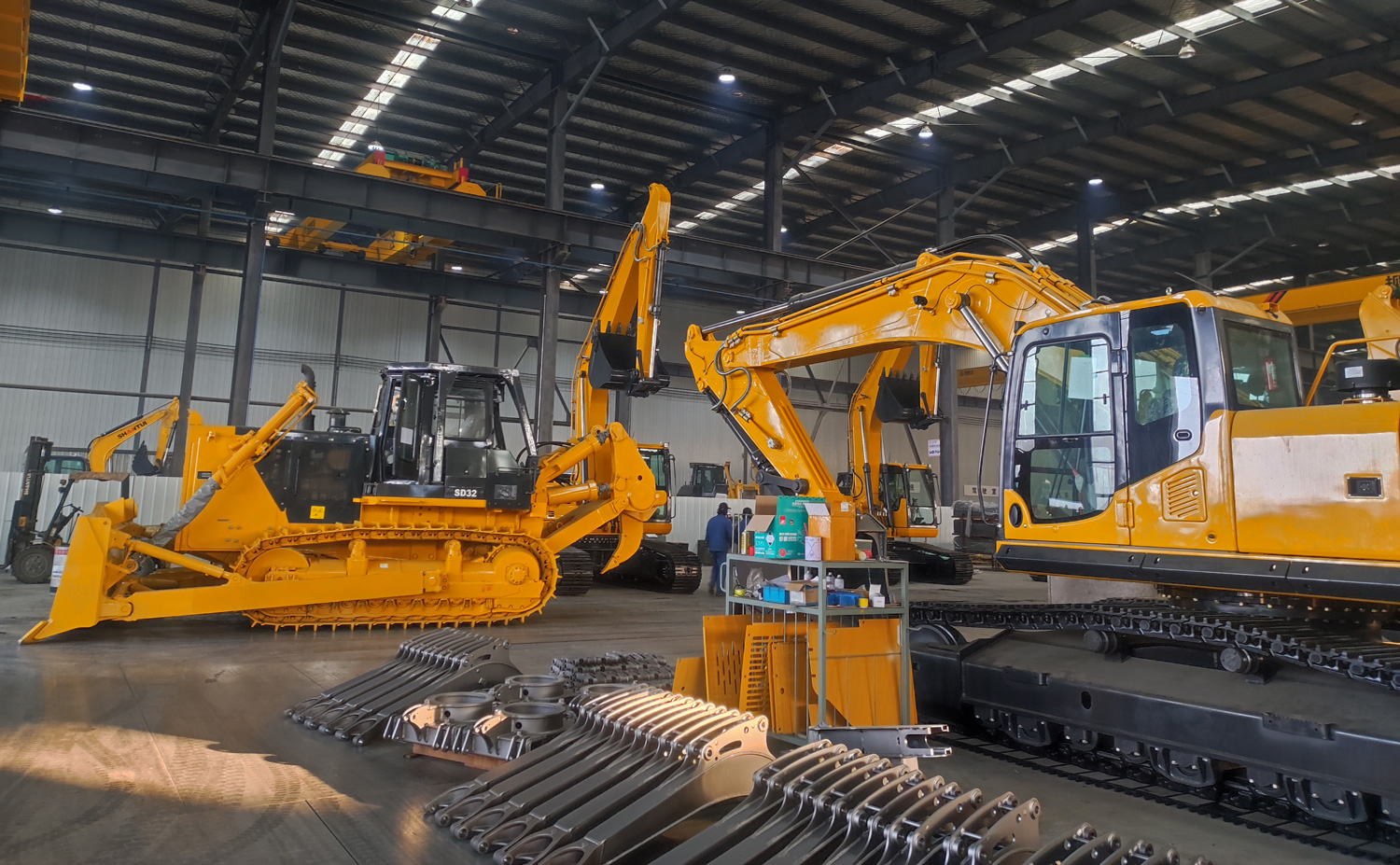
Checklist: Cab, Protection, and Maintenance Accessibility
- The cab is a six-sided enclosed type, with optional FOPS&ROPS protective structure. For working faces with rockfall risk in mines, the protective structure should be included in inquiry conditions and the selected configuration confirmed.
- The data mentions corrugated tube protection for wiring harnesses, graded wiring, large open side panels reserved for maintenance space, and centralized external arrangement of lubrication and maintenance points. During verification, the supplier can be asked to identify the locations of centralized lubrication points and daily inspection access, but maintenance intervals should not be inferred from this.
- High-brightness LED work lights are standard, supporting day and night operation. For two-shift or night-shift operation, lighting layout, site power supply, and refueling arrangements must be checked separately.
- All maintenance intervals, oil specifications, and disassembly/inspection procedures should be based on the accompanying manual. This article does not provide specific intervals.
Transport and Site Verification Before Mobilization
Overall dimensions are 8650×4130×3760 mm (standard and rock versions). The coal version is 8650×4755×3760 mm due to the wider blade. Before transport, verify the flatbed trailer width, mine road turning radius, and unloading site according to the actual version. The minimum turning radius of 3800 mm can serve as a reference for site layout but cannot replace on-site measurement. If the mine road width is close to this value, the mobilization route and turnaround points should be planned in advance.
Conditions Still Requiring Confirmation
- Power correction and cooling margin under high-altitude, high-temperature, or heavy-dust conditions; the data does not provide specific curves.
- Actual ground pressure changes under different track shoe widths and blade combinations.
- Blade wear rate and replacement interval for the rock version under specific rock types.
- Local emission access, transport permits, and lifting plans.
- Whether the ripper and blade can be configured simultaneously must be confirmed according to the order configuration table.
The purpose of the readiness check is to turn these items to be confirmed into written conditions before work begins, rather than testing them one by one after the equipment arrives. The parameters in the checklist come from public data for this 320-hp class track dozer and apply as a verification framework for similar heavy-duty hauling tasks. Specific projects should still combine material, haul distance, shifts, and site conditions to confirm configuration and applicable boundaries item by item with the supplier.