






















"The bigger the tonnage, the better it loads" is a phrase heard often in earthworks and quarry loading discussions. It treats operating weight as a synonym for loading capability, but loading is a cyclic action: penetrate the stockpile, fill the bucket, swing, align with the truck bed and dump, then swing back for the next bucket. Tonnage only indicates the scale of the machine; what really determines whether loading runs smoothly in a given application is whether these steps can be completed in a continuous sequence.
This article addresses that misconception: when heavier equipment is genuinely more suitable, when added tonnage does not automatically deliver better loading performance, and under what conditions a 45-tonne-class tracked excavator is worth considering.
Several variables sit between tonnage and loading capability
Facing the same dump truck, the loading rhythm is affected jointly by the following factors:
- The material condition in the stockpile or at the face: loose soil, broken material, or hard material requiring greater breakout force;
- The match between bucket capacity and truck body volume: too small a bucket increases the number of cycles, while too large a bucket may not fill fully or may overload the truck;
- Bucket digging force and stick digging force, which determine how much effort is needed to penetrate the stockpile;
- Swing radius and dump height, which determine whether the bucket can be aligned with the truck bed without stopping;
- Hydraulic system flow and control response, which affect the continuity of combined operations;
- Ground bearing capacity and machine positioning, which determine whether the machine can approach the stockpile and whether the swing area is restricted.
Greater tonnage usually brings a wider undercarriage and larger structures, but if stockpile organisation, truck bed height and swing space do not cooperate, the loading cycle will still be interrupted. Conversely, a machine of moderate tonnage whose bucket capacity, digging force and dump reach are well matched may also perform steadily in medium-scale loading.

Where 45-tonne-class equipment stands on this question
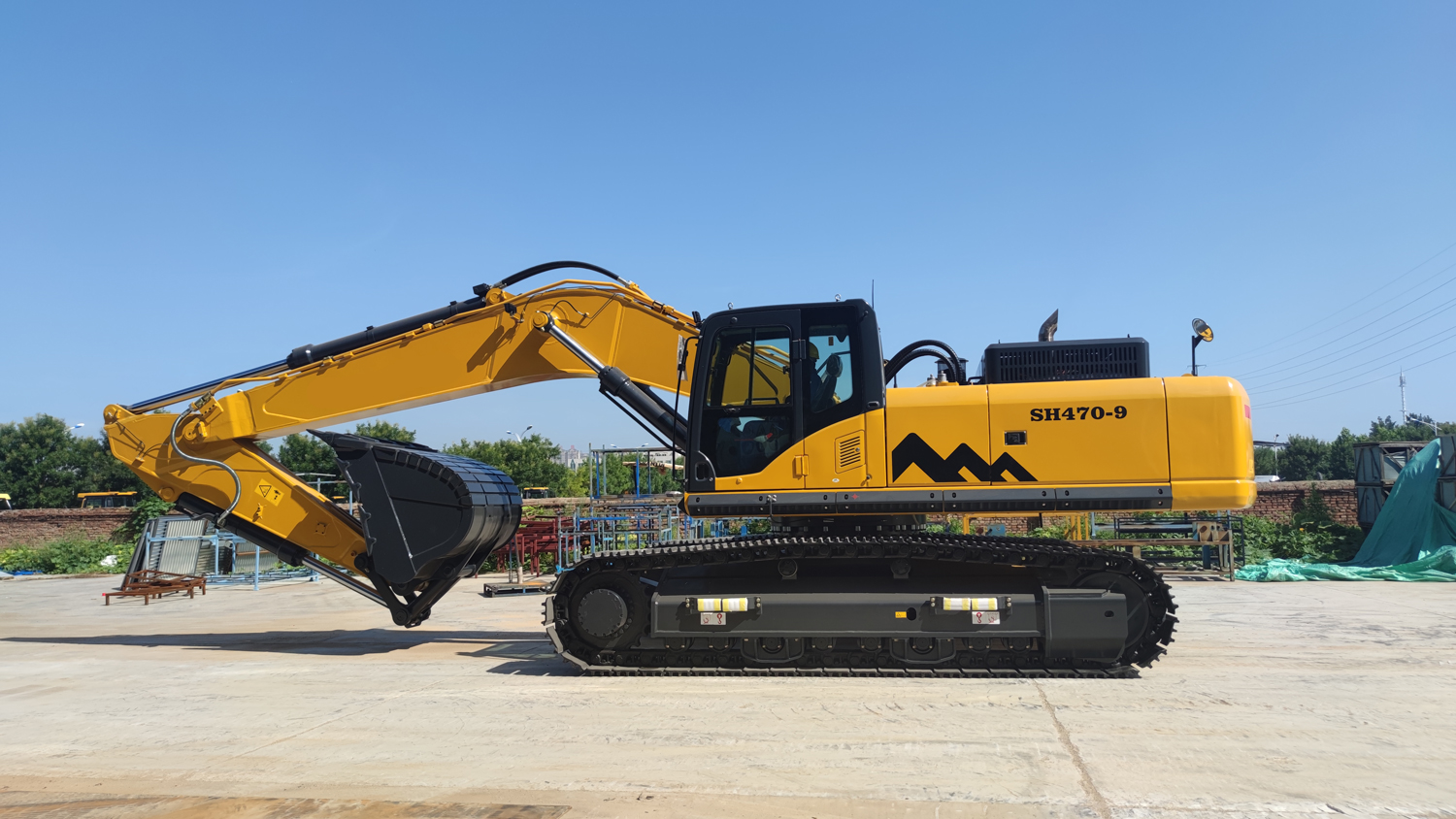
Take the SH470 from this site's product information: a tracked excavator with an operating weight of 44,900 kg, powered by a Cummins QSM11 engine rated at 250 kW (335.6 HP), with a bucket capacity of 2.0–2.2 m³, bucket digging force of 290 kN, stick digging force of 236 kN, and a Linde load-sensing hydraulic system with a maximum operating flow of 2×360+27 L/min. These figures place it in the scale range for heavy loading and digging work, rather than establishing capability through tonnage numbers alone.
Placing it back into the loading question requires checking each item:
- Bucket capacity matched to the truck body. A bucket capacity of 2.0–2.2 m³ corresponds to larger-tonnage dump trucks or applications requiring a higher effective payload per bucket. If the on-site truck bodies are on the small side, the large bucket capacity may not be fully utilised and may instead require controlling the load per bucket.
- Digging force matched to the material. A bucket digging force of 290 kN and stick digging force of 236 kN suit heavy-duty digging and penetration into hard material, but whether the material is loose or needs breaking still depends on actual on-site conditions; the data cannot replace a material assessment.
- Dump reach matched to truck bed position. A maximum dump height of 7,615 mm and maximum digging radius of 12,016 mm mean that, from a reasonable position, the machine can cover higher truck beds and a certain range of the stockpile. However, dump truck parking position, ground levelness and swing space all affect whether dumping is actually smooth.
- Hydraulic configuration matched to cycle rhythm. The role of the load-sensing hydraulic system is to distribute flow between the engine and hydraulic pumps, and the information describes it as supporting precise control and smooth combined operations. This is system-level support and cannot be used to infer cycle times or hourly output on a specific site.
In other words, the data for this machine supports the statement that "it has the scale and working range required for heavy loading", but not the statement that "a larger tonnage therefore makes it necessarily more suitable for all loading tasks".

When heavier equipment deserves priority consideration
Work through the following conditions step by step rather than jumping straight from tonnage to a conclusion:
| Assessment condition | Signals that heavier equipment is more meaningful | Information to verify first |
|---|---|---|
| Material and working face | Hard material, large lumps, or continuous loading requiring greater breakout force | Material type, lump size, whether loosening or breaking is needed |
| Truck body and haulage match | Large truck body volume, high payload per bucket required | Dump truck body capacity, payload, bed height and parking method |
| Working radius | Greater distance between stockpile and haul road, requiring larger swing coverage | Actual positioning, obstacles in the swing area, whether maximum digging radius covers the area |
| Site and transport | Ground bearing capacity and access roads allow heavy tracked equipment to pass | Operating weight, overall width, transport dimensions and road width/weight limits |
| Shift and continuity | Concentrated loading tasks, long single-shift operating hours | Fuel tank capacity, refuelling arrangements, maintenance downtime conditions |
If most of the above conditions do not hold — for example, small truck bodies, a narrow site or frequent relocations — then heavier equipment may bring additional constraints on transport and positioning, and its loading rhythm may not be smoother than that of medium-sized equipment.
Application boundaries and items to confirm for this machine
The SH470 information points to use scenarios including large open-pit mining, quarries, large-volume earthworks and heavy material loading. This can serve as directional guidance, but is not a commitment of suitability for any given site. Before purchase, at least the following must be confirmed:
- Whether the on-site material is of a type requiring high digging force for penetration, or is mainly loose material;
- Whether the body capacity and payload of the matched dump trucks form a reasonable match with the 2.0–2.2 m³ bucket;
- Whether the maximum digging depth of 7,800 mm and maximum digging radius of 12,016 mm cover the actual working face and haul road layout;
- Whether dimensions such as the overall width of 3,490 mm and overall length in transport condition of 12,090 mm can pass through access roads and working platforms;
- Whether the 600 mm track shoe width and 80.2 kPa ground pressure suit the current ground bearing conditions;
- Whether local fuel supply, maintenance conditions and operator availability meet the requirements of a continuous work schedule.
If any one of these conditions does not hold, the conclusion on equipment selection may change. The information does not provide output, fuel consumption or cycle time data for specific sites, so loading efficiency or cost-benefit cannot be calculated from it.
What information to bring to a purchasing discussion
If loading is the primary work objective, it is advisable to provide the following when requesting a quotation: material type and lump size, average daily loading volume or number of truck trips, body capacity and payload of the matched dump trucks, the relative positions of the stockpile and haul road, ground bearing capacity and access road conditions, single-shift operating hours, and whether breaking or other work equipment is required. On the equipment side, the bucket capacity, digging force, hydraulic system configuration, track and undercarriage specifications, and transport dimensions and weight need to be checked.
Tonnage can be a starting point for screening, but whether loading is suitable ultimately comes down to whether the material, truck body, positioning and cyclic actions can work together. Clarify these items first, then discuss what tonnage of equipment to choose — the judgement will be far more reliable.