






















Earthmoving projects often present this judgment: the same bulldozer may first push loose soil and do rough grading, then later enter a mine stripping face to push crushed rock and clear rock debris. If machines are configured only on the principle that "more horsepower is safer," unnecessary costs may be incurred in transport, fuel consumption, and undercarriage wear; conversely, forcing a medium-sized machine to handle heavy-load continuous pushing may make downtime the main cost. This article follows the order of increasing work intensity to explain under what conditions it is worth raising the selection to the level of a large crawler dozer.
First distinguish the actual differences between the two types of pushing tasks
General earthmoving and mine stripping are not the same kind of load. The former involves relatively loose materials and controllable single-push distances, with the machine mainly handling site preparation and short-distance transfer; the latter commonly involves hard materials, block stone, and mixed materials, with high cutting resistance, more frequent impacts on the blade and tracks, and work faces that often require continuous equipment operation. When judging selection, at least the following items should be examined separately:
- Material state: loose soil, bulk material, or stripping material containing block stone and weathered rock;
- Push distance and cycle rhythm: how far a single pass goes and approximately how many cycles must be completed per shift;
- Work face bearing capacity: whether track ground contact conditions are stable and whether frequent turning is required;
- Continuous operation duration: whether it is phased support or full-shift or even multi-shift continuous pushing.
If any of these items clearly leans toward heavy load, selection cannot be based only on "whether it can push," but on whether the equipment can remain stable under long-term impact.

Judgment path for capability progression
After breaking down the requirements, proceed in the following order rather than choosing a model first and then finding reasons for it.
Step 1: Confirm whether the task is heavy-load continuous pushing
If the material is mainly loose soil and backfill, and the push distance is not long, a medium-sized crawler dozer can usually cover it, and the focus should be on blade capacity and site passability. If the material contains large amounts of block stone, requires cutting into hard ground, or repeatedly clearing the stripping face, the nature of the load changes; at this point, priority should be given to checking the undercarriage's impact resistance and the drivetrain's continuous output capability.
Step 2: Check whether the undercarriage and structure correspond to impact loads
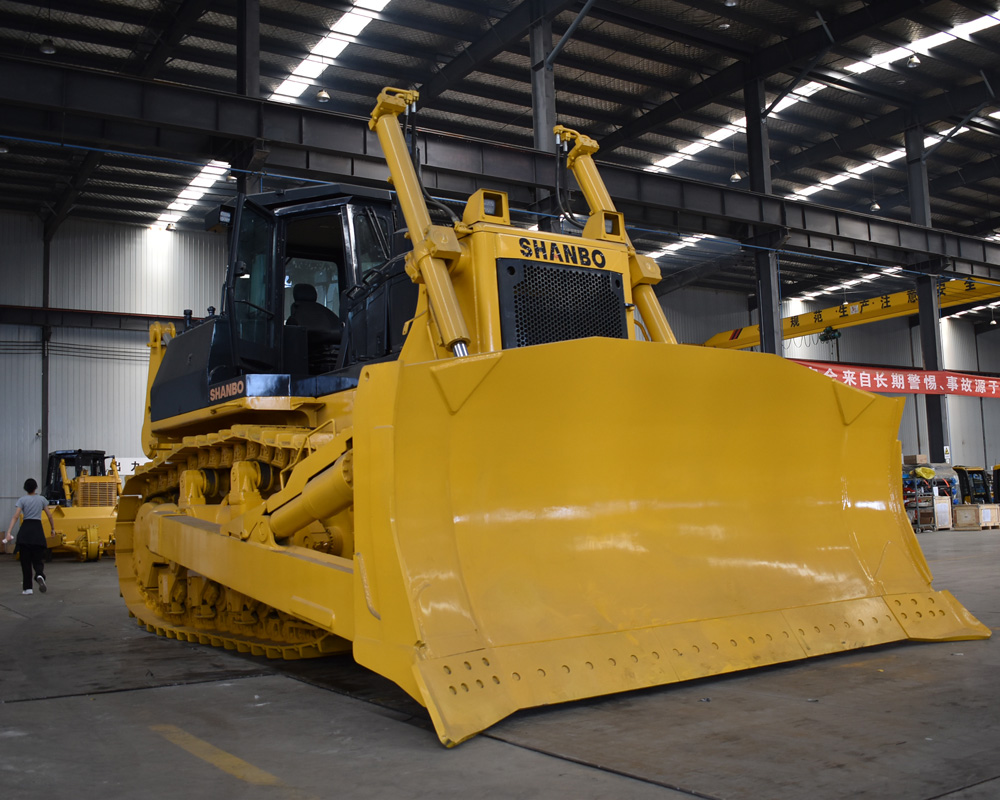
In heavy-load pushing, the undercarriage is the part most concentrated in bearing impact. The value of a large bulldozer often lies not only in the power figure but in whether the undercarriage structure, main frame, and travel system can disperse impact. Taking the SD46-6 associated with this article as an example, its information gives a K-type floating undercarriage, an integral articulated undercarriage, and a fully enclosed box-type main frame, and states that a multi-stage damping assembly is used to offset vibration from complex road surfaces. These descriptions correspond to travel and working conditions such as mountainous areas, rocky ground, and mining areas, rather than ordinary flat-ground bulk material pushing.

Step 3: Check whether blade and ripper configurations match the material
Stripping operations often involve both pushing and ground breaking. The SD46-6 is standard-equipped with a semi-U bulldozer blade; the information gives a blade capacity of 16 m³, blade width of 4314 mm, and maximum cutting depth of 700 mm; at the rear is an adjustable-angle single-shank heavy-duty ripper. Note here: large blade capacity means higher single-pass volume, but it also requires the machine's traction and site conditions to keep up; the ripper is suitable for loosening hard ground, but whether to use it still depends on geotechnical properties and whether loosening operations are permitted.
Step 4: Evaluate power and transmission under continuous operation
The SD46-6 information lists a rated power of 340 kW / 600 hp, equipped with a hydraulic shift transmission and planetary final drive, and states that the transmission assembly has multi-plate hydraulic clutches and forced circulation lubrication. For long-duration continuous pushing tasks, this type of structure indicates the power transmission path and lubrication method; purchasers still need to check cooling, maintenance, and spare parts conditions in light of their own shift arrangements. The information does not give fuel consumption or maintenance interval values, so no advance commitment should be made.
Parts of the SD46-6 information corresponding to heavy-load conditions
| Information item | Verified content | Corresponding working conditions |
|---|---|---|
| Machine specifications | Operating weight 54000 kg, ground pressure 0.123 MPa, gradeability 30° | Ground contact and slope passability under heavy-load conditions must be checked against actual site measurements |
| Undercarriage structure | K-type floating undercarriage, integral articulated undercarriage, multi-stage damping | Travel and work faces with frequent impact such as rocky ground and mining areas |
| Working equipment | Semi-U bulldozer blade, capacity 16 m³; single-shank heavy-duty ripper | Large-area earth-rock accumulation, bulk material handling, and hard-ground loosening |
| Safety structure | Standard ROPS/FOPS, optional upgraded integrated protective frame | Working environments with high risk of falling objects and rollover |
The values in the table only describe the configurations recorded in this model's information and cannot be used to infer that it can achieve a certain efficiency in any mine or under any material. Whether ground pressure of 0.123 MPa is suitable for a given site must be judged in light of ground bearing capacity and rainy-season conditions; gradeability of 30° is the value marked in the information, and actual passage is also affected by traction, load, and operating method.
When it is unnecessary to go up to this level
If the task is mainly general earthmoving, rough site grading, and short-distance transfer, with scattered work faces and frequent relocation, then the transport dimensions, access roads, and relocation costs of large equipment become an additional burden. In this case, a medium-sized crawler dozer is more suitable in terms of mobility and support. Conversely, if the project is truly mine stripping or large-scale earth-rock accumulation, with continuous shifts and sensitive downtime losses, only then is it worth raising the selection to the large level and focusing checks on the undercarriage, transmission, and protection.
Conditions to be settled before purchase
- Material and work face: proportion of stripping material, block stone size, whether ripping is needed, work face bearing capacity and slope conditions;
- Work volume: single-shift pushing cycles, push distance, whether multi-shift continuous operation is needed;
- Transport and access: transport dimensions of the large complete machine, road width, and bridge bearing capacity must be verified separately; the information does not give transport dimensions;
- Support and maintenance: spare parts supply, maintenance site, and arrangements for operators and maintenance personnel;
- Safety configuration: whether an upgraded integrated ROPS & FOPS protective frame is needed, assessed according to on-site falling-object and rollover risks.
When requesting a quotation, provide material type and proportions, average daily pushing volume, work face conditions, shift arrangements, and transport conditions, and clearly state blade and ripper configuration requirements and protective structure options so that specific configurations can be confirmed item by item. Fuel consumption, maintenance intervals, transport dimensions, and actual operating efficiency not listed in the information should be supplemented by the supplier before the contract.