






















The rhythm of a truck-loading operation can be broken into several motions: penetrating the pile, filling the bucket, swinging the full bucket, dumping, and returning the empty bucket. If the site reports "it won't cut" and "it swings slowly," these correspond to different specification fields. The former depends on the combination of digging force and bucket capacity; the latter depends on hydraulic flow, swing speed and the machine's ability to move around the site. Mixing the two problems together makes it easy to judge on a single number.
Below, using public data for a 50-tonne crawler excavator listed on this site as an example, we explain the reading order. First, a caveat: these figures describe the machine's parameters under given conditions and cannot be directly converted into actual loading productivity on a specific site; material condition, bench height, haul truck matching and operator skill all change the result.
First separate the two questions: won't cut, or slow cycle
Whether the pile is hard rock, dense clay or loose earth and rock determines the force needed to penetrate the bucket. A slow loading cycle may come from hydraulic response, swing speed, unsuitable dump height, or difficulty moving the machine between the face and the haul truck. Writing the site problem into these two categories before checking the data makes it easier to obtain verifiable information than asking vaguely whether "loading is fast."

The data for this 50-tonne crawler excavator on this site gives: operating weight 49,600 kg, bucket digging force 290 kN, arm digging force 236 kN, and bucket capacity 2.2–2.5 m³. Digging force and bucket capacity must be read together—with the same nominal digging force, a smaller bucket concentrates force per unit cutting width, while a larger bucket carries more payload per pass but penetration resistance also changes. The data does not give actual fill factors for different materials; this can only be listed as an item to confirm.
Hydraulic flow and motion speed: the fields behind cycle time
The machine uses a load-sensing hydraulic system with a main pump configuration of 2× variable piston pumps plus 1× gear pump, and maximum operating flow of 2×380+27 L/min. Load sensing synchronizes engine output with hydraulic demand, which the data describes as reducing energy loss and improving response. For loading work, this means whether flow supply keeps up with combined motions (such as boom lift plus swing), but the actual feel of response still depends on valve tuning and operating habits, which the data cannot quantify.
Also directly related to the cycle are swing speed of 9.3 rpm and travel speed of 3.2/5.3 km/h. Swing speed affects the turning time for full and empty buckets, while travel speed affects the time spent repositioning the machine at the face. Both are figures available in the data, but neither alone supports a conclusion about "how many trucks per hour."

How data fields map to loading stages
| Loading stage | Available data fields | What to note when reading |
|---|---|---|
| Penetration and filling | Bucket digging force 290 kN, arm digging force 236 kN, bucket capacity 2.2–2.5 m³ | Force and bucket capacity must be read together; material hardness is not covered by the data |
| Combined-motion response | Load-sensing hydraulic system, maximum operating flow 2×380+27 L/min | Flow is the system's upper capability limit, not the actual cycle time |
| Full and empty bucket swing | Swing speed 9.3 rpm | Affected by swing radius and where the haul truck is parked |
| Movement at the face | Travel speed 3.2/5.3 km/h, gradeability 70% (35°) | Ground evenness and slope conditions must be checked on site |
What role does engine power play in the loading cycle
The machine is powered by a Cummins QSM11 engine, 6-cylinder in-line, turbocharged and intercooled, 11 L displacement, rated power 250 kW/2000 rpm. The data emphasizes its design for high-load continuous operation and lists three working modes for operators to trade off power output against hydraulic flow according to site conditions. For buyers, the power figure itself cannot answer whether loading is fast or slow; more worth noting is whether the power system and hydraulic system matching offers adjustable modes during intensive continuous loading, and whether capacities such as the 650 L fuel tank and 350 L hydraulic tank/406 L system suit the site's refueling and maintenance rhythm.
The data also describes "fuel economy" but gives no hourly fuel consumption figure. Any specific fuel consumption conclusion requires measurement under actual working conditions; this article does not cite unsupported numbers.
Working range and dumping conditions: the other half that is easily overlooked
Smooth loading also depends on whether the excavator can dump material into the truck bed from a suitable position. The machine has a maximum digging height of 10,924 mm, maximum dump height of 7,615 mm, maximum digging depth of 7,800 mm and maximum digging radius of 12,016 mm. If the haul truck bed is high or parking is restricted, dump height and swing radius directly affect whether frequent repositioning is needed. Overall length 12,090 mm, width 3,490 mm and tail swing radius 3,655 mm also determine the margin for arranging the machine and trucks at a narrow face.
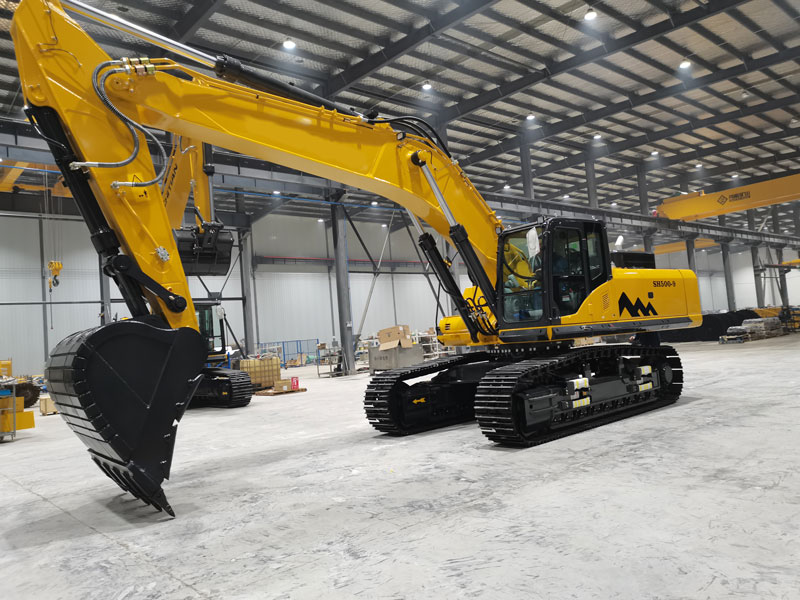
- Haul truck model and bed side height: determines whether dump height is sufficient.
- Face width and truck turning space: related to tail swing radius and overall width.
- Bench height and ramps: the data gives gradeability of 70% (35°), but usable slope also depends on ground traction and load distribution, which must be confirmed on site.
- Transport to site: overall transport dimensions and weight must be checked with the carrier; the data does not cover disassembly and transport plans.
Confirmation checklist to bring back before purchase
Based on the above data, this 50-tonne crawler excavator can be one of the candidate machines for high-volume earthmoving and truck loading and heavy-duty mining work. Whether it is suitable still depends on whether the following information can be established:
- Material type and condition: hard rock, blasted stone, dense clay or loose material, which determines whether the digging force and bucket capacity combination is reasonable.
- Attachment configuration: the data lists a bucket capacity range but does not state the specific bucket type and tooth configuration for each capacity; confirm with the supplier.
- Haul truck matching: bed height, volume and parking method affect dump height and swing angle.
- Site conditions: ground bearing capacity, ramps, face dimensions and rainy-season effects; figures such as ground pressure 81.9 MPa in the data must be judged against the site.
- Shift pattern and continuous operation intensity: the specific applications of the three working modes, maintenance intervals and spare parts supply are not detailed in the data; request the manual or service information separately.
- Power and emissions compliance: the engine configuration must be checked against the project location's emissions and market-access requirements.
When requesting a quote, provide the material type and estimated volume, haul truck model, face layout drawing, site ramps and bearing conditions, daily shifts, and attachment and bucket capacity preferences, so the supplier can give a verifiable configuration description. All parameters cited in this article come from the public product data on this site and do not include measured productivity, fuel consumption or customer-use conclusions.