






















When replacing a diesel dozer with a battery-electric one, buyers rarely ask "can it push?" but rather "can it push for a full shift?" These two questions draw on different sources: the first depends on motor power and hydraulic configuration, while the second depends on battery capacity, charging conditions, and work organization. A 272 hp electric dozer can approach a diesel dozer of the same horsepower class in terms of power, but whether full-shift operation is feasible depends on whether the remaining charge can last until the charging window, how long that window is, and whether usable power supply conditions exist on site. The following, based on verified information for a battery-electric medium dozer, explains the assessment sequence and the items that still require on-site confirmation.
First, break "a full shift" into three verifiable quantities
"A full shift" is not an equipment specification but a work arrangement. To determine whether an electric dozer can replace a diesel one, at least three things must be put on the table: actual operating hours per shift, acceptable downtime for charging within the shift, and the charging power available on site. All three come from the project itself, not from equipment data, yet they determine whether the equipment specifications are meaningful.
- Operating hours: net pushing time from entry to shift end, excluding waiting for materials, relocation, and breaks.
- Charging window: whether the machine is allowed to stop for charging during lunch breaks, shift handovers, or at night, and for how long.
- Power supply conditions: whether the site has a power source and interface that can meet DC fast-charging power requirements.
Until these three are determined, any range assessment is only an estimate. The data also does not provide continuous operating hours on a full charge, energy consumption per unit of earthwork, or driving range, so it is not possible to directly convert "how many hours a machine can push."
Power side: what 272 hp and a 200 kW motor indicate
This battery-electric medium dozer uses a 200 kW (272 HP) permanent magnet synchronous motor for drive, with stable torque of 200 Nm; the travel motor controller supports 210 kW power and 800 AAC current. The hydraulic system is independently driven by a 50 kW (68 HP) permanent magnet synchronous hydraulic motor with 280 Nm torque, paired with a 100+65+25 triple gear pump and standard working pressure of 30 MPa.

These data answer only one question: in terms of power configuration, it is a medium dozer in the 272 hp class, with the main motor and hydraulic motor separately driving travel and work equipment. They cannot answer full-shift range, nor can they indicate actual hourly output for a given material type and pushing distance. Pushing efficiency depends on material density, pushing distance, ground conditions, and operating organization, all of which require on-site measurement; the data does not provide corresponding values.
Battery side: how to use 423.94 kWh
The energy storage configuration given is a 614.2 V, 690 Ah, 423.94 kWh lithium iron phosphate battery pack with an intelligent BMS management system. The value of this figure for procurement decisions lies not in whether it is "large" or "small," but in that it determines the upper limit of the charging interval: the larger the battery capacity, the longer the operating time that can be arranged between two charges; however, how long it actually lasts still depends on load intensity and auxiliary power consumption.
What is easily overlooked is auxiliary load. The machine's thermal management system includes 8 kW compressor cooling, 2.5 kW fresh air cooling, and 10 kW electronically controlled air conditioning; the liquid cooling system is a 45 kW plate-fin radiator with a 400 W PWM water pump, plus battery heating and low-voltage circuit auxiliary power. Under high or low temperature environments or during long periods of air conditioning operation, these loads consume battery power along with the main motor. The data does not provide the power consumption proportion of each load, so they can only be recorded during on-site measurement and cannot be pre-converted into a range reduction factor.

Charging side: what on-site conditions 2×250 A DC fast charging corresponds to
The data states that the machine supports 2×300 kW battery interfaces, 2×250 A DC fast charging, and 2×400 kW DC discharge. This can be understood on two levels: first, the vehicle side has dual high-current fast-charging interfaces; second, to achieve this charging speed, the on-site power source, charging equipment, and cables must match the corresponding power. Vehicle support for fast charging does not mean the existing on-site power source can provide fast charging.
If the site can only provide lower-power charging conditions, charging time will be significantly extended, and charging originally planned for the lunch break may encroach on operating time. Therefore, at the selection stage, "charging power" should be treated as an input condition alongside battery capacity, rather than being resolved after the equipment arrives on site.
| Check item | Information provided | Content requiring on-site confirmation |
|---|---|---|
| Energy storage | 614.2 V, 690 Ah, 423.94 kWh lithium iron phosphate | Actual power consumption per shift and method for recording remaining charge |
| Charging interface | 2×250 A DC fast charging, 2×300 kW battery interfaces | On-site power capacity, charging equipment power, interface and cable matching |
| Auxiliary power | Cooling, air conditioning, battery heating, and other systems | Actual impact during high/low temperature seasons and air conditioning use duration |
| Work organization | Not covered in the data | Shift division, charging window length, backup equipment arrangements |
Which scenarios are more suitable for prioritizing this type of equipment
The data points the application scenarios of this 272 hp battery-electric medium dozer toward urban municipal construction, environmental protection projects, green mines, and indoor low-noise demolition projects with strict low-carbon requirements, and also mentions suitability for equipment rental and green low-carbon construction projects. Combined with zero emissions, low noise, and modular power-hydraulic design, this can be understood as: only when the project has clear restrictions on emissions and noise, and the site has or can build charging conditions, does this type of equipment have a basis for discussing "replacing diesel."
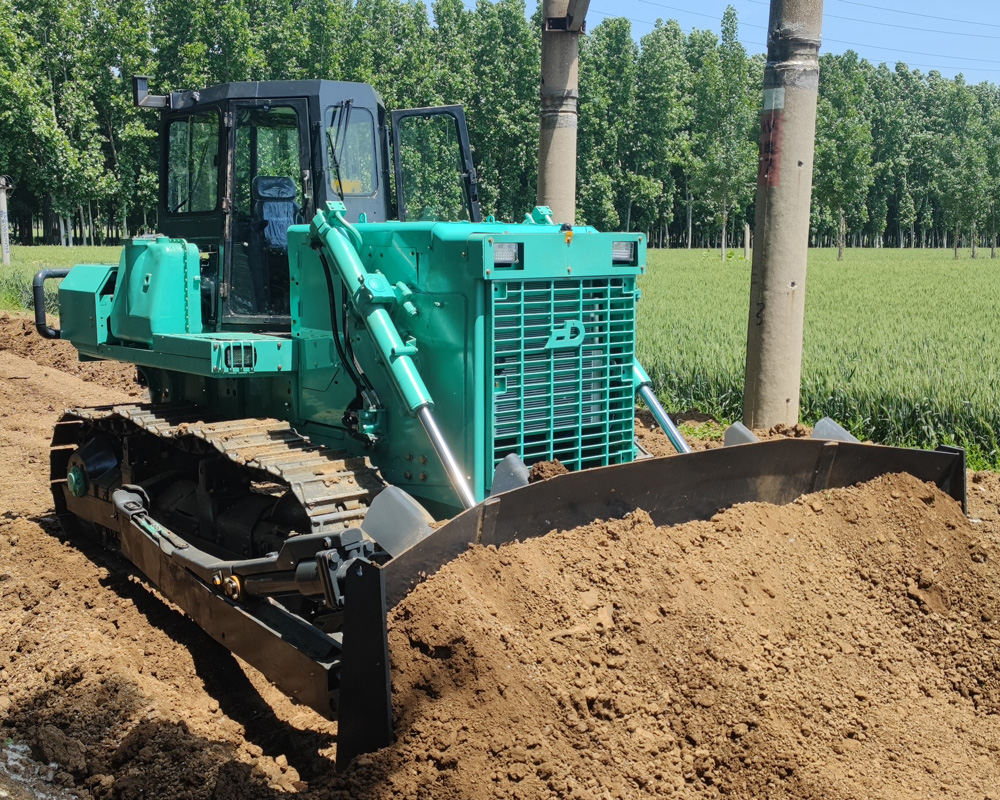
Conversely, if the site is in the field far from a power source, has long continuous operating hours per shift with no fixed charging window, or requires frequent cross-area relocation, then the difficulty of organizing charging for a battery-electric solution will become a constraint before equipment performance does. This does not mean the equipment cannot go there, but that these conditions need to be addressed item by item before procurement; one cannot assume that the refueling rhythm of a diesel machine can be transferred directly to electric equipment.
Items still requiring confirmation with the supplier before procurement
- Actual operating time on a full charge: not provided in the data; requires calculation or trial-run records based on the project's materials and pushing distance.
- Battery performance in low and high temperature environments: the data mentions that thermal management supports stable operation in extreme temperature regions, but does not give specific temperature ranges or range changes.
- Who provides charging equipment, interface standards, and on-site distribution capacity: the data only describes vehicle-side interface capability and does not cover charging station support.
- Maintenance arrangements: the data mentions that power and hydraulics use modular design to simplify routine maintenance, but does not give maintenance intervals or high-voltage system service conditions; follow the manual and supplier requirements.
- Safety protection: the data lists configurations such as insulation monitoring, high-voltage shielded cables, and waterproof connectors; operation and maintenance must still follow manufacturer procedures, and high-voltage components must not be modified without authorization.
When requesting a quotation, it is recommended to provide: pushing material and density, operating hours per shift and pushing distance, site power supply conditions and allowable downtime for charging, whether air conditioning or low-temperature starting is needed, and blade and track configuration requirements. These determine not only whether to choose an electric dozer, but also whether the charging plan should be planned together with the equipment.