






















Whether a large crawler excavator can enter a mine is often not limited first by how fast it can dig, but by whether it can get in, stand stably, and turn freely. Mine haul roads, bench widths, dumping platforms, and temporary parking areas differ from ordinary earthwork sites. Once the equipment exceeds site conditions, even the strongest digging and loading capacity becomes unusable. This article uses a 55.9-tonne crawler excavator selected on this site as an example to explain which load-bearing and transport boundaries should be defined before entry, and which parameters can only serve as clues for judgment and cannot be directly treated as passage permits.
First distinguish two types of boundaries: can it travel and can it stand stably
“Can it travel” concerns road and turning conditions: whether the overall width, transport length, tail swing radius, and minimum front swing radius can pass through curves, narrow sections, and passing bays on mine roads. “Can it stand stably” concerns ground bearing and slope: whether the ground beneath the tracks can support the machine's total weight when it stands on a working face or dumping platform, and whether slopes and wet surfaces introduce additional risks.
These two types of boundaries must be checked separately. One favorable field does not mean the overall conditions are satisfied. The model data discussed in this article provides operating weight, ground pressure, overall dimensions, gradeability, and traction, which can be used to form a checklist, but cannot replace site surveys and manufacturer confirmation.
Load-bearing side: what operating weight and ground pressure each indicate
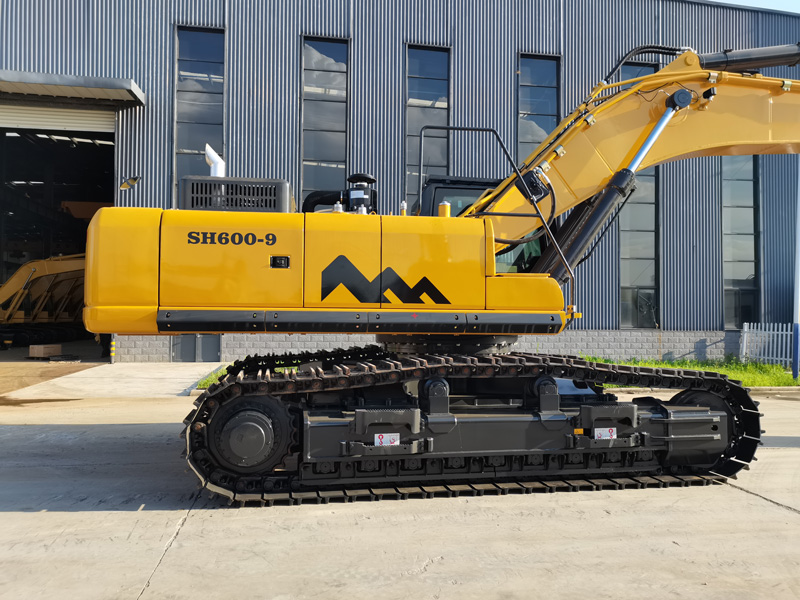
The machine has an operating weight of 55,900 kg, ground pressure of 85.3 kPa, track shoe width of 600 mm, 9 track rollers per side, and 2 carrier rollers per side. Operating weight determines the total load the ground must bear; ground pressure reflects the extent to which this weight is distributed over the track contact area. Both must be considered together: for the same total weight, different track shoe widths and contact lengths produce different pressure on the ground.

At a mine site, this means checking the actual condition of the working face, haul roads, and dumping point ground. Loose overburden piles, uncompacted backfill areas, and platforms softened by rain have different support capacity from compacted hard rock platforms. The 85.3 kPa in the data is a static indicator and cannot be directly used to conclude that a certain ground “will definitely support” the machine; actual soil type, moisture condition, slope, and whether the equipment is swinging under load all change the actual forces. This part requires on-site confirmation.
Transport side: how overall dimensions and swing radius correspond to road conditions
The machine has an overall length of 10,252 mm, track contact length during transport of 4,414 mm, overall width of 3,718/4,154 mm, overall height to cab top of 3,379 mm, tail swing radius of 3,822 mm, and minimum front swing radius of 4,840 mm. These figures correspond to different aspects of entry planning:
- Overall width determines the overwidth assessment after loading onto a transport vehicle and whether narrow sections of mine roads allow vehicles to pass each other;
- Overall length and track contact length during transport affect flatbed trailer selection, loading/unloading site length, and turning sweep space;
- Tail swing radius and minimum front swing radius affect whether there is sufficient margin when the machine swings at bench edges, dumping points, and narrow working faces;
- Overall height affects clearance under culverts, overhead pipelines, and conveyor galleries during transport.
The data provides two overall width values, indicating that width may differ under different configurations or transport states. Which state will be used for entry and whether the work equipment will be removed must be confirmed item by item with the supplier and transport contractor; one figure alone cannot be used as the basis for passage.

Slopes and traction: applicable limits of the gradeability field
The machine's rated gradeability is 70% (35°), traction force is 349 kN, and travel speed is 3.55/6.1 km/h. Gradeability is usually an overall machine capability indicator under specific test conditions and is not equivalent to “safe passage with full load on any 35° slope.” Whether an actual slope is usable also depends on road surface material, wetness, load, slope length combined with curves, and site requirements for equipment stability.
Therefore, this field is more suitable for judging whether fixed mine ramps fall within the equipment's capability range, rather than for promising that a temporary haul road is passable. If the mine has long-distance uphill hauling under load, combined curves and slopes, or muddy sections after rain, the road longitudinal slope, pavement structure, and turning radius should all be submitted to the supplier for confirmation.
Put digging and loading capacity into the same checklist
Only after the load-bearing and transport boundaries are confirmed does the question arise whether digging and loading capacity matches the mine's materials and production schedule. The data for this machine gives a bucket capacity of 2.5–3.5 m³, bucket digging force of 328 kN, stick digging force of 271 kN, maximum digging depth of 7,114 mm, maximum dumping height of 7,150 mm, and maximum digging radius of 11,406 mm. These fields can be used to judge whether it can cover the mine's bench height, truck body side height, and overburden advancement method, but specific production rates, cycle times, and matched truck numbers still depend on material condition, blast fragmentation, working face organization, and operator skill. The data does not include measured values under these conditions.
| Check area | Data fields | Corresponding site questions |
|---|---|---|
| Ground bearing | Operating weight 55,900 kg, ground pressure 85.3 kPa, track shoe width 600 mm | Whether ground conditions at the working face, roads, and dumping platform allow the machine to stand and travel |
| Transport passage | Overall length 10,252 mm, overall width 3,718/4,154 mm, overall height 3,379 mm | Whether flatbed trailer selection, narrow road sections, clearance, and loading/unloading sites are adequate |
| Swing space | Tail swing radius 3,822 mm, minimum front swing radius 4,840 mm | Whether safe margins exist for swinging at bench edges, passing bays, and dumping points |
| Slope conditions | Gradeability 70%, traction force 349 kN | Whether slopes, road surfaces, and load conditions of fixed ramps and temporary haul roads are within capability |
Items still requiring supplier confirmation before entry
- What configuration or transport state each of the two overall width values corresponds to, and which state will be used for entry;
- Transport dimensions and weight after removing the work equipment, and whether additional lifting equipment is required;
- Test conditions for the ground pressure indicator and whether on-site ground types are within the manufacturer's recommended range;
- Road surface conditions and load requirements corresponding to the gradeability rating;
- Effects of mine altitude, temperature, dust, and other environmental conditions on equipment configuration;
- Maintenance requirements and inspection items for the hydraulic system, engine, and undercarriage under continuous heavy-duty operation, with reference to the accompanying manual.
The data does not provide complete answers to these items. Written confirmation from the supplier should prevail before purchase; parameter tables alone should not be used for inference.
Conditions to provide together when requesting a quotation
If preparing to request a quotation for a mine digging and loading task, it is recommended to also provide: mine material type and blast fragmentation, bench height and daily production schedule, slopes and road surface conditions of the working face and roads, entry road width and clearance restrictions, flatbed transport conditions, shift organization, and whether specific work equipment is required. Only then can the supplier judge whether a crawler excavator of this class falls within the applicable range and provide matching configuration details. Product page for reference: 55–60 tonne crawler excavator.