






















Municipal road subgrade compaction is often carried out layer by layer: lower fill, upper fill, and locally trench backfill and around inspection wells. If equipment procurement only asks 'what tonnage is suitable,' it is difficult to match the on-site rhythm. A more feasible approach is to first break down the compaction target into several verifiable equipment conditions, then match the whole machine parameters item by item.
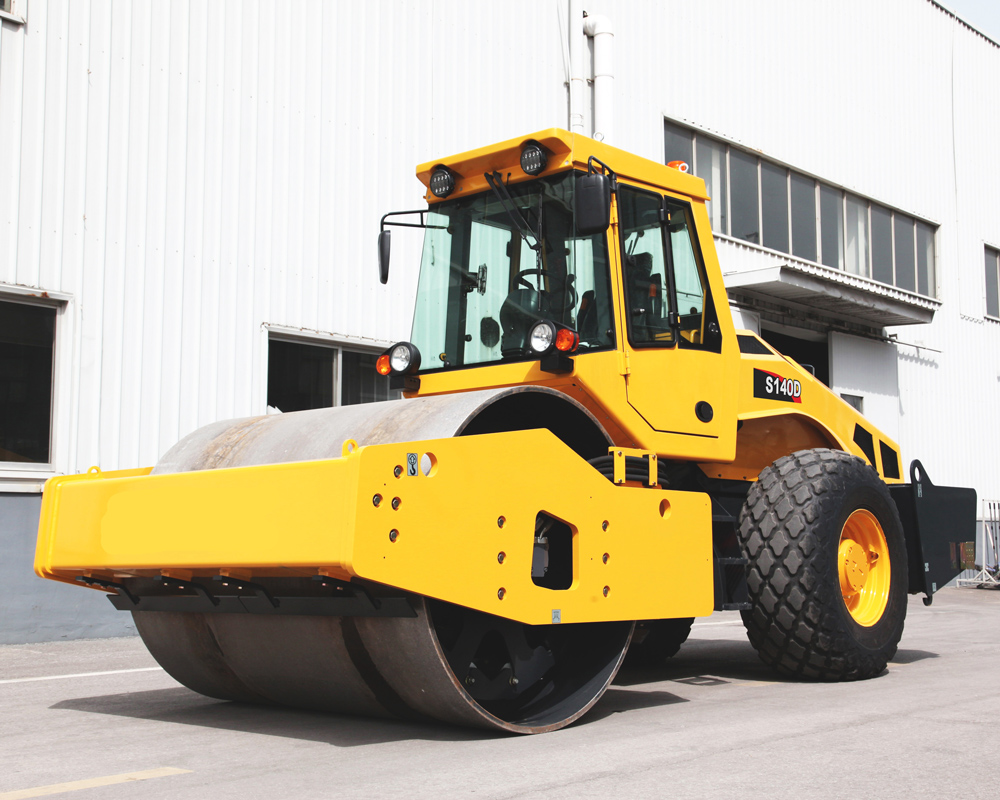
The following uses verified data of a 14-ton class single drum vibratory roller as an example to illustrate this decomposition method. The 'assumed scenario' in the text is only for explaining the judgment logic and does not represent any actual project.
Item 1: Layer thickness and material determine the required compaction energy
The core constraints of subgrade layered compaction are single layer thickness and fill type. The thicker the layer and the coarser the fill, the higher the compaction energy required; thin layers with more fine-grained material rely more on the number of passes and uniformity. The corresponding fields available on the equipment side are operating weight, linear load, and centrifugal force.
The machine has an operating weight of 14,000 kg, static linear load of 390 N/cm, vibration frequency of 28/32 Hz, centrifugal force of 325/200 kN, and amplitude of 2.2/1.1 mm. This set of data indicates it has a combination of two frequency levels and two amplitude levels: high frequency with small amplitude and low frequency with large amplitude are respectively aimed at different stages of compaction needs. Which level to use for a specific layer is not given in the data in relation to material and thickness; it must be determined by the construction party based on test section results and cannot be concluded directly from the parameter table.

Item 2: Compaction stage determines how vibration parameters are configured
Subgrade compaction is usually divided into initial compaction, secondary compaction, and final compaction, and some projects also include static rolling for surface finishing. The same machine plays different roles at different stages, so 'whether it has dual frequency and dual amplitude' is more worth confirming first than 'what is the maximum centrifugal force.'
- When higher energy is needed, low frequency with large amplitude is an optional direction;
- When approaching surface finishing or when surface flatness is sensitive, high frequency with small amplitude is more often discussed;
- Whether static rolling for surface finishing is undertaken by this machine depends on whether the equipment supports traveling with vibration off; the data does not clearly state this, and it needs to be verified with the supplier.
A common misconception should be avoided here: interpreting the two parameter levels as 'automatic matching for any soil layer.' Parameters are only a capability range; the actual level selection still depends on fill, moisture content, and test section results.
Item 3: Work area width determines drum width and travel route
Municipal road subgrade work areas are often restricted by enclosures, pipeline well locations, and temporary traffic, and the width is not always the full width. The machine's drum width is 2,130 mm, and overall width is 2,290 mm. The difference between drum width and overall width relates to the operable range when approaching curbs, manhole covers, and enclosures.

Assume a certain subgrade section has an effective width of about 6 meters; a 2,130 mm drum roughly requires three overlapping strips for coverage, and the overlap amount, round-trip route, and staggered wheel arrangement must be planned before entering the site. If the work area is divided into narrow strips by inspection wells, the coordination between drum width and turning radius becomes more critical—the machine's turning radius is 6,330 mm, which is an overall dimension requiring reserved turning space. Whether narrow sections are suitable for this machine should be calculated based on the site plan.
Item 4: Transfer and shifts determine mobility requirements
The machine's speed range is 0–9 km/h, and gradeability is 50%. Municipal road construction often involves multiple transfers within the same contract section; the speed range and gradeability correspond to short-distance self-propelled transfer and slope entry/exit capability, not long-distance highway travel. If flatbed truck transport is required between contract sections, the overall dimensions of 6,200×2,290×3,150 mm directly affect transport vehicle selection and verification of height and width limits along the route.
Regarding shift arrangements, the data gives a 111 kW engine meeting EU Stage V/ Euro 5 emissions, but does not provide fuel tank capacity or fuel consumption data. Continuous operation duration, refueling frequency, and whether a backup machine is needed can only be listed as items to be confirmed and should not be inferred from power figures.
| Site condition | Corresponding equipment field | Verification point |
|---|---|---|
| Layer thickness and fill | Operating weight, linear load, centrifugal force | Determine level based on test section; parameters do not replace process testing |
| Compaction stage | Dual frequency and dual amplitude, vibration start/stop | Static rolling surface finishing capability needs supplier confirmation |
| Work area width | Drum width, overall width, turning radius | Calculate overlap and turning space |
| Contract section transfer | Speed range, gradeability, overall dimensions | Long-distance transport requires a separate flatbed truck |
What this decomposition can and cannot conclude
After decomposing according to the four items above, it is possible to preliminarily judge whether a 14-ton class single drum vibratory roller covers the project's layer energy demand, work area width, and transfer conditions. However, it cannot answer 'how many passes are qualified for compaction'—the number of passes depends on fill, moisture content, underlying layer strength, and test section results; nor can it answer 'how much fuel is consumed' or 'how many square meters can be compacted per shift.' These data are not provided and need to be verified during inquiry and testing stages.
In addition, single drum vibratory rollers are mainly aimed at subgrade and fill layer compaction. If the project includes asphalt surface layers, dual drum or pneumatic tire equipment belongs to another construction method and cannot be judged by the parameters in this article.
Information items recommended to prepare before inquiry
- Fill type, design layer thickness, and compaction degree requirements for each layer;
- Contract section plan drawing, marking well locations, enclosures, and effective work width;
- Daily planned compaction area and shift arrangements;
- Transfer distance between contract sections and whether flatbed transport is required;
- Whether the machine needs to also handle static rolling surface finishing, and local emission stage requirements.
Write these items into the inquiry document so that suppliers can give targeted responses on drum width, vibration configuration, and transport dimensions, rather than just quoting a tonnage.