






















When you turn to the spec sheet of a landfill compactor, crushing width and compaction capacity are often the two most prominent fields and the easiest to take out of context. But looking at these two numbers alone, you can neither judge whether the machine can adapt to the spreading rhythm of a given landfill nor judge whether it can compact waste to the expected density on site. The problem is that these two fields answer questions at different levels and need to be read together within the sequence of landfill operations.
First, clarify: what each field answers
Crushing width corresponds to the lateral range a compactor can cover in one pass, and it affects the organization of the working strip width and travel routes. Compaction capacity is a range value, usually expressed in tons per cubic meter in the specifications, describing the degree of compression the equipment may achieve under specific material and layer conditions. What they have in common is that both are conditional indicators—apart from spreading thickness, material composition, moisture state, and number of passes, citing either one alone can easily lead to misjudgment.
In other words, crushing width determines "how wide one pass is," while compaction capacity describes "to what degree it can compact under suitable conditions." The former relates to how travel routes and working faces are arranged on site, while the latter relates to whether the landfill's management target for waste body density can be achieved. Neither directly equals construction efficiency, nor does either directly mean the equipment is necessarily suitable for a given site.
Taking the specifications of a 23-ton compactor as an example
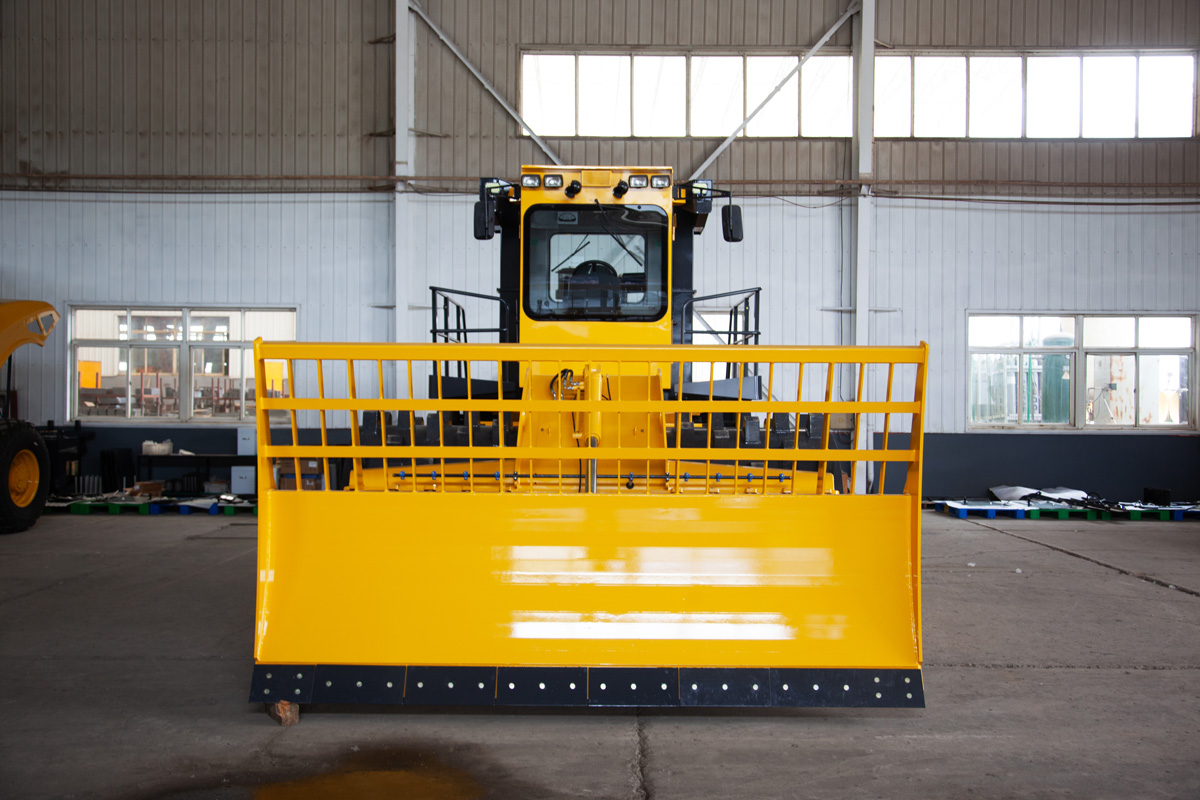
In the product information on this site, the C230H landfill compactor has a crushing width of 3430 mm, a compaction capacity rated at 0.35 to 0.9 tons per cubic meter, an operating weight of 23000 kg, a minimum ground clearance of 490 mm, a blade height of 1880 mm, a maximum speed of 11 km/h, overall dimensions of 8100 × 3500 × 3670 mm, and a 192 kW engine. The information also states that it is suitable for municipal solid waste landfill compaction, waste crushing, waste reduction, and solid waste treatment projects.

Looking at these fields together, several preliminary judgments can be formed, but each comes with conditions:
- A crushing width of 3430 mm means a relatively wide coverage per pass, so landfill cells with wider working faces can reduce the number of turns, but the actual route still depends on the spreading direction and cell division.
- The compaction capacity range of 0.35 to 0.9 tons per cubic meter is quite wide, indicating that the compression effect is highly related to material, layer, and number of passes, and the upper limit should not be taken as the default result for routine operations.
- The minimum ground clearance of 490 mm is related to the bearing capacity of the landfill surface and the form of waste accumulation, but the information does not give clear boundaries for slope travel or soft ground conditions, which need to be verified on site.
- The 192 kW engine power corresponds to the overall power configuration of the machine and cannot be used to infer fuel consumption or throughput per unit time.
It should be noted here that the compaction capacity range given on the spec sheet is not a promised value. It is more like a hint: the equipment has a certain range of compression capability, and where it actually falls depends on whether the spreading thickness is controlled, whether the waste composition is uniform, whether the number of passes is sufficient, and whether the site bearing capacity is stable.
Why it cannot be read like an ordinary road roller
Roadbed compaction deals with soil or stabilized materials, where layer thickness and moisture content are relatively controllable, and the relationship between the compaction equipment and the material being compacted is relatively definite. Landfill compaction faces municipal solid waste with highly variable composition, where crushing, compression, and volume reduction often occur simultaneously, and the structure of the compaction wheels and the overall machine protection also differ from those of road rollers. Therefore, understanding crushing width as steel wheel width and compaction capacity as a fixed increase in density would deviate from the actual meaning of these two fields in the landfill context.

Articles on this site have already discussed the differences in selection logic between landfill compactors and roadbed rollers, so this is not repeated here. The point to emphasize in this article is that the fields on the spec sheet need to be read within the landfill operation sequence—spreading comes first, crushing and compression follow, and compaction capacity describes the range of results that may be achieved in this sequence.
Reading order for specifications: conditions first, then values
If you read the spec sheet item by item from top to bottom, it is easy to treat crushing width and compaction capacity as isolated indicators. A more reasonable order is:
- First confirm the equipment category and applicable scenario description to determine whether it is intended for landfill compaction and waste reduction rather than road compaction.
- Then look at the operating weight and overall dimensions to determine whether transport and site entry conditions are met.
- Then understand crushing width in the context of working face width and travel routes, and understand compaction capacity in the context of spreading thickness and number of passes.
- Finally, check the power configuration, ground clearance, and protection-related fields to determine whether the site bearing capacity and working environment require further confirmation.
This order cannot replace a site survey, but it can prevent treating a single value as the decisive basis in the early stage of procurement.
Items still to be confirmed before purchase
Based on the available information, the following points are not covered by the spec sheet and need to be verified with the user or on site:
- The landfill's daily processing scale and working face width, used to judge whether the travel route corresponding to the 3430 mm crushing width is reasonable.
- Waste composition and the method of controlling spreading thickness, which directly affect where the actual value falls within the 0.35 to 0.9 tons per cubic meter compaction capacity range.
- Site bearing conditions and slope travel requirements; the information gives a minimum ground clearance of 490 mm but does not specify the specific boundaries for climbing or soft ground.
- Shift arrangements and transport conditions; the overall dimensions and maximum speed are known, but the entry route, turning radius, and unloading area need to be checked separately.
- Protection configuration and maintenance inspection items, which should be determined according to the accompanying manual and on-site safety management requirements.
If these conditions are not yet clear, crushing width and compaction capacity can only serve as preliminary screening criteria, and it cannot be concluded that "this machine is suitable for this landfill." The selection judgment should be made after aligning the equipment fields with the site conditions item by item.
Conditions to provide when requesting a quotation
If you enter the inquiry stage, it is recommended to provide the following at the same time: the landfill's daily processing volume and working face width, waste composition and the method of controlling spreading thickness, site bearing and slope conditions, shift arrangements, transport and entry routes, and whether specific protection configurations are required. The specific configuration of the compaction wheels and overall machine protection should also be confirmed, because the crushing width and compaction capacity on the spec sheet do not cover these details.