






















When a site is cut by fencing down to a single access lane, the stockpile is only a few dozen meters from the backfill area, and the corners still need to be graded, such tasks are often placed directly in the category of “work a small dozer should handle.” But what really determines whether a machine can be used is not the word “small,” but whether several specific conditions can be met at the same time: whether the overall dimensions can pass through the access lane, whether there is enough space for turning, whether the bearing capacity of the undisturbed ground can support the crawler ground pressure, and whether the blade is the main tool in a push cycle. Only after these conditions are listed clearly is it meaningful to look at equipment data.
First, break “narrow site” into four verifiable constraints
Narrowness is not a condition that can be uniformly quantified. For the same machine, leaving turnaround space at the edge of a stockyard and being able to push only in one direction in a gap between buildings are completely different working methods. At the preparation stage, it is advisable to confirm at least the following four items:
- The minimum clear width of the access lane and the height of entrances and exits, and whether the overall machine dimensions are allowed to pass;
- Whether the machine can turn or reverse out at the end of the push, or can only push in one direction and then reverse back;
- Whether the working surface is undisturbed soil, backfill, or existing hardened ground, which directly affects whether crawler ground pressure is controllable;
- Whether, in addition to the blade, the machine also handles auxiliary work such as ripping and towing, which determines how rear attachments should be configured.
If any one of these four items is not met, it cannot be solved by “switching to a machine one size smaller”; it may require adjusting the process or changing the work organization. The following section uses verified data for one small crawler dozer to explain the correspondence between these constraints and equipment parameters.
Overall dimensions correspond to access conditions, not to “small”
Taking the SD10 small dozer as an example, its overall dimensions are 4400×2960×3030 mm, and its operating weight is 10000 kg. The purpose of these figures is not to compare which machine is smaller, but to answer “can it get onto the site.” In the width direction, both the 2960 mm blade width and the outer edges of the crawlers must be considered; if there are temporary supports, drainage ditches, or cable trays along the access lane, additional clearance must be allowed.

The length direction is equally important. An overall length of 4400 mm means that a section of reversing or turning space is needed at the end of the push, and it cannot be judged simply by whether the body length exactly equals the lane length. If the site layout involves one-way pushing and returning along the same route, it is necessary to assess whether such repeated movements will lengthen the work cycle.
The correspondence between ground pressure and ground bearing capacity
The data gives a track shoe width of 450 mm and a ground pressure of 54.4 kPa. Ground pressure is an important reference for assessing passability on soft ground, but conclusions cannot be drawn from it alone. The moisture state of undisturbed soil, the degree of compaction of the backfill layer, and the depth of surface softening after rain will all change actual bearing performance. The same machine does not perform the same way on dry compacted fill as on freshly placed, uncompacted loose soil.
If the site has already been hardened, crawler ground pressure is usually not the main constraint; if the working surface is soft backfill or soft ground during the rainy season, it is necessary to confirm in advance whether the ground pressure matches the ground bearing capacity. The data does not provide passability data for this model under various soil types, so it should not be inferred from it that the machine can operate normally under any soft-ground conditions. A feasible approach is to treat site soil type, moisture state, and the intended track shoe width together as conditions to be checked during quotation and before mobilization.

What power and transmission type mean for narrow-site work
This model uses a mechanical transmission, 4F+2R, with forward speeds of 2.6–10.4 km/h and reverse speeds of 3.7–6.7 km/h. In working conditions that involve repeated forward and reverse movement on narrow sites, the gear and speed ranges determine the operating rhythm: low gears are used for working close to corners and for precise pushing, while higher speed gears are used for short hauling over longer distances. This is not to say that mechanical transmission is suitable for all scenarios, but only to show that gear configuration is closely related to how the work cycle is organized.
The engine is a 4BT3.9-C125 diesel engine with a rated power of 81 kW (125 HP)/2300 r/min and a maximum drawbar pull of 95 kN. Power and drawbar pull data can help judge the range of pushing resistance it is suitable for, but how fast it can actually push and how much it can move per unit time still depend on material density, push distance, and operating method. The data does not provide measured data on efficiency or fuel consumption, so productivity should not be calculated from it.
What blade and rear attachments correspond to
The blade dimensions are 2960×960 mm, with a maximum lift height of 830 mm and a maximum digging depth of 350 mm. Straight, curved, and coal blades are available. For the rear, either fixed towing equipment or a three-shank ripper can be selected. These options correspond to different uses: site grading and short-distance pushing place more emphasis on blade width and penetration control; pushing bulk materials such as coal places different requirements on blade shape; and the ripper is used to handle hard layers that need to be loosened. When choosing, all options should not be treated as “standard advantages”; instead, trade-offs should be made according to the actual material and process.
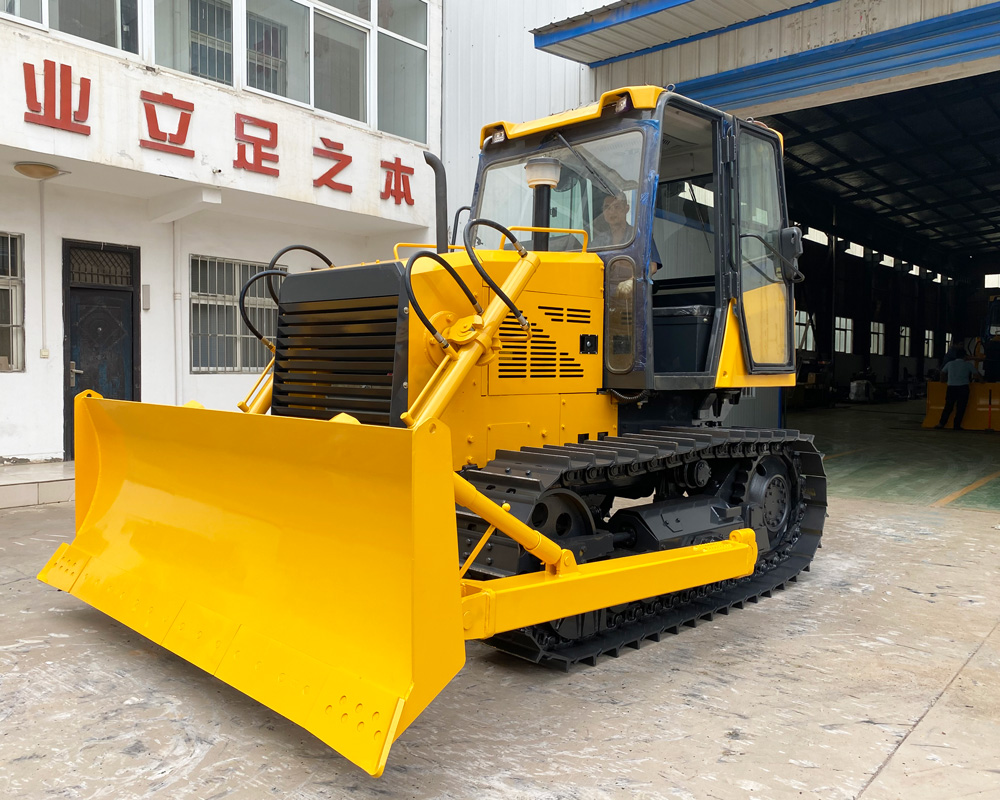
It should be noted that the data does not provide information on this model’s pushing efficiency under different materials, slope-working capability, or passability on wet ground. If the working surface includes slopes, soft ground with long-term standing water, or hard interlayers, these are all conditions that should be separately confirmed before mobilization and cannot be directly inferred from the existing parameters.
Checklist recommended before purchase
- Material type and moisture state of the working surface, and whether ripping is needed first;
- Range of push distances and whether site grading is also required;
- Minimum clear width of the access lane, turning space, and the transport method for machine entry and exit;
- Single-shift operating duration and on-site fuel supply conditions;
- Blade model and rear attachment requirements, and whether the machine is used only for pushing or also for towing and ripping;
- Ground bearing conditions, and, where necessary, verification of ground pressure adaptability using measured data or supplementary survey data.
The value of a small dozer on a narrow site lies in matching overall dimensions, ground pressure, and blade configuration within the same set of working conditions, rather than simply understanding it as a lower-spec version of a medium machine. The above data only covers the basic geometry, power, and undercarriage parameters of this model. Whether it is suitable for a specific project still needs to be confirmed item by item in light of material, site bearing capacity, transport conditions, and shift arrangements.