






















Continuous truck loading is not the repetition of a single motion. Swing, boom lift, arm retraction and bucket rotation often occur simultaneously, and the hydraulic system must distribute flow among different loads while avoiding excess pressure loss. Looking only at bucket capacity or digging force can easily lead to overlooking the influence of the hydraulic circuit on loading rhythm. This article focuses on "what load-sensing hydraulics means in continuous truck loading" and explains the basis for judgment and its boundaries using only verified information.
What requirements does continuous truck loading place on the hydraulic system
During the loading cycle, the operator usually expects swing to complete in sync with boom and arm motions. If the hydraulic system cannot distribute flow according to the actual load of each actuator, combined motions may interfere with one another. On the other hand, during stages such as empty-bucket swing and light-load lowering, the load is low; if pump output still maintains high pressure and high flow, energy is consumed in the form of throttling loss.
Therefore, when discussing load-sensing hydraulics, two points are actually of concern: first, whether flow can be distributed on demand during combined motions; second, whether system pressure can decrease with load during light-load stages. Both points are related to loading rhythm and fuel consumption, but the specific effect still depends on material, operating habits and whole-machine matching.
Basic concept of load-sensing hydraulics
A load-sensing hydraulic system senses load pressure and adjusts pump displacement or pressure so that pump output matches actuator demand. Compared with fixed-pressure or negative-flow control methods, its design intent is to reduce flow loss at neutral or under light load and to maintain the flow distribution relationship among circuits when multiple valves are actuated.

It is necessary to distinguish that load sensing is a hydraulic control method and is not equivalent to electronic control or pure electric power. It describes the regulation logic between pump and valve and cannot be used to infer the machine's power form, fuel consumption values or operating efficiency.
Hydraulic configuration in the product information
Verified information shows that this model adopts a Linde load-sensing hydraulic system, with a pump configuration of 2 variable piston pumps plus 1 gear pump, maximum operating flow of 2×360 + 27 L/min, system pressure of 31.4 MPa, and a Toshiba main valve. The information also lists functions such as the straight travel circuit, boom and swing priority logic, bucket and boom regeneration circuits, and load-holding valves.
| Information field | Verified content | Relationship to truck loading |
|---|---|---|
| Hydraulic system | Linde load-sensing system | Used to explain the design approach of adjusting pressure and flow with load |
| Pump configuration | 2× variable piston pumps + 1× gear pump | Dual-pump flow distribution is related to combined motions |
| Maximum operating flow | 2×360 + 27 L/min | Reflects the flow scale of the hydraulic system, not directly equal to loading efficiency |
| System pressure | 31.4 MPa | Related to actuator pressure capability and must be understood in combination with specific working conditions |
| Main valve functions | Straight travel, priority logic, regeneration circuits, load-holding valves | Involves flow distribution and position holding during combined motions |
The Toshiba main valve functions in the information include boom and swing priority logic, as well as bucket and boom regeneration circuits. The former corresponds to the flow distribution sequence when multiple motions are operated simultaneously, while the latter involves partial reuse of return oil, with the aim of speeding up the corresponding motions. These descriptions are configuration information at the hydraulic circuit level and cannot be directly converted into loading time per bucket or loading volume per hour.

Correspondence with continuous truck loading requirements
In continuous truck loading scenarios, the regulation method of the load-sensing system can be linked to the following requirements:
- Coordination of combined motions: dual variable pumps and main valve priority logic are used to explain the flow distribution approach when swing, boom and arm move simultaneously.
- Control of energy loss during light-load stages: load-sensing regulation causes pump output to change with load; the information describes this as reducing energy waste but does not give a specific fuel-saving ratio.
- Position holding under heavy load: the main valve integrates load-holding valves, which the information states can hold position under pressure; this corresponds to operational stability during loading waits or positioning.
- Switching between travel and operation: the straight travel circuit is used to explain the stability design when travel and upper-structure motions are performed simultaneously.
The above correspondences can only indicate the system design orientation and cannot prove that a certain cycle time will necessarily be achieved at a specific material yard. Loading rhythm is also affected by operator skill, material looseness, transport vehicle positioning and site layout.
Other conditions related to continuous truck loading in the whole-machine information
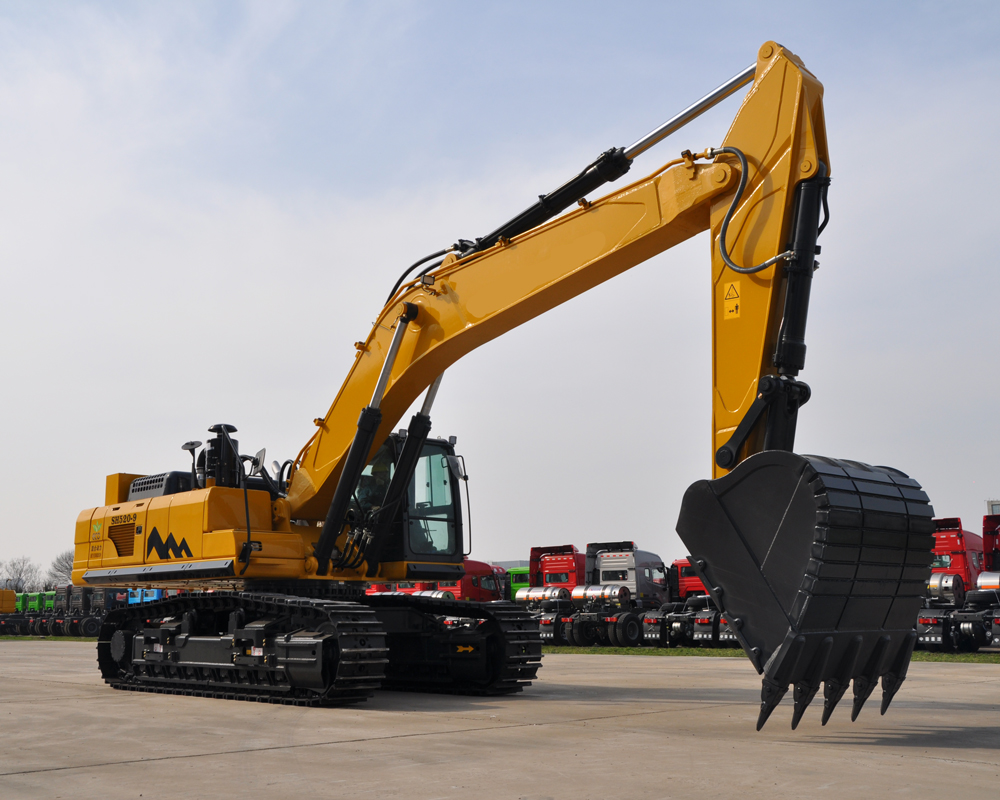
This model has an operating weight of 50500 kg, bucket capacity of 2.5–3.5 m³, bucket digging force of 292 kN, arm digging force of 251 kN, and rated engine power of 280 kW. The information positions it for open-pit mining, large earthworks and high-load operations. Load-sensing hydraulics is only part of the machine's capability; continuous truck loading also requires checking:
- Material type and looseness factor: whether it is hard material or graded material requiring greater cutting force.
- Transport vehicle positioning and swing angle: affects swing time per cycle.
- Site bearing capacity and flatness: determines the stability of machine travel and positioning.
- Shift arrangement and continuous operation duration: involves heat dissipation, hydraulic oil temperature and maintenance arrangements.
The information mentions three working modes, auto idle and synchronized speed control, used to match performance with the task. These functions, together with load-sensing hydraulics, form the whole-machine configuration, but whether they suit a specific project still needs to be judged in combination with site conditions.
Items to confirm before purchase
Load-sensing hydraulics can serve as one inspection point in selection for continuous truck loading, but it cannot replace whole-machine matching judgment. During inquiry and information verification, it is recommended to confirm the following:
- Types, particle sizes and bulk density of the loading materials, and whether crushing or ripping support is required.
- Average daily loading volume, transport vehicle specifications and work shifts, used to assess continuous operation intensity.
- Site layout, swing angle and ground bearing conditions, to confirm whether the machine's operating range covers them.
- Maintenance requirements of the hydraulic system, including filters, oil cleanliness and main valve inspection items; refer to the accompanying manual for specific intervals.
- Power form, emission requirements and on-site fuel or power supply conditions; the information for this model is a diesel engine and should not be confused with pure electric power.
The load-sensing configuration in this model's information can be linked to the requirements for combined motion coordination and energy loss control in continuous truck loading, but there is no verified comparative data on loading capability, fuel consumption or cycle time, so quantitative commitments should not be made on this basis. Actual selection should be based on on-site materials, transport coordination and work organization, with the hydraulic configuration treated as part of the whole-machine judgment.