






















When a project involves both routine earthmoving and soft/wet site improvement, buyers often ask: can the same crawler dozer handle both jobs simply by changing versions? The key is not whether horsepower is sufficient, but whether the ground can support the machine, and whether the undercarriage and blade match the material and site. Using data for a 178 hp mid-size crawler dozer's standard and super wetland versions, this article explains which conditions the version differences hinge on, and what information still requires on-site confirmation.
First, distinguish the equipment requirements of the two job types
Routine earthmoving mainly depends on the ability to cut into material, pushing efficiency, and undercarriage durability. The machine must repeatedly travel, cut, and push on compacted ground or general soil foundations. Ground pressure does not need to be extremely low, but blade cutting force and overall stability must be adequate.
Soft/wet sites are the opposite: the machine must first be able to stand and travel, otherwise even high pushing force is useless. Ground pressure, track shoe width, and weight distribution directly affect sinkage. The two job targets impose different requirements on undercarriage configuration, which is why the same machine is offered in different versions.

Data differences between standard and super wetland versions
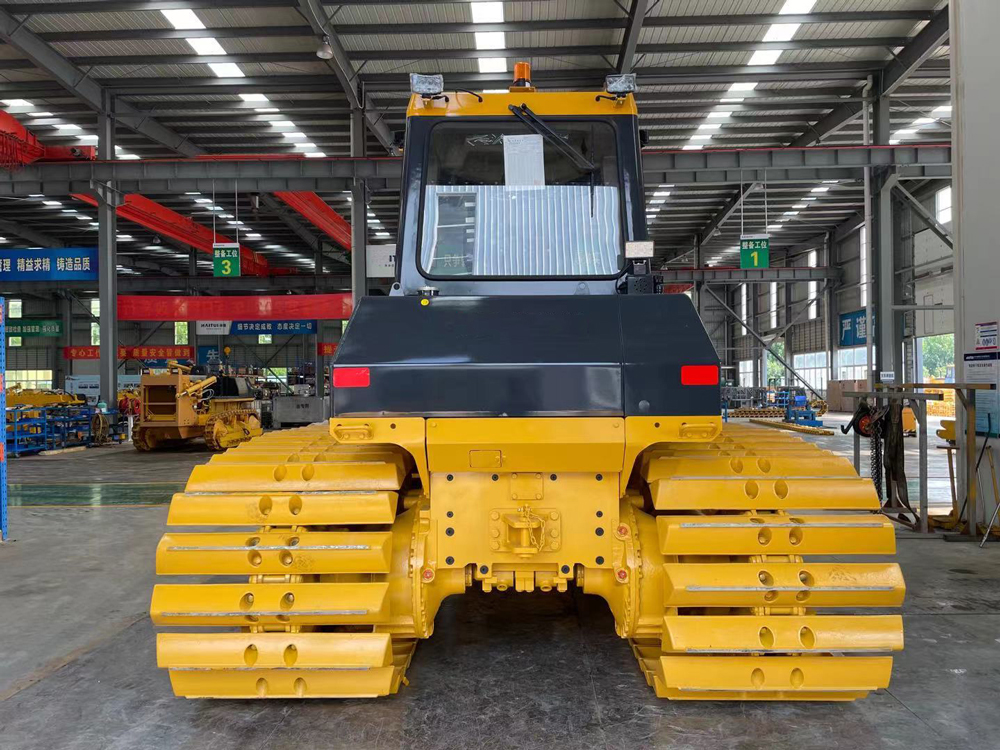
Taking our site's 178 hp crawler dozer data as an example, the standard version has an operating weight of 17,000 kg, ground pressure of 58 kPa, track shoe width of 510 mm, and a standard straight blade, with optional angle blade, U-blade, etc. The super wetland version has an operating weight of 16,900 kg, ground pressure of 22 kPa, track shoe width of 960 mm, uses boat-shaped ribbed wide track shoes, and a straight blade with a width of 4,150 mm.
| Item | Standard version | Super wetland version |
|---|---|---|
| Operating weight | 17,000 kg | 16,900 kg |
| Ground pressure | 58 kPa | 22 kPa |
| Track shoe width | 510 mm | 960 mm |
| Blade type | Straight blade; optional angle blade, U-blade, etc. | Straight blade |
The two data sets show that the super wetland version does not solve soft-ground problems with more power, but reduces ground pressure by widening the track shoes. The standard version has relatively higher ground pressure and is more suitable for earthmoving on ground with some bearing capacity. The operating weights are close, indicating that the differences between the two versions mainly lie in the undercarriage ground-contact configuration, not the power class.
Ground bearing capacity is the first threshold for version selection
If the work surface is compacted soil foundation, gravel site, or treated construction access road, the standard version's ground pressure is usually more readily accepted by the ground; its narrower track shoes also allow more flexible steering and cutting. If the site is swamp, mire, loose wetland, or river improvement area, first confirm whether the machine can travel and work under load; here the super wetland version's low ground pressure and wide track shoes are more targeted.

However, low ground pressure does not mean it can enter any soft ground. The data does not provide the super wetland version's trafficability under different moisture contents or mire depths, nor the allowable maximum sinkage. These must be confirmed by site geotechnical investigation, bearing tests, or construction experience, and cannot be inferred from ground pressure values alone.
Blade configuration should follow material and work sequence
The standard version data lists multiple work implements such as straight blade, angle blade, U-blade, coal blade, rock blade, and sanitation blade, with optional three-shank ripper for breaking clay and frozen soil. This means the standard version offers broader blade adjustment space for general earthmoving, backfilling, and site leveling.
The super wetland version data specifies a straight blade with a width of 4,150 mm. Soft/wet site operations usually focus on pushing, spreading, and site preparation, and the straight blade has corresponding use scenarios. However, if the project also involves extensive hard-soil cutting or frozen-soil breaking, it is necessary to separately confirm whether the super wetland version can be equipped with a ripper and whether the undercarriage is suitable for such load conditions. The data does not list a ripper configuration for this version; buyers should verify directly with the supplier before purchase.
Transport and mobilization conditions cannot be ignored
The two versions have different track shoe widths, which also affects overall transport dimensions. The standard version's machine dimensions are 5,140×3,455×3,024 mm, and the super wetland version's are 5,262×4,150×3,074 mm. The increased width means transport vehicles, access roads, and work site entrances must be rechecked for passability. If the project requires frequent relocation, the securing method of the wide tracks on a flatbed and road width limits also need to be confirmed in advance.
Items to verify before purchase
- Work surface ground type and bearing capacity: whether it is compacted soil foundation, gravel site, or soft wet mire, and whether geotechnical or bearing test data are available.
- Material type: mainly general earthmoving and backfilling, or involving clay and frozen soil breaking, and whether ripper configuration is needed.
- Work sequence combination: whether different blades such as angle blade and U-blade are needed, and whether the super wetland version can accommodate these attachments.
- Transport conditions: transport dimensions corresponding to track shoe width, road width limits, and relocation frequency.
- Power and emissions: the standard version data specifies a WP10 electronically controlled engine with rated power of 131 kW, meeting China's National Stage IV emission standards for non-road machinery; whether other versions share the same configuration should be based on actual data.
If the project is mainly a single working condition, the version can be selected based on ground bearing conditions and material type. If two working conditions alternate, it is necessary to assess whether to accept that one machine has limited capability under some conditions, or to combine version selection with work scheduling. The data does not provide efficiency figures for cross-condition use; this part can only be judged from site conditions.