






















In loading tasks, the difference between medium and heavy crawler excavators is often simplified to "different size, different speed." Actual task allocation depends more on material state, truck bed height, swing space at the working face, and transport conditions for equipment mobilization. Higher tonnage does not necessarily mean faster loading, and lower tonnage does not mean auxiliary work only; these conditions must first be broken down to see how far the equipment data can cover.
Break the loading task into three constraints
- Material constraint: loose soil, undisturbed soil, stone-containing material, or blasted rock directly affects cutting resistance and spillage during loading.
- Unloading constraint: truck bed height determines the required dump height, while truck width and parking position determine whether the swing radius is sufficient.
- Organizational constraint: access roads, flatbed transport conditions, and transfer arrangements between multiple loading points determine the actual available working hours.
Once these three points are defined, the division of labor between medium and heavy crawler excavators becomes clearer: the former is more suitable for loading at dispersed points with restricted access and looser material; the latter is more suitable for concentrated single-point loading with denser material, requiring higher dump height and greater working coverage. However, this judgment is only logical from the task structure; specific capabilities must still be verified against product data.
What the 33-ton crawler excavator data can answer
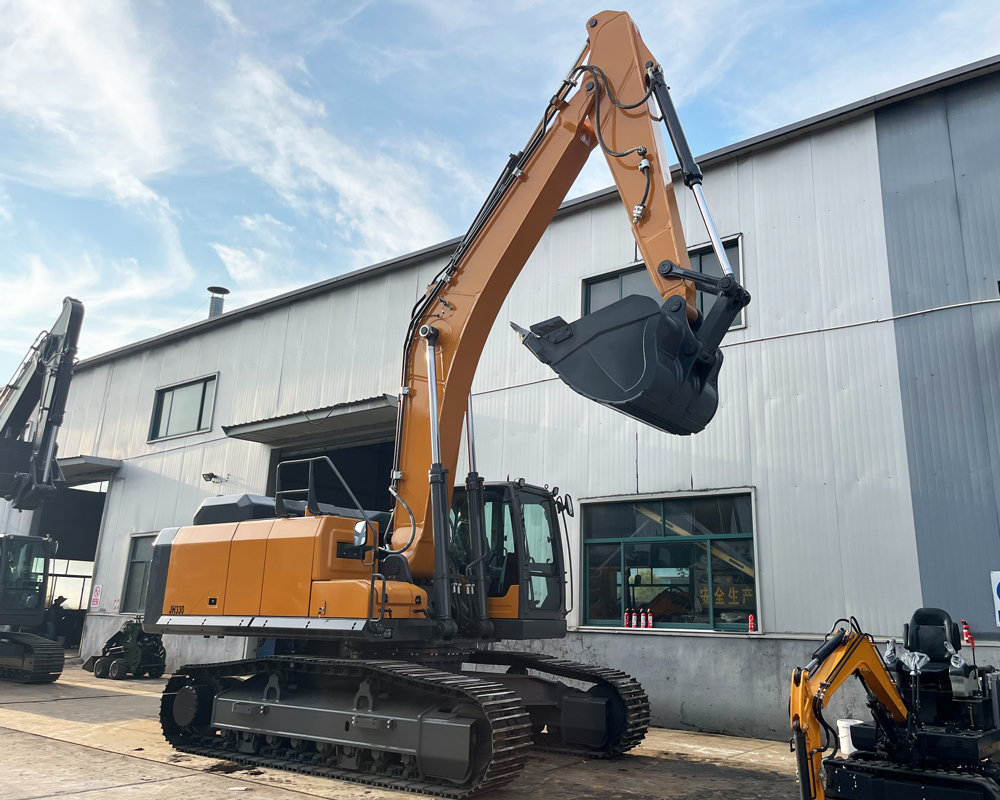
Taking the 33-ton heavy crawler excavator on this site as an example, the core parameters provided are: operating weight approximately 33 tons, engine model 6CTA8.3, rated power 194kW/2200rpm, bucket capacity 1.6m³, maximum bucket digging force 244kN, maximum stick digging force 200kN, system pressure 35MPa, maximum digging radius 10709mm, maximum digging height 10491mm, maximum dump height 7625mm, maximum digging depth 6437mm, minimum ground clearance 470mm, gradeability 35°, wheelbase 3800mm.

The correspondence between these fields and loading tasks is as follows:
| Data field | Corresponding loading requirement |
|---|---|
| Bucket capacity 1.6m³ | Single-bucket load, coordinated with material looseness and transfer rhythm |
| Digging force 244kN/200kN | Cutting and lifting steps when facing dense soil or stone-containing material |
| Maximum dump height 7625mm | Operation arrangement for high-sided trucks or centralized dumping |
| Maximum digging radius 10709mm | Coverage distance between truck parking position and working face |
| Gradeability 35°, ground clearance 470mm | Passage conditions for access ramps and muddy sections in the pit |
It should be noted that these parameters only describe the equipment's own working range and cannot directly derive hourly loading volume, cycle time, or fuel consumption. Loading efficiency is also affected by material state, truck coordination, operator skill, and site organization; such data are not provided and cannot be used to draw conclusions for a project.
How medium and heavy excavator task allocation maps to conditions
Medium crawler excavators are commonly positioned in loading tasks at sites with dispersed working faces, limited road width, and low single-point loading volume, such as municipal earthmoving transfer or small material yard support. In such cases, the machine's lateral dimensions and transfer convenience are often more important than absolute digging force, but this must be verified against the specific model's dimensions and transport requirements; this article does not infer parameters for medium equipment not provided.

Heavy crawler excavator data is more oriented toward continuous, concentrated loading conditions with hard material. For the 33-ton machine, the 244kN bucket digging force, 7625mm dump height, and over 10-meter digging radius indicate a large working coverage for concentrated single-point loading; the 35° gradeability also provides data support for pit ramp access. But this is a conditional judgment: if trucks are parked at the edge of the maximum radius and the material is extremely loose, these parameters cannot directly guarantee loading rhythm; if the transport road cannot support a 33-ton machine and flatbed, equipment selection should first be limited by transport conditions.
Easily overlooked boundaries
Higher dump height is not always better
The 7625mm maximum dump height is a capability limit; in actual loading, the match between common dump height and truck bed should be considered, rather than operating at maximum for every bucket. High dumping requires larger boom and stick angles, resulting in longer movement strokes; whether it suits the project's truck models and layout must be checked after site parking positions are determined.
Digging force and material correspondence
The 244kN bucket digging force targets the cutting and lifting steps in the loading action. The denser the material and the higher the stone content, the greater the reference value of this item; conversely, for loose earth loading, bucket capacity, swing, and truck coordination may have more obvious effects.
Heat dissipation and structural challenges in continuous operation
The data mentions reinforcement at key stress points and robotic welding, but does not provide continuous operation duration, hourly fuel consumption, or maintenance intervals. If the project involves multi-shift continuous loading, such data must be verified separately with the supplier; tonnage alone cannot determine whether the equipment is suitable for long periods without downtime.
Information to prepare before inquiry
- Material type and state: loose soil, undisturbed soil, stone-containing material, or blasted rock, and approximate proportions.
- Loading target: loading volume per shift or per point, truck type, bed height, and quantity.
- Working face conditions: swing space, ramp gradient, water accumulation or mud in the pit.
- Transport and access: flatbed load capacity, road width, bridge and culvert restrictions along the route.
- Shift arrangement: daily working hours, whether continuous operation, operator configuration.
The division of labor between medium and heavy crawler excavators in loading tasks is essentially a match to four conditions—material, unloading, site, and organization—rather than a ranking by tonnage. For projects requiring concentrated single-point loading, higher dump height, and site load capacity permitting, the above parameters of the 33-ton machine can be further verified; if transport conditions are restricted or working points are dispersed, the specific dimensions and transport requirements of medium equipment should first be confirmed before comparison. Product page: 33-ton crawler excavator.