






















When preparing to purchase a compactor for a landfill, spec sheet numbers are often copied into comparison tables: compaction width, spreading depth, gradeability, blade width. After copying, it is still difficult to judge what these numbers mean on site—how many trips per day, how to organize layers, whether slopes can be climbed, and whether additional arrangements are needed for equipment entry. Using the full-machine spec sheet of a 30-ton-class four-wheel landfill compactor as an example, this article explains item by item which type of site arrangement each operational parameter corresponds to, and which questions the spec sheet itself cannot answer and require separate verification.
First Distinguish: Which Fields Describe Operating Method and Which Describe Machine Conditions
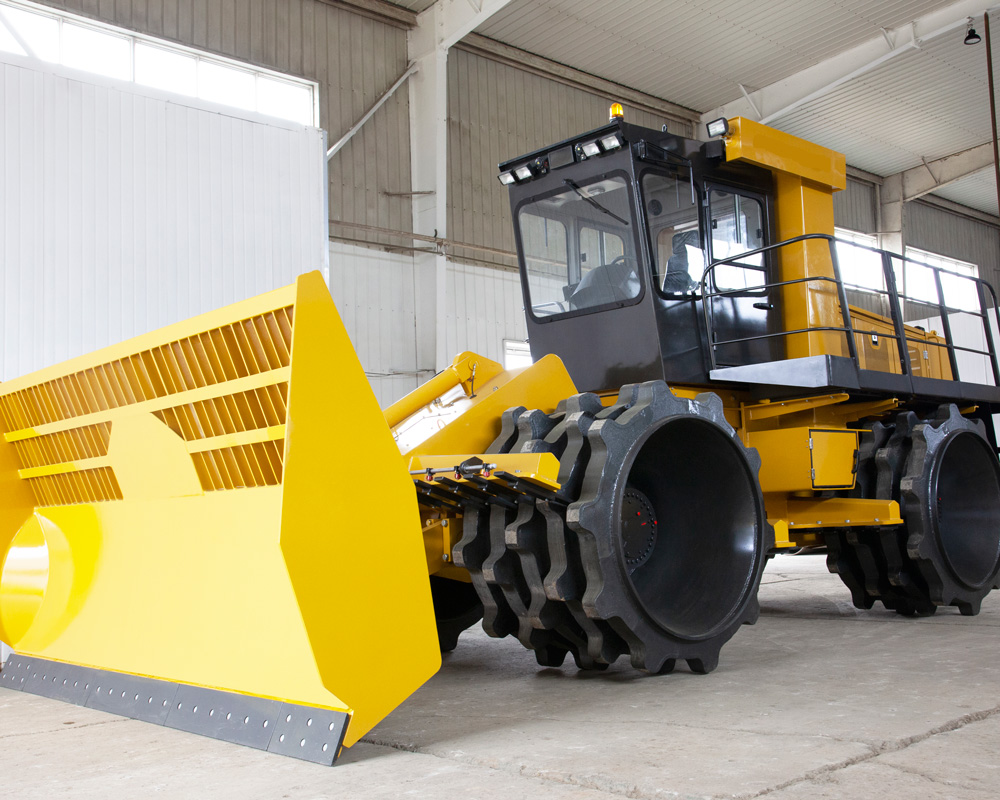
This C300H spec sheet describes the purpose quite specifically: used for pushing, leveling, and compacting refuse piles in landfill sites, and also for filling and compacting cohesive materials at highway, airport, port, wharf, dam, and industrial construction sites. For landfill operations, the fields that truly affect site organization fall roughly into two categories.
- Fields directly describing operating method: compaction width 3430mm, compaction spreading depth over 1 meter, dozer blade height 1880mm, roller teeth count front 50×2/rear 40×2.
- Fields describing machine travel and load-bearing conditions: operating weight 29100kg, gradeability 100%, minimum ground clearance 490mm, front-rear wheelbase 3500mm, four-wheel drive with rear-wheel proportional differential lock.
The two categories must be read separately. Operating method determines how crews are scheduled and how layers are divided; machine conditions determine whether the equipment can reach the work face and run on what ground. Viewing them together easily mistakes one number for an overall assessment of machine capability.
Compaction Width 3430mm: Corresponds to Work Strip Width, Not Single-Pass Coverage
This machine's compaction width is 3430mm, with roller widths of 1195mm front and 970mm rear, and both front and rear roller diameters of 1620mm. The compaction width in the spec sheet describes the overall working width of the machine; it does not equal the width acted upon by each roller individually, nor can it be directly converted into the volume of refuse covered per pass.

On site, compaction width first affects how work strips are divided. Landfill work faces typically advance in sequence through dumping points, spreading areas, and compaction areas. If the compaction strip is too narrow, more round trips are needed; if too wide, the leveled layer itself must be sufficiently wide and flat. The spec sheet does not provide operating efficiency data for different layer thicknesses, so compacted area per shift cannot be calculated from it; it can only serve as an input condition for work strip planning.
Spreading Depth Over 1 Meter: Must Be Considered Together with Layer Organization
The spec sheet states that the machine uses high-strength wear-resistant cutting teeth and that compaction spreading depth can reach over 1 meter. This is the spec sheet's statement of cutting tooth operating depth, a machine-side parameter. Whether the site organizes operations with layers over 1 meter depends on refuse composition, dumping rhythm, spreading equipment, and compaction pass requirements; the spec sheet does not provide these premises.
What can be determined is that the cutting teeth and roller teeth configuration point to an operating method combining crushing and compaction simultaneously; the front 50×2 and rear 40×2 tooth arrangement corresponds to its four-roller structure. If the site adopts thin-layer multi-pass organization, the actual spreading depth will be lower than the spec sheet upper limit; this must be separately determined in the layer plan and cannot be directly applied from the spec sheet value.
Dozer Blade Height 1880mm: Interface with Pushing and Leveling Processes
The spec sheet describes the machine as using an ultra-wide, ultra-high dozer blade, providing large-capacity pushing force per stroke and reducing empty travel time. Dozer blade height 1880mm is an explicit dimension given in the spec sheet, but blade width, blade capacity, and other data are not listed, so single-pass pushing volume cannot be judged from it.

For site arrangements, the significance of the blade is that the machine combines pushing, leveling, and compaction in one unit; the spec sheet describes it as "one machine, two functions: pushing and compacting refuse simultaneously." This multi-functional positioning suits landfills with dispersed dumping points that require frequent switching between leveling and compaction; if the site already has separate dozing and leveling equipment, the machine's blade function is supplementary rather than essential, and its weighting in selection should be adjusted accordingly.
Gradeability 100% and Four-Wheel Drive: Corresponding to Slope Travel and Soft Ground Passage
The spec sheet gives gradeability of 100% and states that it uses four-wheel drive, a large-tonnage PR75-37 drive axle, and rear-wheel proportional differential lock, maintaining power output on one side when the other side slips. This configuration corresponds to travel requirements on landfill mound slopes and soft refuse layers.
It is necessary to distinguish that gradeability is a statement of machine capability under spec sheet conditions, not a guarantee of stable operation on any slope or under any refuse moisture condition. The actual slope gradient of the landfill, the settlement and stability state of the refuse mound, and surface moisture conditions during the rainy season all need separate verification before entry. The spec sheet does not provide hourly operating volumes under different slopes and ground conditions, so slope operation efficiency cannot be promised based on it.
Operating Weight and Ground Clearance: Check Items for Transport and Site Bearing
The machine's operating weight is 29100kg, overall dimensions length 8100mm, width 3800mm, height 3670mm, and minimum ground clearance 490mm. These data affect site arrangements mainly at two ends: first, entry transport—the 3800mm width and 3670mm height mean the transport method must be calculated in advance; second, work face bearing—a 29-ton-class machine traveling on refuse mounds and temporary roads requires site confirmation of bearing conditions; the spec sheet does not provide foundation bearing requirements.
| Spec Sheet Field | Value | Corresponding Site Verification Direction |
|---|---|---|
| Compaction width | 3430mm | Work strip division and round trip arrangement |
| Compaction spreading depth | Over 1 meter | Layer thickness organization and compaction pass requirements |
| Dozer blade height | 1880mm | Interface method for pushing and leveling processes |
| Gradeability | 100% | Actual slope gradient and mound stability state |
| Operating weight | 29100kg | Transport plan and work face bearing |
Off-Sheet Conditions Still Requiring Confirmation for Site Organization
The spec sheet also mentions: engine 192kW, emission level Stage 3; load-sensing hydraulic system supporting priority steering function; centralized lubrication system automatically lubricating 12 key working points at regular intervals; fully enclosed cab with high-level air intake and activated carbon filtration, plus stainless steel medicine tank and powered spray mechanism; ROPS safety protection structure. These configurations correspond to power, control, maintenance, driving environment, and hygiene protection aspects, and can serve as configuration check items during procurement, but their actual effect depends on site use conditions; the spec sheet does not provide measured data.
Items not covered by the spec sheet that need supplementary confirmation during the inquiry stage include:
- Impact of refuse composition and moisture content on cutting tooth wear and compaction effect;
- Daily refuse intake and distribution of dumping points, to judge whether single-machine coverage is sufficient;
- Actual slope gradient, surface condition, and delineation of safe operating areas on the mound;
- Matching of entry road and transport vehicle dimensions and load capacity;
- Spare parts supply, cutting tooth replacement method, and maintenance conditions;
- Compliance of emission level with local environmental requirements.
When requesting quotations from suppliers, it is recommended to provide material type and layer organization method, average daily workload and shift arrangement, site slope and bearing conditions, transport dimension restrictions, and specific requirements for power, blade, compaction wheels, and protective configuration. Put these conditions on paper first, then check them item by item against the compaction width, spreading depth, gradeability, and overall dimensions on the spec sheet; this is more effective for judging whether the machine fits one's own landfill operating method than looking at any single number.