






















A bulldozer cannot directly penetrate every type of ground with its blade during earthmoving. When encountering hard soil, weathered rock, gravel interlayers, or frozen soil, the blade struggles to penetrate, the machine repeatedly slips, and the push cycle is prolonged. The ripper is designed for such operations: the shank tip first loosens the ground, and then the blade pushes the material or loading equipment removes it. However, "equipped with a ripper" does not mean it can handle any ground. The number of shanks, ripping depth, overall machine traction conditions, and the friability of the material itself all determine the actual effect. The following answers this question based only on SD22 ripper data.
Conclusion first: a ripper achieves "loosening," not "digging through"
The ripper's working target is ground that the blade cannot directly penetrate but that has developed joints or limited cementation, such as hard plastic clay, weathered rock, gravelly soil, and some frozen soil. For intact hard rock, large boulders, or high-strength cemented layers, there is insufficient basis for loosening them with a bulldozer-mounted rear ripper alone; other rock-breaking methods are usually required. The ripping depths given in the SD22 data are 695 mm for the single shank and 666 mm for the three shanks. These are reference values for the depth reachable by the shank tip, not the breaking depth achievable in all materials. The actual rippable depth depends on material strength, joints, and moisture condition.
Single-shank and three-shank are not simply a matter of more or fewer
The SD22 can be equipped with a single-shank or three-shank ripper. The differences between the two in the data center on the number of shanks and depth:

| Configuration | Ripping depth (mm) | Lift height (mm) | Corresponding operating orientation |
|---|---|---|---|
| Single-shank ripper | 695 | 515 | Concentrates force to penetrate harder-to-loosen ground |
| Three-shank ripper | 666 | 555 | Greater coverage width, suitable for relatively uniform hard soil and gravel layers |
The single shank concentrates traction on one shank tip, which is more conducive to penetrating locations with greater resistance; the three shanks cover a greater width at once and can accelerate advancement of the loosened surface when material conditions are relatively uniform and point-by-point breakthrough is not required. Only the depth and height in the data are stated here; no inference can be drawn from them about the efficiency of the two configurations in a specific ground, which depends on on-site trial ripping results.
Overall machine conditions determine whether the ripper can "pull it"
The ripper is a rear-mounted working device, and its working capability depends on overall machine traction and undercarriage support. The SD22 standard version has an operating weight of 23450 kg, rated engine power of 175 kW (235HP), ground contact length of 2730 mm, ground clearance of 405 mm, and ground pressure of 66 kPa. These data indicate that it is in the medium crawler bulldozer class, and ripping traction comes from the overall machine weight and track adhesion. If the ground is wet and soft and ground pressure is insufficient, the machine may sink or slip before the shank tip penetrates; if the material is too hard, forced ripping will aggravate wear on the shank tips and shank holders. Therefore, judging whether a certain ground can be handled cannot rely only on ripping depth; site bearing capacity and material strength must also be considered.
Consider together with blade configuration
The SD22 standard version can be equipped with a straight blade, angle blade, U blade, or semi-U blade, with blade widths ranging from 3725 to 4635 mm and a blade depth of 540 mm. Ripped material still needs to be pushed or gathered by the blade, and the blade type is related to push distance and material looseness. The ripper and blade are front and rear matching components on the same machine; during procurement, they should be verified together under the same working conditions rather than viewed separately.

Which grounds are worth prioritizing for a ripping solution
Based on the scope supported by the data, they can be distinguished as follows:
- Hard plastic clay, compacted hard soil: blade penetration resistance is high but the material can be broken; the ripper has room to work, and the specific depth requires on-site trial ripping.
- Weathered rock, soft rock with developed joints: this falls within the "hard soil ripping operation" scenario orientation mentioned in the data; whether it can be loosened depends on the degree of weathering and joint spacing.
- Gravelly soil, mixed-stone sites: the SD22W rock version data lists this as one of the application scenarios, but gravel particle size and content directly affect shank tip loading.
- Intact hard rock, large boulders: the data provide no basis for loosenability, and handling should not be promised under a ripper solution.
- Frozen soil: the data do not specifically give applicable conditions for frozen soil ripping; confirmation is required separately based on freezing depth and temperature.
The above are conditional judgments, not on-site conclusions. The same type of ground varies greatly under different moisture contents and degrees of weathering; trial ripping should be arranged before formal configuration.
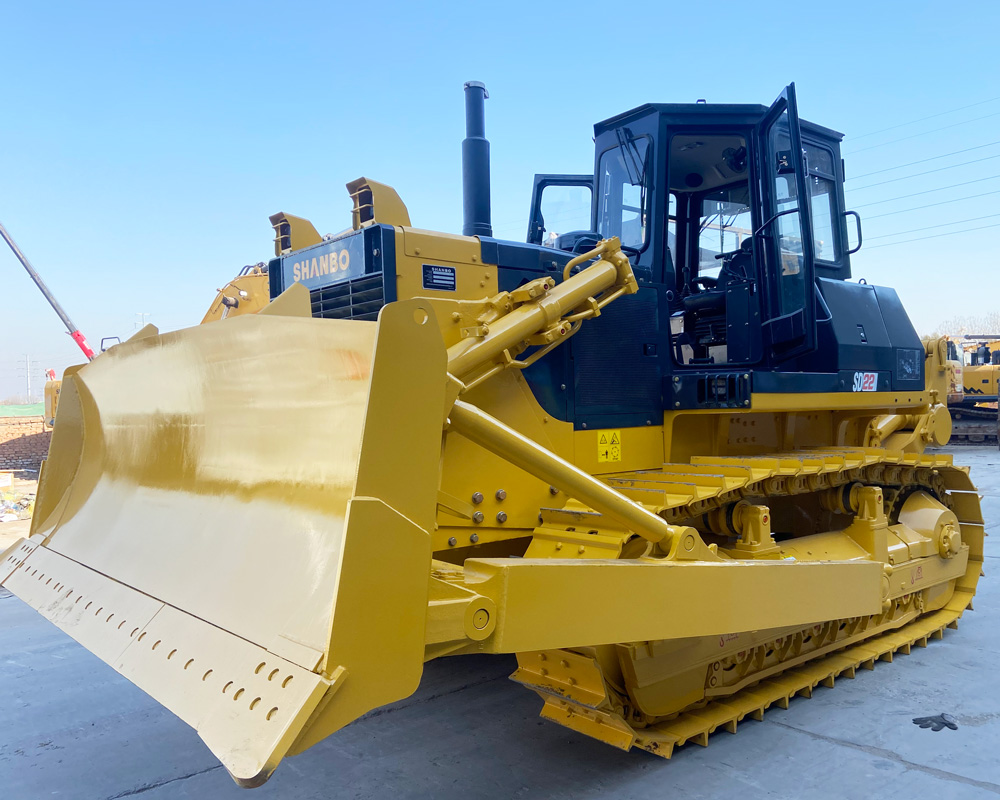
Items still requiring confirmation before procurement
Regarding "whether a medium bulldozer with a ripper can handle the target ground," the following conditions should be clearly stated during inquiry and solution verification:
- Material type and state: soil, weathered rock, or gravel; strength, particle size, moisture content, and whether frozen.
- Target ripping depth and workload: how deep ripping is required, and how many linear meters or cubic meters per shift.
- Site bearing capacity and slope: whether the ground can bear the 66 kPa track ground pressure, and whether slope operations have additional restrictions.
- Ripper shank count selection: single shank or three shanks, and how it matches the blade type and push distance.
- Supply of wear parts for shank tips and shank holders: the data do not give replacement intervals; spare parts conditions need to be confirmed with the supplier.
- Transport and site entry: overall dimensions are 5495 × 3725 × 3402 mm, and the transport plan should be verified accordingly.
- Safety and operation: specific operating procedures for ripping should refer to the accompanying manual; the data do not provide operating steps.
A ripper can expand the ground adaptability range of a medium bulldozer, but how far it expands is ultimately determined jointly by the material, overall machine traction conditions, and trial ripping results. Listing these conditions clearly is closer to real selection than looking at a single depth value alone.