






















The biggest difference between deep pit operations and ordinary earthmoving is that equipment often has to advance in layers within the pit, repeatedly travel up and down ramps, and work on narrow faces far from surface unloading points. In this situation, if any one of four things fails — can it reach the material, can it stand securely, can it be transported in, and can it match the haul trucks — then no matter how large the machine's specifications are, it cannot achieve effective output. This article uses verified data for a 120-tonne ultra-heavy mining excavator as a reference to outline the applicability limits that must be defined in advance for deep pit conditions.
First, clarify the four types of constraints that deep pit operations impose on equipment
Deep pits are a condition-sensitive application. Before purchase, the operating objective should be broken down into verifiable constraint items rather than starting with tonnage or bucket capacity.
- Depth and coverage: the height difference from the mining face to the unloading point and the bench height determine whether the digging radius and digging height are sufficient.
- Standing stability: the ground bearing capacity and slope of the pit floor and ramps determine whether the operating weight, ground pressure and climbing ability can match.
- Material and fragmentation: the hardness and lump size of the ore rock determine how digging force and bucket capacity should be combined.
- Access and relocation: the width, bearing capacity and clearance of transport routes determine whether the machine can be delivered to the pit entrance and relocated within the pit.
Only some of these four conditions have corresponding values in the data provided in this article; the rest must be verified on site before a judgment can be made.
Working range corresponds to the coverage requirements of layered advancement in deep pits
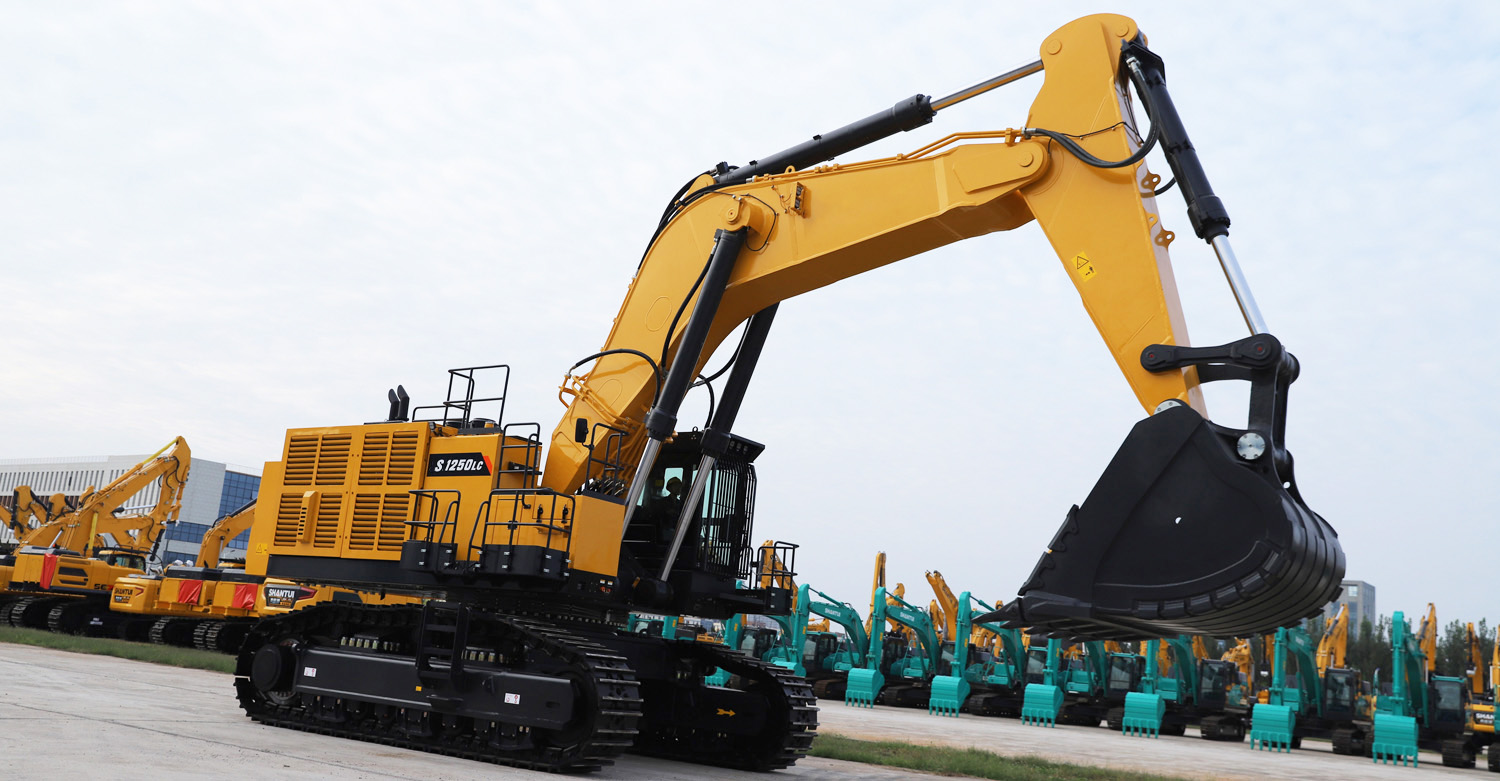
Deep pits usually use layered mining, with the machine completing cutting, slewing and dumping within the same bench. The data shows that this model has a maximum digging radius of 13,875 mm, maximum digging depth of 8,165 mm, maximum digging height of 12,480 mm, maximum dumping height of 8,065 mm, and overall length of 14,845 mm. These values indicate that it is intended for mining layouts requiring large-area coverage.
However, working range values cannot be directly converted into "how deep it can dig." The actual mining depth also depends on bench division, ramp layout, haul truck parking positions and pit floor drainage arrangements. If the working face at the pit bottom is narrow and frequent retreat is required, even if the radius is sufficient, cycle efficiency may be reduced because of insufficient slewing space. Therefore, working range should be used as an initial screening condition for "whether it can cover the mining face," while the final depth plan must still be confirmed by the site layout.

The combination of digging force and bucket capacity determines the material suitability direction
This model has a bucket digging force of 610 kN, stick digging force of 532 kN, bucket capacity of 7.5–10 m³, and is equipped with an engine rated at 680 kW with a displacement of 26.1 L. For large-scale bulk excavation and hard ore rock cutting, these data indicate that it is designed for high-intensity cycles.
Note that bucket capacity is a range rather than a fixed value. The same machine will have different cutting capability and cycle rhythm under different bucket capacities; the harder the ore rock and the larger the lump size, the more attention should be paid to the match between digging force and bucket capacity rather than looking at only one item. The data does not provide actual cycle times or unit energy consumption under different material conditions; these are items to be verified.
Operating weight and ground pressure affect travel on the pit floor and ramps
This model has an operating weight of 120,000 kg, ground pressure of 147 kPa, traction force of 745 kN, gradeability of 70% (35°), and standard track shoe width of 700 mm. Deep pit floors are mostly compacted or semi-compacted ground, while ramps carry repeated heavy-load traffic; ground pressure and traction force are key fields for judging whether stable travel is possible.
However, the data gives whole-machine parameters, which does not mean that any ramp can be traversed. Actual travel is also affected by the actual ramp gradient, road surface material, moisture condition and turning radius. At ramp turns in particular, the extra-wide undercarriage (overall width 5,385 mm, track gauge 3,900 mm) requires wider passage space. It is recommended that ramp width, turning radius and road surface construction be submitted together for verification before purchase, rather than directly replacing on-site assessment with the upper limit of gradeability.

Transport and site access conditions are often overlooked
The difficulty of bringing ultra-heavy equipment to site is often greater than that of the work itself. This model has an overall width of 5,385 mm, overall height (to the top of the cab) of 4,475 mm, overall length of 14,845 mm, and total track width of 4,600 mm. Deep pits are usually located in mountainous areas or deep within mining districts, and transport routes may be restricted by tunnel clearances, bridge load capacity, sharp curves and temporary road widths.
The data does not provide the disassembly method or maximum single-piece weight for transport configuration; such information must be confirmed separately before formulating a transport plan. If the access road cannot accommodate whole-machine travel, whether disassembled transport is possible and whether an assembly site is available on site will directly affect whether the plan is feasible.
Truck loading coordination must be considered together with haul truck specifications
This model has a maximum dumping height of 8,065 mm and tail swing radius of 5,100 mm; combined with its large bucket capacity design, it is suitable for working in fleets with large haul trucks. Loading efficiency in a deep pit depends not only on the excavator itself but also on the haul truck body height, parking position and in-pit road width.
If the haul trucks are too small, dumping a large bucket capacity in multiple passes will instead lengthen the cycle; if the in-pit roads are too narrow, slewing and waiting will keep the machine in non-cutting status for long periods. The data does not provide cycle time or shift output for this model, so when preparing a loading plan, material volume can only be estimated based on bucket capacity and slewing range; the specific fleet size must be verified on site.
Which conditions must be verified before purchase
The following conditions have no corresponding data in this article and are items to be confirmed before ordering:
- Bench height, ramp gradient and design road bearing capacity of the deep pit;
- Ore rock hardness, lump size and whether loose blasting pretreatment is required;
- Tonnage and body height of matching haul trucks and in-pit road width;
- Disassembly plan for machine transport, single-piece weight and on-site assembly conditions;
- In-pit power supply, maintenance area and spare parts turnover arrangements;
- Actual cycle performance and unit energy consumption under different bucket capacity configurations.
Before these items are confirmed, it is not recommended to determine solely on the basis of tonnage or bucket capacity that this model is suitable for a particular deep pit project.
Conditions to provide together when requesting a quotation
If entering the quotation stage, it is recommended to organize the following information by equipment category: material type and hardness, daily/shift workload, height difference between the mining face and unloading point, ramp gradient and road surface construction, in-pit road width and turning radius, matching haul truck specifications, transport access route clearances, and working equipment and bucket capacity configuration requirements. Whether parameters such as track shoe width and ground pressure match on-site ground conditions should also be raised as verification items.
Product page for reference: 120-tonne ultra-heavy mining excavator. All values stated in this article come from verified data for this product; performance conclusions not covered must be subject to on-site conditions and manufacturer confirmation.