






















In an earthworks contract section, a bulldozer rarely does just one job: it first pushes soil dumped by excavators to the fill surface, then performs rough grading at site edges, and may need to rip frozen soil or hard gravel first. When these processes are assigned to one machine, the real question is not "how much horsepower to buy" but what conditions each process imposes on the blade, undercarriage and machine version, and whether one machine can satisfy them all at once.
Below, using verified data for a 260 hp mid-size crawler bulldozer as an example, requirements are broken down by process, then its configuration is mapped to specific operating conditions, and remaining items that still need confirmation before purchase are identified.
First, break "multi-process" into independent operating conditions
Multi-process earthworks is easily described as "highly versatile," but dozing, grading and ripping impose different equipment requirements:
- Dozing: concerns hourly push volume, haul distance, ground bearing capacity and material density; tractive force and ground contact conditions affect whether the machine can keep pushing.
- Rough grading: concerns blade width, height and adjustment method, as well as controllability at low speed.
- Ripping and breaking: clay, frozen soil and hard gravel require a ripper; ripping depth and number of shanks determine whether material can be loosened enough to doze.
- Loose-material handling: depends more on matching blade capacity and blade type; straight, angle and U-blades suit different stockpiling and pushing methods.
Only after listing these conditions does it become clear that some requirements concern whole-machine capability while others are merely work-equipment options, and the two must not be conflated. Material density, haul distance and shift output not mentioned in the data still need to be supplemented from site conditions.

Work backward from work objectives to configuration items that need attention
Dozing and grading: look first at tractive force and blade
The model data gives an operating weight of 23,450 kg, maximum theoretical tractive force of 460 kN, ground pressure of 66 kPa, and three track shoe widths of 560/610/660 mm. The semi-rigid suspension undercarriage expands track ground contact area, and the data directly links this to increased tractive force. For dozing, these figures indicate "whether force can be transmitted to the given ground," not a production guarantee.
Standard configuration is a straight-tilt blade with 4.6 m³ capacity, 3,725 mm width, 1,315 mm height, maximum lift height of 1,210 mm and maximum digging depth of 540 mm. The straight-tilt blade suits scenarios where cutting and pushing are equally important; the data separately lists angle, U and semi-U blades as options, indicating blade type should be determined by stockpiling method and push distance rather than assuming one blade type covers all processes.
Ripping and breaking: the ripper is work equipment, not whole-machine capability
The data lists a three-shank ripper weighing 2,600 kg, with maximum ripping depth of 666 mm, maximum lift height of 555 mm, ripper width of 2,000 mm and shank spacing of 930 mm; the text also mentions an optional large single-shank ripper with adjustable digging angle for frozen soil, clay and hard gravel strata. Note that whether a ripper performs effectively depends on material rippability, tip wear and operating method; the data gives no applicability conclusions for various strata, so material type should be listed as an item to confirm at purchase.

Power and drivetrain: continuous operation conditions corresponding to stable output
The model uses a WP12G280E304 engine, China III emissions, gross power 206 kW (277 hp), net power 194 kW (260 hp), rated speed 1,900 r/min, maximum torque 1,250 N·m @1,200–1,300 r/min. The data describes a highly reliable powershift transmission, torque converter and two-stage straight-tooth final drive, and states the power unit can maintain stable operation under full load and high-temperature environments. These are manufacturer statements; actual continuous operation is still affected by ambient temperature, cooling maintenance and operating habits, and cannot be directly converted into shift output.
It is important to distinguish: the "intelligent electronic control system" in the data refers to automatic fault detection and operation monitoring, not pure electric power. This machine is a fuel model; do not arrange power supply and refueling as for electric equipment just because "electronic control" appears.
Configuration mapping: which needs the whole machine handles and which options solve
| Work requirement | Corresponding configuration in the data | Still to confirm |
|---|---|---|
| Earthmoving dozing and rough grading | Straight-tilt blade 4.6 m³, maximum theoretical tractive force 460 kN, semi-rigid suspension undercarriage | Haul distance, material density, ground bearing capacity |
| Stockpiling and specific pushing methods | Optional angle blade, U-blade, semi-U blade | Matching of blade type to material and push distance |
| Loosening clay, frozen soil, hard gravel | Three-shank ripper, maximum ripping depth 666 mm; optional single-shank ripper | Strata rippability, tip wear |
| Soft ground or low bearing capacity | 560/610/660 mm track shoes optional, ground pressure 66 kPa | Whether actual ground pressure matches site bearing capacity |
| Forestry, wetland, desert, sanitation, rock and other versions | Data states the series includes standard, forestry, wetland, desert, sanitation and rock versions | Differences in protection, undercarriage and work equipment for each version must be checked item by item against version-specific data |
The purpose of this table is to match "what to do" with "what configuration does it." Items not appearing in the table, such as fuel consumption, shift efficiency and payback period, have no verifiable data in the source, so this article makes no inferences.
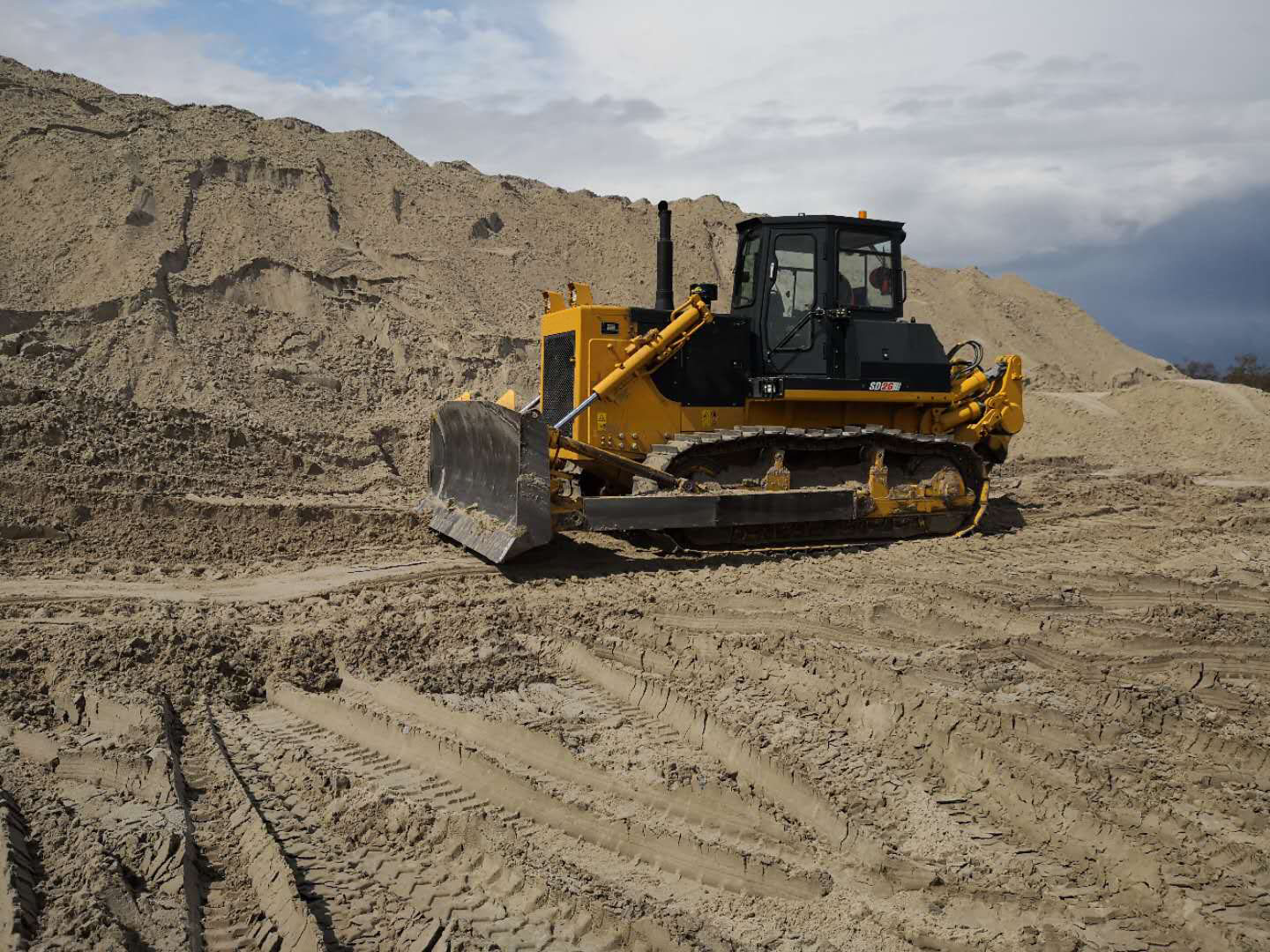
Application boundaries and pre-purchase verification sequence
According to the data, this equipment is positioned for general engineering construction, road construction, site grading, mine earthworks and mid-size heavy-duty operations. Whether it suits a specific contract section still requires verification in the following order:
- Process list: how much dozing, grading, ripping and loose-material handling each account for, and whether one machine must rotate among them.
- Material and ground: soil type, whether frozen soil or hard gravel is present, site bearing capacity and moisture state, corresponding to track shoe width and ripper configuration.
- Blade and work equipment: whether the straight-tilt blade meets the pushing method, whether angle or U-blade is needed, and whether ripper shank count and ripping depth cover the target strata.
- Version conditions: if forestry, wetland, desert, sanitation or rock conditions are involved, request configuration descriptions for the corresponding version; do not assume standard-version data applies to all versions.
- Transport and relocation: overall length 5,462 mm (excluding drawbar) and track-shoe-to-track-shoe width 2,560 mm; before relocation, check transport vehicle and road width/weight limits; the data does not give total transport weight or loading plan.
- Maintenance conditions: the data mentions a large opening engine hood, maintenance-free battery and maintenance reminder marks for daily inspection; specific maintenance intervals and inspection requirements should refer to the accompanying manual, and this article gives no operating steps.
Site conditions to state together when requesting a quote
If procurement proceeds along the above lines, at the inquiry stage it is advisable to provide the supplier with material type and proportions, average daily dozing volume or grading area, haul distance, ground bearing capacity and slope, whether ripping is needed and strata description, work shifts, power form requirements, and blade and track shoe specification preferences. For multi-process projects, also state the sequence of processes and whether operating conditions span versions, so the supplier can judge whether to provide standard or version-specific data. Original equipment images and sample parameters can serve as preliminary basis; final configuration, applicable conditions and delivery time should still be subject to written technical confirmation and site-condition review.