






















When buyers receive a mid-size crawler excavator spec sheet, many look first at bucket capacity and tonnage and then make a judgment. But what really determines whether the machine can work with dump trucks for loading, or relocate itself across muddy or sloped sites, is often scattered across the engine, hydraulic, travel, undercarriage and working range fields. Looking at any single item in isolation makes it easy to mistake "big numbers on paper" for "good performance on site."
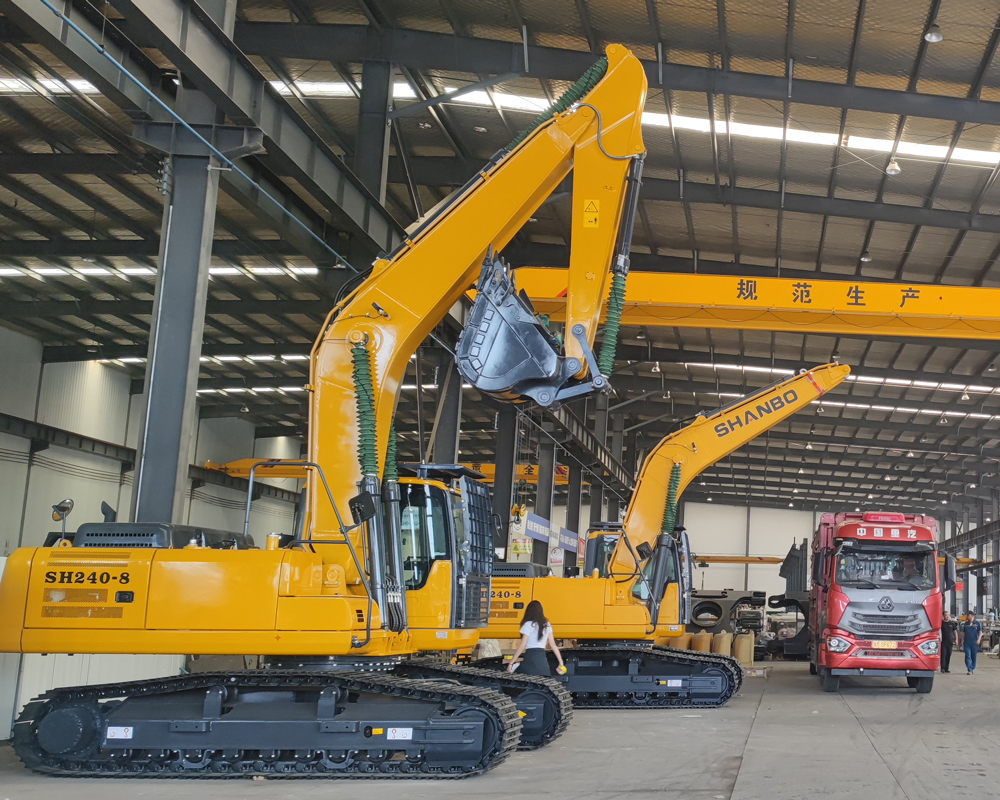
Below, following a practical judgment sequence, the sheet is broken into three groups: fields related to the loading cycle, fields related to travel and site passability, and fields related to working range and layout. The example data comes from the verified specifications of a 23.2-tonne mid-size crawler excavator and is used only to show how the fields work together; it does not mean the model suits all working conditions.
Group 1: The loading cycle is not about bucket capacity alone
Loading is a cycle of dig, swing, dump and return. Bucket capacity only determines how much material is taken per pass; whether the bucket fills fully and swings smoothly also depends on cutting force and hydraulic action. The fields on this sheet directly related to loading can be matched as follows:

- Bucket capacity 1.2 m³, bucket width 1254 mm: corresponds to material particle size and truck-bed matching; coarse material and clay place different demands on bucket type.
- Bucket digging force 146 kN, arm digging force 107 kN: corresponds to whether hard soil and gravel layers can be penetrated, rather than looking only at bucket capacity.
- Main pump maximum working flow 2×224 L/min, working circuit pressure 34.3 MPa, swing circuit pressure 25.5 MPa: corresponds to whether combined operations are smooth, such as raising the boom and swinging at the same time during loading.
- Swing speed 12.4 r/min: corresponds to the cycle rhythm of each dump.
Only by reading these fields together can you judge whether the bucket capacity matches the material, whether cutting force is sufficient, and whether the hydraulic system can support continuous combined operations. A quotation that reports only bucket capacity gives the supplier no basis for judging whether the configuration is suitable.
Group 2: Which figures cover travel and site conditions
Mid-size crawler excavators often need to relocate themselves within a site, sometimes climbing slopes to reach the work face. The travel system fields on this sheet include: two travel speeds of 5.1 km/h and 3.1 km/h, maximum traction force 214 kN, and gradeability 35° (70%). For the undercarriage, track length is 4460 mm, overall track width 2800 mm, track shoe width 600 mm, with 9 track rollers and 2 carrier rollers per side, and ground pressure 49.8 kPa.
These figures answer different questions: travel speed affects relocation time; traction force and gradeability affect passage over slopes and muddy roads; ground pressure affects whether the machine sinks on soft ground. Note that 49.8 kPa is the ground pressure value given in the sheet; whether the machine can work on a specific soft foundation still needs to be confirmed against on-site soil bearing capacity and track shoe selection—do not draw conclusions from a single figure.

Group 3: Working range fields correspond to dumping and excavation layout
What is most easily overlooked during loading is dump height and horizontal reach. The working range given on this sheet is: maximum digging height 10095 mm, maximum dump height 7190 mm, maximum digging depth 6490 mm, maximum horizontal digging reach 9860 mm, minimum swing radius of the working equipment 2970 mm, and tail swing radius 2920 mm.
In purchasing, these can be used as follows: compare the dump truck sideboard height with the maximum dump height to judge whether the work surface needs to be raised; use the maximum horizontal digging reach to estimate the distance between the machine position and the stockpile; and use the tail swing radius and minimum swing radius to judge whether swinging in a narrow site is restricted by surrounding structures. These are layout conditions, not performance promises.
Conditions still to confirm beyond the spec sheet
A spec sheet can describe the configuration, but not all site conditions. Before requesting a quotation and finalizing the configuration, it is advisable to list the following information as well:
- Material type and particle size distribution: hard soil, gravel and clay place different demands on bucket type and teeth.
- Matching dump truck capacity and sideboard height: determines whether bucket capacity matches and whether dump height is sufficient.
- Site bearing capacity and slope conditions: ground pressure and gradeability need to be judged against the actual road surface.
- Relocation transport method: overall transport dimensions and weight limits need to be checked against the transport plan.
- Shift pattern and continuous operating duration: corresponds to refueling and maintenance arrangements for the 330 L fuel tank and 250 L hydraulic oil tank.
- Working equipment configuration: whether breaker piping, etc. is needed is an additional option and must be confirmed separately.
Reading the sheet in the three groups of loading, travel and layout, then requesting quotations with the above conditions in hand, is more likely to yield a usable configuration response than asking only about tonnage and bucket capacity.