






















What a heavy bulldozer will actually do often decides its configuration earlier than "how much horsepower to buy." A landfill pushes loose household waste, a coal yard pushes bulk fuel, and a quarry pushes weathered rock and crushed stone—three materials with different demands on blade shape, base wear resistance and undercarriage wear. When one chassis platform is split into versions by working condition, the buyer faces a version trade-off rather than a single spec sheet.
This article focuses only on verified information for one 320-horsepower-class heavy crawler bulldozer, explaining which operating conditions the multi-version split addresses and which conclusions must be left for on-site verification.
Three working conditions, each with its own bottleneck
- Landfill and sanitation work: The material is loose and low-density, so pushing resistance itself is modest; the pressure comes from site flatness, dust and daily turnover. The blade must gather and spread loose material.
- Coal-yard bulk stockpiling and reclaiming: The material is bulk fuel with large single-pass volumes, so blade capacity and wear resistance matter more than soil-cutting ability; the body structure must withstand repeated pushing and yard cleanup.
- Stone and rock conditions: The material is hard with large lump sizes, so the blade takes impact and wear, push arms and undercarriage parts wear faster, and traction and ripping capability must be considered separately.
These three needs cannot be met by one column of parameters at once; version differences are exactly the result of tuning the same platform in different directions.

Version split and actual differences in the materials
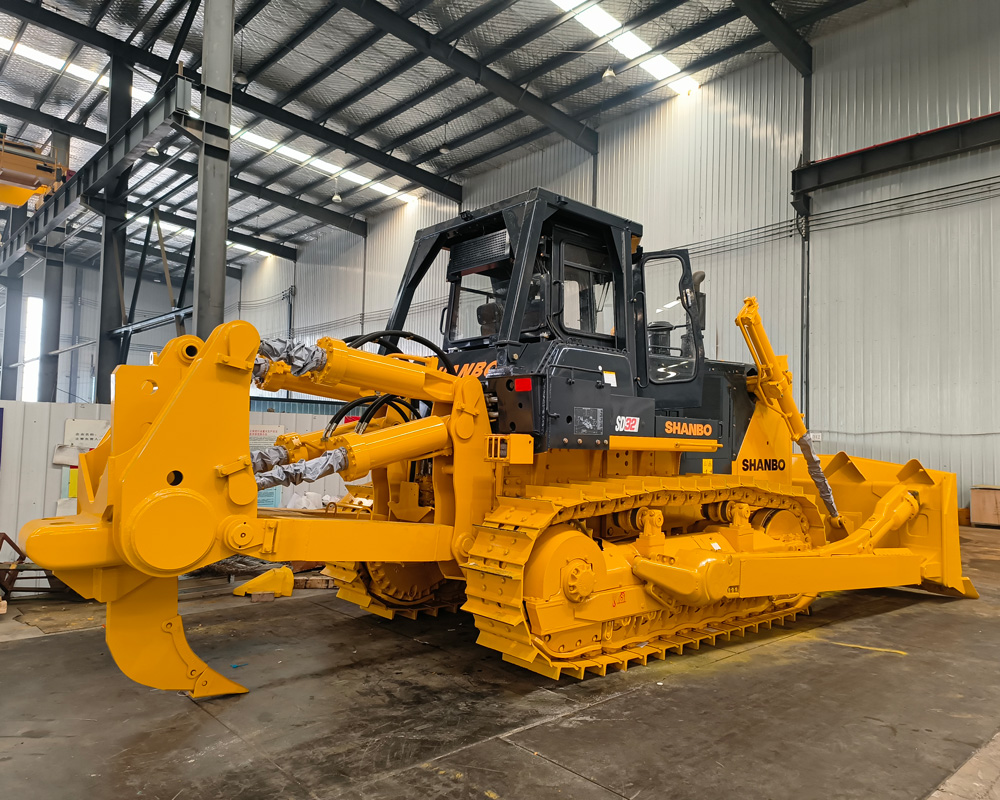
The series is divided into standard, rock, desert, sanitation and coal versions. The machine uses an electronically controlled engine with rated power of 257–258 kW (2000 rpm), operating weight of 40.2–40.9 t, and ground pressure of about 97.7–99.4 kPa. The versions directly tied to working conditions are as follows:
| Version | Blade and undercarriage highlights | Intended work |
|---|---|---|
| Standard | Straight/angle/semi-U blade, blade width 4130–5000 mm; track shoes 560/610/660/710 mm optional; single-shank or three-shank ripper available | General earthwork, water conservancy, road construction and similar mixed work |
| Coal version (SD32C) | Semi-U or U-shaped coal blade, width 4806/4520 mm, height 1710 mm; 610 mm wear-resistant track shoes standard; no drawbar structure | Pushing and yard cleanup at power plants, ports and bulk stockyards |
| Rock version (SD32W) | Thickened high-wear-resistant rock blade and reinforced push-arm assembly; rock straight/angle/semi-U blade | Crushed-stone quarrying, weathered-rock stripping, stony soil excavation |
| Sanitation version | Listed as one version in the materials, but no separate blade or undercarriage parameters are given | Request configuration details from the supplier based on actual landfill material and site conditions |
The table shows that the coal and rock versions differ in more than the blade: the former uses a wide, tall coal blade and wear-resistant tracks to handle large pushing volumes of loose material and eliminates the drawbar structure; the latter focuses on blade thickness, wear resistance and push-arm rigidity. The undercarriage still shares the same basic structure with 228.6 mm track pitch, 2140 mm track gauge and 3150 mm ground contact length, with differences in track shoe width and ground pressure (standard 97.7 kPa, coal 98.4 kPa, rock 99.4 kPa).
What must be confirmed separately for the sanitation version
The materials list the sanitation version as an available version but give no separate blade dimensions, track shoe width or protective configuration. Therefore, for landfill scenarios, the only confirmed point is that the series offers a sanitation-oriented version; no specific capability can be inferred from it. Before actual selection, the supplier must be asked to verify: the blade type and capacity for the sanitation version, whether structural reinforcement has been made for loose material, how undercarriage protection is handled, and what the on-site dust and leachate environment requires for maintenance point locations.

Likewise, landfill compaction performance, slope travel capability and continuous operating duration all depend on layer thickness, site bearing capacity and shift arrangements. The materials contain no compaction or gradeability data, so these can only be on-site verification items and must not be written as equipment promises.
Beyond versions, which common conditions must be calculated
The three versions share a 640 L fuel tank, 97 L hydraulic tank, minimum turning radius of 3800 mm, ground clearance of 500 mm, maximum forward speed of 11.5 km/h in third gear and maximum reverse speed of 13.5 km/h in third gear. These figures have practical meaning for transport and site layout: overall dimensions are about 8650×4130×3760 mm (the coal version reaches 4755 mm because of its wider blade), so access road width, turning space and flatbed load capacity must be calculated in advance.
For power form, the materials clearly state an electronically controlled engine, i.e., a fuel-powered model; the electronic throttle and digital monitoring panel are control and monitoring features, not pure electric power, and should not be confused during selection.
Pre-purchase verification sequence
A more practical sequence is to first define the material and work motions, then look at the version, and finally check supporting conditions:
- Whether the material is loose household waste, bulk coal or stony soil determines whether blade type or wear resistance and rigidity takes priority;
- Daily pushing volume and working-face length determine blade width and whether a ripper is needed;
- Site bearing capacity and transport routes determine track shoe width selection and the machine transport plan;
- Missing independent parameters for the sanitation direction, and landfill slope and layer conditions, should be listed as items to confirm with the supplier;
- For maintenance, check centralized lubrication points and side guard plate inspection space per the manual; do not assume a maintenance interval.
When requesting a quote, provide material type and density, daily workload, site dimensions and bearing capacity, transport method, shift arrangements, and whether a ripper, drawbar or specific blade type is needed, so the supplier can give configuration and lead-time information for the corresponding version.