






















In earthwork and municipal engineering, "medium crawler excavator" is often treated as a broad purchasing bracket. But "medium" is only a class designation: tonnage, bucket capacity and structural configuration within this bracket vary across manufacturers and product generations, and a class name alone can hardly determine whether a machine can complete a given loading or excavation task. What must first be clarified is: what material the machine will dig, what size of transport truck it will work with, how wide the working face is, and how long continuous operation will last; then check which fields in the specific data correspond to these conditions.
Define the question first: a medium crawler excavator must answer not "is it big enough" but "does it match"
The following scenario is a conditions analysis, not a customer case that has occurred: a municipal earthwork project requires trench excavation, sand loading and local site leveling; the transport vehicles are conventional dump trucks; the working face is narrow; and the machine must also relocate itself. At this point the buyer cares not about absolute tonnage but about whether bucket capacity matches the truck bed, whether digging depth and dumping height cover the trench section, and whether the crawler undercarriage suits the ground. Only by listing these operating conditions item by item and then checking the equipment data can one judge which real capabilities lie behind the word "medium."
Mapped to the data: what the parameters of a 15-tonne-class crawler excavator can explain in selection
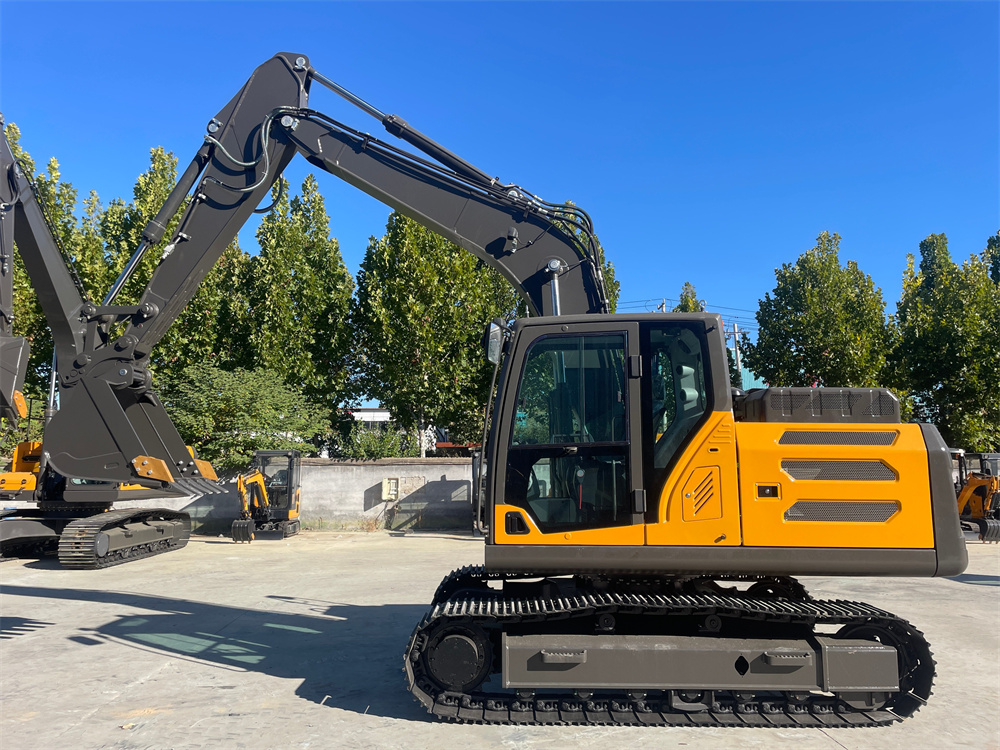
The SH150 on this site is a 15-tonne-class crawler excavator with an operating weight of 15,000 kg, rated power of 110 kW (148 hp) and bucket capacity of 0.6 m³. The following explains item by item how these parameters relate to the operating conditions above, without equating the parameters themselves with construction results.

Tonnage and undercarriage: affecting transport and site adaptability
Operating weight and overall dimensions determine how the machine enters the site. Its overall dimensions are 7737×2500×2847 mm, minimum ground clearance is 380 mm, and maximum gradeability is 30°. The significance of these figures for selection is that they serve as a starting point for checking flatbed load capacity, access road width and ramp conditions; however, whether it can actually pass still depends on site road conditions, slope length and ground bearing capacity, and the gradeability figure alone cannot be used to promise operation on any slope.
Bucket capacity and digging force: corresponding to truck-loading coordination and material penetration
The 0.6 m³ bucket capacity, 91 kN maximum bucket digging force and 55 kN maximum arm digging force are the basic fields for judging the loading cycle and material adaptability. Bucket capacity must match the truck bed capacity: too small a bucket lengthens the loading cycle, while too large a bucket may not coordinate with the truck bed and working face. Digging force figures must be understood in light of material type: sand, soft soil and loosened earth-rock differ from hard undisturbed soil in cutting requirements. The data does not give actual working efficiency under different materials, so material category, moisture state and whether breaking is needed should be listed as items to confirm before purchase.

Working range: determining whether trenches and dumping can be reached in one pass
The machine's maximum digging depth is 5343 mm, maximum vertical digging depth 4790 mm, maximum digging height 8627 mm, maximum dumping height 6025 mm and maximum digging radius 8198 mm. These figures can be used to check trench depth, dumping height and working-face coverage. For example, when trench depth or truck sideboard height approaches these values, operating margin must be left and machine positioning and swing space confirmed; whether a specific section can be met should still be rechecked against on-site setting-out and the actual angle of repose of the material, and the parameter values cannot be taken directly as constructible depth.
Hydraulics and structure: relating to continuous operation and component durability
The data shows that the machine adopts dual-pump confluence technology, built-in cushioning in the main cylinders, a redesigned track frame cross-section to reduce mud accumulation, and forged structures at key joints. These are structural and hydraulic design descriptions that can be used to understand the machine's response in continuous loading cycles and maintenance convenience, but the data provides no cycle-time tests, wear-life or fuel-consumption figures, so efficiency gains or operating-cost reductions cannot be inferred from them.
Operation and maintenance conditions: affecting shift organization and daily checks
The machine is equipped with electronic throttle control, intelligent auto-idle and an LCD display, and the oil filter, pilot filter, fuel filter and water separator are located at ground level. This information can be used to assess operating convenience and the accessibility of daily checks, but maintenance intervals, filter replacement intervals and specific inspection steps should follow the accompanying manual; this article does not give maintenance intervals or disassembly/repair steps.
Applicable limits: which conclusions cannot be drawn from this data
- The data does not give actual productivity under different soil types, moisture contents and ramp conditions, so loading efficiency or daily output cannot be promised.
- No fuel consumption, endurance or energy consumption test data is provided, so fuel costs or energy-saving ratios cannot be inferred.
- No adaptability verification for plateau, severe cold or corrosive environments is provided; the 110 kW engine and turbocharging configuration can only serve as check items, not as proven environmental commitments.
- "Medium" does not mean the machine suits all medium earthwork tasks; for hard-rock excavation, large-scale mine stripping and ultra-deep foundation pits, the work equipment, structural strength and transport conditions must be checked separately.
- The data does not state a matching list of optional work equipment (such as breakers or different bucket types); related supporting conditions should be confirmed at the inquiry stage.
Checklist to verify before purchase
| Check item | Site information to provide | Corresponding data field |
|---|---|---|
| Material and excavation section | Soil category, moisture state, trench depth and width | Bucket capacity, digging force, maximum digging depth |
| Truck-loading coordination | Truck bed capacity, dumping height, vehicle turnaround method | Bucket capacity, maximum dumping height, swing radius |
| Site and relocation | Working-face width, ramp gradient and length, flatbed conditions | Overall dimensions, gradeability, minimum ground clearance |
| Shifts and maintenance | Daily operating hours, refueling or recharging arrangements, maintenance space | Fuel tank capacity description, filter locations |
At the inquiry stage, it is advisable to provide material type, workload and schedule, site plan and transport conditions, daily shift arrangements, and whether specific work equipment is needed. The more specific this information, the better one can judge whether this 15-tonne-class crawler excavator falls within the capability range the project requires; for parts not covered by the data, written confirmation should be obtained from the supplier before signing the contract.