






















The scheduling challenge on asphalt paving sites is often not the roller itself, but the rhythm between roller and paver: as the paver advances continuously, the roller must complete initial, intermediate, and final compaction within a limited time, without causing material waiting due to slow transfers, and without compromising layer quality through insufficient or excessive passes. Municipal roads have narrow working faces and frequent transfers, so scheduling must also account for equipment entry/exit and avoidance time. This article focuses on tandem vibratory rollers, explaining which equipment conditions to verify when scheduling by layer, and uses verified data for a specific product to explain the corresponding relationships.
Start scheduling analysis from paving rhythm and layer structure
Asphalt surface courses are typically divided into lower, middle, and upper layers, each with different thickness, mixture type, and temperature window, imposing different requirements on compaction equipment. Before scheduling, three inputs must be clarified: the paver's current operating speed and single-pass width, the layer structure and thickness planned for the shift, and the number and sequence of passes required by the compaction process. These three determine how much area the roller must cover in what time, and whether dual-frequency/dual-amplitude switching is needed to adapt to different layers.
Municipal roads have another often-underestimated constraint: short working segments with many intersections and manholes, requiring the roller to frequently decelerate, turn, and make short transfers. If equipment is selected solely on compaction capacity, scheduling may result in the roller waiting in narrow sections and falling behind the paver in wide sections. Scheduling is essentially about checking "compaction capacity" and "mobility" on the same timetable.
The role and boundaries of tandem drum equipment in scheduling
Tandem vibratory rollers typically handle initial and intermediate compaction in asphalt paving, and can also be used for final compaction, depending on construction organization. Their advantage is that both drums can vibrate front and rear, forming a continuous compaction band on the paved layer and reducing temperature unevenness caused by single-side rolling. However, tandem drum equipment is sensitive to layer thickness and mixture temperature: under thin layers or low temperatures, improper vibration parameters may cause surface cracking or aggregate crushing. Scheduling must consider the paving temperature window together with the switching time for vibration frequency and amplitude.

Additionally, the static linear load and centrifugal force of a tandem roller determine single-pass compaction depth. If scheduling assumes fixed pass counts without verifying the match between actual equipment output and layer thickness, some sections may be under-compacted while others are over-compacted. These must be confirmed through test sections or process parameters before work begins, not applied solely from experience.
Corresponding conditions in the data for a 12.3-ton tandem drum machine
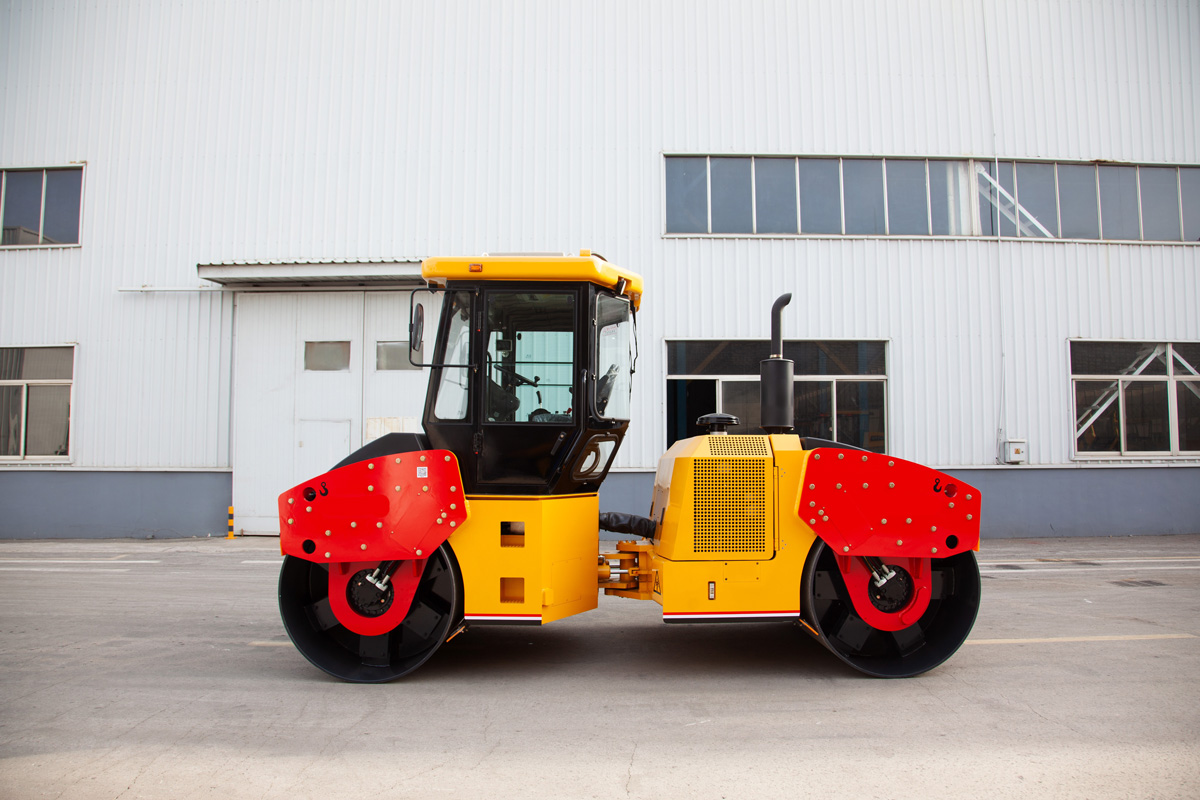
Verified data for the product associated with this article shows: operating weight 12,300 kg, drum width 2,130 mm, front and rear static linear load both 283 N/cm, vibration frequency 42/50 Hz, amplitude 0.8/0.35 mm, centrifugal force 145 kN×2 (90 kN×2 at high frequency), travel speed 0–12 km/h, gradeability 30%, ground clearance 440 mm, steering angle ±40°, turning radius 6,000 mm, powered by a 119 kW engine with imported hydraulic system, and equipped with a fully enclosed noise-reduced cab.
Placing these parameters back into scheduling scenarios allows item-by-item correspondence:
- Drum width and single-pass coverage: The 2,130 mm compaction width determines single-pass coverage; scheduling can estimate required passes and overlap based on paving width, reducing repeated travel.
- Dual frequency/dual amplitude and layer switching: The combination of 42/50 Hz frequency and 0.8/0.35 mm amplitude provides parameter switching space for different layers and thicknesses; scheduling must include switching time in process sequencing rather than assuming switching can occur at any time without affecting rhythm.
- Symmetric static linear load distribution: Both front and rear at 283 N/cm means consistent pressure in both directions, so scheduling need not adjust pass assumptions by direction, though actual layers still require confirmation.
- Travel speed and transfers: 0–12 km/h stepless speed regulation provides speed adjustment margin for short municipal road transfers and intersection avoidance; however, actual transfer time is also affected by traffic organization and working face conditions, and cannot be estimated solely from maximum speed.
- Steering and passability: ±40° steering angle, 6,000 mm turning radius, and 440 mm ground clearance correspond to maneuverability needs in narrow sections and near curbs; scheduling still requires on-site confirmation of avoidance space for manholes, curbs, and temporary facilities.
| Scheduling input | Corresponding condition in data | Still requires on-site confirmation |
|---|---|---|
| Single-pass paving width | Drum width 2,130 mm | Actual paver width and overlap |
| Layer structure and thickness | Dual frequency 42/50 Hz, dual amplitude 0.8/0.35 mm | Parameters and passes determined by test sections for each layer |
| Transfers and avoidance | 0–12 km/h, turning radius 6,000 mm | On-site traffic organization and working face obstacles |
| Continuous work shifts | 200 L fuel tank, fully enclosed cab | Actual fuel consumption and operator shift arrangements |
It should be noted that the above data does not provide compaction degree, productivity, or fuel consumption figures for specific layer thicknesses, so no commitment can be made regarding compaction results at a given paving speed. Scheduling plans still require confirmation through test sections and on-site process parameters.

Supporting conditions to secure before scheduling implementation
Equipment parameters are only part of scheduling; the following conditions must also be secured on site:
- The ratio of pavers to rollers, estimated by paving speed and compaction passes rather than evenly divided by equipment count;
- Isolation and traffic organization between compaction and paving zones, preventing rollers from turning or stopping on unformed layers;
- Mixture temperature monitoring and time arrangement for the compaction window, ensuring waiting times in the schedule do not exceed the allowable temperature range;
- Transfer routes and entry/exit times; municipal roads must also consider night construction, traffic diversion, and time restrictions near sensitive locations;
- Operator familiarity with dual-frequency/dual-amplitude switching and speed control, avoiding rhythm fluctuations due to unfamiliar operation.
Additionally, the machine's overall dimensions are 4,920×2,300×3,200 mm; road width limits, height limits, and turning conditions must be verified during transport and entry. These are transport organization matters and should be confirmed together with the equipment entry plan before scheduling.
Applicable boundaries and items to be confirmed
Tandem vibratory rollers are suitable for asphalt paving and municipal road surface compaction, but not all layer conditions suit the same set of parameters. Thin layers, low temperatures, modified asphalt, or special mixtures may require adjusting vibration frequency, amplitude, or switching to static rolling, as determined by test sections and construction process requirements. The machine data does not address applicability under special mixtures or extreme climate conditions; such projects require separate confirmation.
For subgrade layered compaction, landfill compaction, or large-area earthwork compaction, the operating logic of tandem drum equipment differs from single-drum vibratory rollers, pneumatic tire rollers, or landfill compactors, and the scheduling approach in this article cannot be directly applied. This article addresses only asphalt paving and municipal road surface compaction.
Information to prepare before requesting a quote
To verify equipment configuration for a specific project, prepare the following information: layer structure and thickness of each layer, mixture type and temperature window, paver model and operating speed, single-pass width and segment length, planned shifts and schedule, transfer distance and road conditions, and on-site power or fuel supply conditions. For the roller, verify drum width, vibration frequency and amplitude configuration, static linear load, travel speed, and steering conditions; if special layer or climate requirements exist, state them as well so that configuration or process parameter adjustments can be confirmed.
Equipment selection should ultimately be judged based on test section compaction results, construction organization, and transport conditions. The correspondences provided in this article serve only as a reference for organizing verification items before scheduling.