






















The daily operation sequence of a domestic waste landfill is usually not "dump—roll once—finish." After waste is unloaded, it must first be spread and crushed, then compacted in layers, followed by covering with new material to continue the cycle. If this process is treated as ordinary roadbed compaction and handled by a machine only responsible for flattening, the spreading and crushing steps are likely to be disconnected. This article focuses on these process characteristics to explain why landfills need to consider compaction equipment separately based on crushing and spreading requirements, and uses verified information on a 26-ton landfill compactor to explain the selection basis and applicable boundaries.
Process Differences Between Landfill Operations and Roadbed Compaction
The goal of roadbed compaction is relatively simple: under controlled moisture content and layer thickness, use vibration or static pressure to compact the material to the specified density. The working object of a landfill is domestic waste with uneven composition, loose material, high compressibility, and mixed with packaging, fabrics, and bulky items. Before the equipment enters the compaction process, it often needs to spread and crush the waste pile first so that the layer thickness tends to be uniform, allowing compaction to proceed effectively.
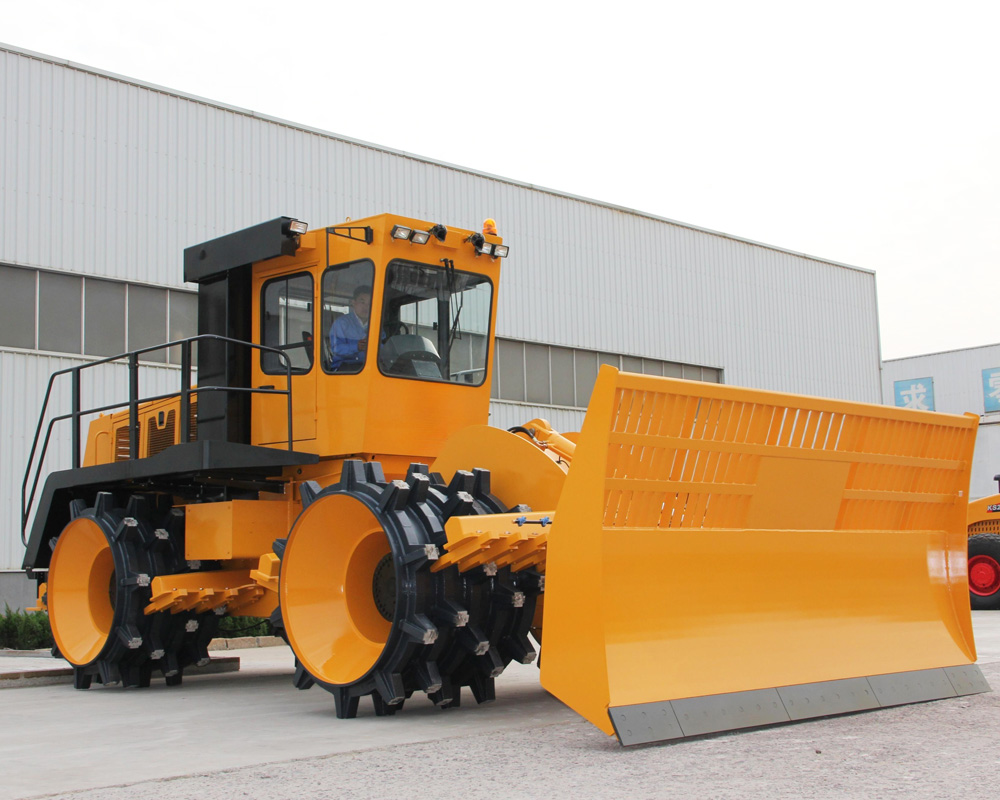
In other words, landfill equipment must simultaneously handle three actions: spreading, crushing, and compacting, rather than only the final step. The reason dedicated landfill compactors differ structurally from ordinary rollers is precisely that they require compaction wheels with crushing function, strong blade pushing capability, and passability adapted to the waste pile. The following comparison only illustrates the differences in operational positioning between the two types of equipment and does not involve judgments of superiority between specific brands or models.
| Comparison Item | Ordinary Roadbed Roller | Landfill Compactor |
|---|---|---|
| Main working object | Road materials such as soil, gravel, asphalt mixture | Loose, mixed materials such as domestic waste |
| Core action | Vibration or static pressure densification | Alternating spreading, crushing, and compaction |
| Working device characteristics | Steel drum or tires | Compaction wheels with crushing teeth, equipped with blade pushing structure |
| Site concerns | Layer thickness, moisture content, number of compaction passes | Material layer uniformity, crushing effect, pile passability |
The purpose of this table is to help determine equipment category, not to say that ordinary rollers cannot enter landfills for auxiliary operations. In actual projects, tasks such as cover soil compaction and on-site road maintenance may still use other compaction equipment, but the main compaction process of the waste pile requires separate configuration according to landfill working conditions.
What Site Requirements Do Crushing and Spreading Capabilities Correspond To
The effectiveness of waste compaction largely depends on whether the material layer is uniform. If the layer is locally too thick, the compaction wheels cannot reach the bottom; if bulky items are not crushed, voids are likely to form after compaction. The two data items of crushing width and blade height correspond to the spreading and crushing range that the equipment can cover in one operation.

Taking the C260H associated with this article as an example, its crushing width is 3430mm and blade height is 1880mm. The crushing width affects the width of the material strip that can be processed in a single pass; when the width is larger, the advancement of the working face can reduce the number of round trips. The blade height relates to the working height of the blade pushing structure in front of the waste pile, affecting the operating range when spreading and gathering materials. These two values need to be considered together with the width of the landfill working face, daily waste intake, and spreading method, and cannot be used alone as a capacity conclusion.
Another parameter related to site organization is the ground clearance of 490mm. Landfill ground is soft and has many debris, so space needs to be left between the equipment chassis and the ground for passage. The size of the ground clearance affects the passage conditions when the equipment moves on the waste pile and on-site roads, but whether it can pass smoothly also depends on waste moisture content, pile slope, and on-site road maintenance. The data itself cannot provide a passage guarantee for any site.
How to Incorporate Compaction Capacity Figures into Site Arrangements
The compaction capacity given in the C260H data is 0.35–1.0+t/m³. This range represents the compaction density interval that the equipment can achieve under corresponding operating conditions, not a fixed construction result. Which level can actually be achieved depends on waste composition, layer thickness, number of compaction passes, moisture content, and working face organization. When purchasing or scheduling, this range should be used as a reference for judging whether the equipment matches the landfill compaction target, rather than as a commitment that holds true for all waste materials.
Other equipment parameters include operating weight 26000kg, engine power 192kW, maximum travel speed 11km/h, and overall dimensions 8100×3800×3670mm. Operating weight and engine power affect the equipment's operational stability and pushing capability on the waste pile; overall dimensions relate to whether the access road, unloading platform, and working face width meet the equipment's turning and passage conditions. These parameters need to be checked item by item against site conditions, especially since landfills are usually located on the outskirts of cities, where access road and working platform widths may become limiting factors.

- Operating weight 26000kg, belonging to 26-ton class equipment; the bearing capacity and width of the unloading platform and on-site roads need to be verified;
- Engine power 192kW, corresponding to Tier 3 emission standards; the emission requirements of the project location need to be confirmed;
- Maximum travel speed 11km/h, suitable for short-distance transfers on site; long-distance transfers require separate transportation arrangements;
- Overall dimensions 8100×3800×3670mm; during transportation, the flatbed trailer dimensions and road width/height limits need to be verified.
Conditions for Judging Whether to Equip a Dedicated Landfill Compactor
Whether to equip a dedicated landfill compactor based on crushing and spreading requirements depends on the scale of the landfill, waste intake, operating system, and existing equipment composition. The following situations can serve as starting points for conditional judgment, but all need to be verified against actual project conditions:
- Daily waste intake is large and the working face requires continuous spreading and crushing, making it difficult for ordinary compaction equipment to handle the upstream processes;
- Waste composition is complex with many bulky items and packaging, requiring compaction wheels with crushing teeth to improve material layer uniformity;
- The landfill pile is high and the working face is narrow, so equipment passability and blade pushing capability directly affect the operation cycle;
- The project has clear management requirements for compaction density and pile stability, requiring dedicated equipment to participate in layered compaction.
If the landfill scale is small, waste intake is limited, or the main operations are cover soil compaction and on-site road maintenance, it is not necessary to directly configure a large dedicated compactor. Existing compaction equipment can first be verified to see whether it can meet the main compaction process of the pile, and then decide whether dedicated equipment needs to be added. This article does not make recommendation conclusions for specific projects.
Site and Supporting Conditions to Verify Before Procurement
Landfill compactors are specialized equipment, and site conditions must be matched with equipment data before procurement. The following checklist is listed in order from site to equipment to facilitate providing complete information during inquiry:
- Material and layer: Main waste composition, proportion of bulky items, average daily intake, planned layer thickness, and compaction density target;
- Site conditions: Working face width, pile slope, on-site road bearing capacity and width, unloading platform dimensions, and site conditions during rainy seasons or periods of high moisture content;
- Transportation and access: Transport vehicles corresponding to equipment overall dimensions, access road width/height limits, and whether oversize transport permits are required;
- Shifts and power: Daily work shifts, continuous operation duration, fuel supply arrangements, and emission standard requirements of the project location;
- Protection and maintenance: Requirements for chassis, cooling, and cab protection in the landfill environment; daily inspection items should be confirmed with reference to the equipment manual;
- Compaction wheels and working devices: Whether the crushing tooth form and blade pushing structure match the waste composition and spreading method.
Among the above conditions, material composition, layer thickness, and site bearing capacity often need on-site measurement or to be provided by the landfill operator, and cannot be inferred solely from equipment data. When inquiring, explain this information together so that the supplier can verify whether the equipment configuration corresponds accordingly, rather than just quoting a model and price.
Applicable Boundaries and Matters to Be Confirmed
It should be clarified that the C260H data cited in this article only covers the parameters and usage descriptions listed for that model. It cannot be used to infer the configuration of other landfill compactor models, nor can the compaction capacity of this model be applied to all waste materials. Values such as crushing width 3430mm, compaction capacity 0.35–1.0+t/m³, ground clearance 490mm, and blade height 1880mm all need to be re-verified in specific construction organization in combination with layer thickness, number of compaction passes, and waste composition.
In addition, landfill operations also involve professional requirements such as pile stability, leachate management, and on-site safety. These are beyond the scope of equipment parameters and should be determined by the landfill operation management and corresponding professionals. Equipment selection is only one part and cannot replace the overall landfill operation plan.
If the project needs to further confirm the degree of match between the equipment and site conditions, prepare information such as waste composition and average daily intake, layer and compaction targets, working face and transport dimensions, shifts and emission requirements, and compaction wheel and protection configuration, then verify item by item with the supplier. Product information can be found on the 26-ton landfill compactor page; specific configurations and applicable conditions are subject to verified technical data.