






















In loading operations, it is common for truck tonnage and excavator specifications to be mismatched: if the truck bed is too large, the excavator needs multiple swings to fill one truck; if the truck bed is too small, the excavator waits longer for trucks. In either case, looking only at the excavator bucket capacity or the truck tonnage cannot determine a suitable loading cycle. You first need to clarify which action segments make up the "cycle," then see which fields in the equipment data relate to these segments.
Below, a 21-tonne medium crawler excavator is used as an example (1 m³ bucket capacity, 129 kW rated power, 140 kN maximum bucket digging force) to explain how the loading cycle can be broken down and checked. The truck tonnage and truck bed dimensions in this article are only condition examples, not verified construction configurations.
First, break the "loading cycle" into four segments
The loading cycle is not a single speed indicator; it consists of at least four segments: material pickup (cutting or grabbing), full-bucket swing, positioning and dumping, and empty-bucket return. If any of the four segments is affected by truck bed dimensions or stopping position, the overall cycle will be lengthened. When trucks and excavators are mismatched, the segment most often affected is "full-bucket swing + positioning and dumping": the higher the truck bed edge and the wider the truck bed, the higher the excavator must lift and the more precisely it must swing, or the more small adjustments are needed.
Therefore, the order for determining the cycle should be: first use truck bed volume and excavator bucket capacity to calculate the approximate number of loads per truck, then use the dump height to check whether the truck bed edge can be reached, and finally see whether the swing speed and action coordination can support this cycle. Tonnage is only a rough reference and cannot replace these three steps.

Number of loads: ratio of bucket capacity to truck bed volume
The data gives a bucket capacity of 1 m³. If the effective volume of the truck bed is about 8 m³, the geometric number of loads is about 8 buckets; if the truck bed is 12 m³, it is about 12 buckets. This ratio directly determines how many swings and how many positioning actions are needed per truck. The larger the truck bed, the more obvious the error in each cycle becomes: if each bucket is slightly underfilled, one or two extra buckets may accumulate over a full truck.
Note that bucket capacity is geometric capacity; the actual amount loaded per bucket depends on material looseness, fill level and operator habits. Estimating the number of loads at 1 m³ above is only a method example and should not be treated as a commitment to actual output.
Dump height: whether the truck bed edge can be reached
The data gives a maximum dump height of 6730 mm and a maximum digging height of 9410 mm. These values are the upper limits of equipment capability, not the requirement that every bucket be raised to the highest point during routine loading. When positioning over a truck, the key is whether the actual height and reach required to align with the truck bed edge and the center of the truck bed fall within the commonly used working range. The higher the truck body and the wider the truck bed, the greater the dump height and swing radius required for positioning, and the longer each cycle will take.
If the truck tonnage is significantly larger than the excavator's common loading range, a situation may arise where the excavator can reach but cannot fill the truck, or can fill it but positions slowly. In this case, consider adjusting the match between truck bed and excavator rather than relying solely on faster operation to compensate.

Swing and positioning: the controllable part of cycle time
The data gives a swing speed of 11–13 rpm. Swing speed affects the time for full-bucket swing and empty-bucket return, but positioning and settling also depend on whether swing start and stop are smooth. The data mentions dual-pump confluence technology, which increases oil flow to the boom, arm and bucket, and smooth swing start and stop, which help with accurate positioning and reduce vibration and impact wear. For loading, accurate positioning means fewer secondary adjustments, and this often has a more direct effect on the cycle than the nominal swing speed.
When the number of loads is fixed, even a few extra seconds of positioning time per cycle will show up as a cumulative difference by the time the truck is fully loaded. Therefore, cycle calculation should consider both "whether positioning is completed in one pass" and "whether swinging is smooth."
Power and hydraulics: conditions supporting continuous cycling
This machine uses a WP6 engine with rated power of 129 kW/2200 rpm, system pressure of 32 MPa, maximum bucket digging force of 140 kN, and arm digging force of 99 kN. These parameters describe the capability basis for cutting, rock breaking and hydraulic output, not the loading cycle itself. The loading cycle is also affected by material type, ground flatness at the stopping position, truck stopping position and operator skill.
The data also mentions electronic throttle control and auto-idle: the engine enters idle after 5 seconds without operation. These functions relate to fuel consumption and noise, but their effect on the loading cycle must be judged in combination with actual operating habits. The data does not provide corresponding time or fuel consumption figures, so cycle changes cannot be calculated from them.
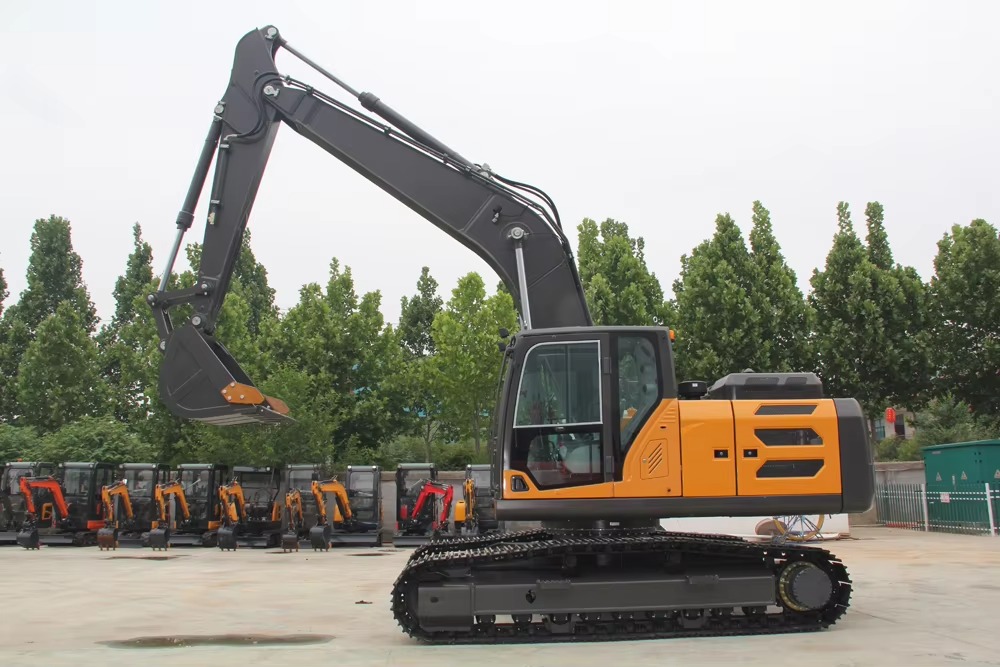
Working range and site conditions
The data gives a maximum digging radius of 9850 mm, maximum digging depth of 6480 mm, maximum digging height of 9410 mm, maximum dump height of 6730 mm, overall dimensions of 9590×2980×3185 mm, tail swing radius of 2880 mm, minimum ground clearance of 470 mm, and maximum gradeability of 30 degrees. These fields are used to determine how the machine stopping position and truck parking position should be arranged: the tail swing radius affects whether the swing will sweep into the truck bed or site boundary, and ground clearance and gradeability affect passage under uneven site conditions.
The loading cycle is closely related to site layout. Uneven ground at the stopping position and frequent changes in truck parking position will directly consume cycle time. The data can describe the equipment's working range and passage parameters, but the specific site layout still needs to be determined based on on-site measurements.
Conditions to confirm before purchase
- The effective volume and edge height of the truck bed, used to calculate the number of loads and the dump height required for positioning.
- The type, looseness and particle size of the main loading material, to judge the actual load per bucket and cutting resistance.
- Ground conditions at the stopping position and the truck parking method, including whether frequent machine repositioning is needed.
- Shift arrangements and continuous operating duration, used to judge whether the power and hydraulic systems need to run at high load for long periods.
- The safe distance between the tail swing radius and the site boundary and truck bed position, which must be verified on site.
The data for this 21-tonne crawler excavator can support checks of bucket capacity, dump height, swing speed, power and hydraulic configuration, but the loading cycle also depends on truck matching and on-site organization. If there is a large gap between truck bed and excavator tonnage, it is recommended to first calculate according to the four segments above, then decide whether to adjust the truck bed match, change the stopping method, or reconsider the equipment specification. The data does not cover cycle time and output for specific materials; related conclusions need to be confirmed through on-site trial loading or further technical communication.