






















When urban municipal earthworks, environmental protection projects and green mining projects begin to list zero emissions and low noise as equipment admission conditions, battery-electric bulldozers are often brought into the comparison. But whether the equipment can be used does not depend on "electric" itself, but on whether the site can provide stable power, whether the battery can be recharged between shifts, and whether the operating intensity falls within a controllable range. This article focuses on these prerequisites and uses verified whole-machine data to explain the order of judgment.
First clarify: what exactly these projects need to solve
Putting an electric bulldozer into the plan usually corresponds to three types of site goals: first, the work area has restrictions on exhaust emissions; second, it is noise-sensitive; third, the project owner hopes to reduce daily fuel costs. All three can be reasons for introducing electric drive, but all require the same thing—the power supply must form a daily arrangement just like diesel refueling.
Therefore, the order of judgment should be reversed: first check whether the site power supply and shift organization meet the conditions, then check whether the equipment data matches the operating requirements, and finally discuss configuration and procurement. If the order is reversed, it is easy to discover only after the equipment arrives that recharging cannot fit into the operating gaps.
First-level condition: on-site power supply capacity and connection method
Recharging a battery-electric bulldozer depends on charging facilities rather than fuel carried on board. The data shows that this model supports 2×300kW battery interfaces, 2×250A DC fast charging and 2×400kW DC discharge, and is equipped with battery heating and a low-voltage auxiliary power supply. This set of data shows two things: the recharging power demand is not low; and the recharging capability is directly tied to the on-site distribution capacity.

Before procurement, the following should be verified with the site:
- Whether the work area or parking area can provide power access that meets the fast-charging power, and whether the transformer and distribution cabinet capacity are sufficient;
- Who provides the charging equipment, and whether the interface and communication protocol match the whole machine;
- Whether the cable routing path and rainproof and anti-crushing measures are included in the site layout;
- Whether the auxiliary power required for battery heating in low-temperature environments is stable.
These are site conditions that whole-machine parameters cannot answer. The data does not provide charging time, driving range or energy consumption per shift, so it is impossible to calculate how many times charging is needed per shift; the question of whether the recharging window can fit into the shift can only be treated as an independent confirmation item.
Second-level condition: shift organization and recharging windows
Diesel bulldozers refuel during operating gaps, which takes little time and is flexible in location; electric bulldozers rely more on fixed points and longer time windows for recharging. The two place different requirements on construction organization.
If the project uses a single-shift system, has concentrated work faces, and the equipment can return to a fixed point for recharging after work, the organizational difficulty is relatively low; if it involves continuous multi-shift pushing, equipment scattered across multiple work faces, and frequent relocation, the recharging points and relocation sequence need to be planned in advance. The data mentions that the whole machine is equipped with battery thermal management, a VCU controller and a remote monitoring module, which can be used to grasp equipment status, but this does not replace on-site shift scheduling.

Items to confirm include: effective daily operating hours, available recharging time between shifts, whether dedicated personnel are assigned to supervise the charging process, and whether a backup recharging plan is available. Without these conditions, the attendance rhythm of electric bulldozers cannot be directly aligned with diesel equipment.
Third-level condition: whether operating intensity matches the whole-machine data
After the power supply and shift conditions are basically established, check whether the equipment itself can cover the pushing task. This model is a 272HP battery-electric medium bulldozer, with a 200kW (272HP) main motor and 200Nm stable torque from a permanent magnet synchronous motor; the hydraulic system is independently driven by a 50kW (68HP) permanent magnet synchronous hydraulic motor with 280Nm torque, equipped with a 100+65+25 triple gear pump and a standard working pressure of 30MPa. The battery is a 614.2V, 690Ah, 423.94kWh lithium iron phosphate pack with an intelligent BMS.
These data show that it has the power and hydraulic configuration of a medium bulldozer and can be used for dozing, lifting, ripping and other operations. However, the data does not provide actual productivity for different materials and pushing distances, nor does it provide conclusions on adaptability to slopes, wetlands or heavy-load continuous operation. Therefore, the judgment should focus on matching conditions:
- Whether the material type and pushing distance fall within the normal range of a medium bulldozer;
- Whether ripping, lifting or other attachments are needed, and whether the hydraulic flow and pressure meet the matching requirements;
- Whether the work face has slopes, soft ground or other conditions not specified in the data, which need separate verification.
Fourth-level condition: environmental adaptability and protective configuration
The configurations listed in the data include an 8kW compressor thermal management system, 2.5kW fresh air cooling, 10kW electronically controlled air conditioning, a 45kW plate-fin radiator and a 400W PWM water pump, and state that it can operate stably in extremely high and low temperature areas. There are also an insulation monitor, high-voltage shielded cables, metal waterproof connectors, as well as a 128GB dashcam, 4G remote monitoring TBOX, 7-inch LCD screen and 2 starlight night-vision cameras.
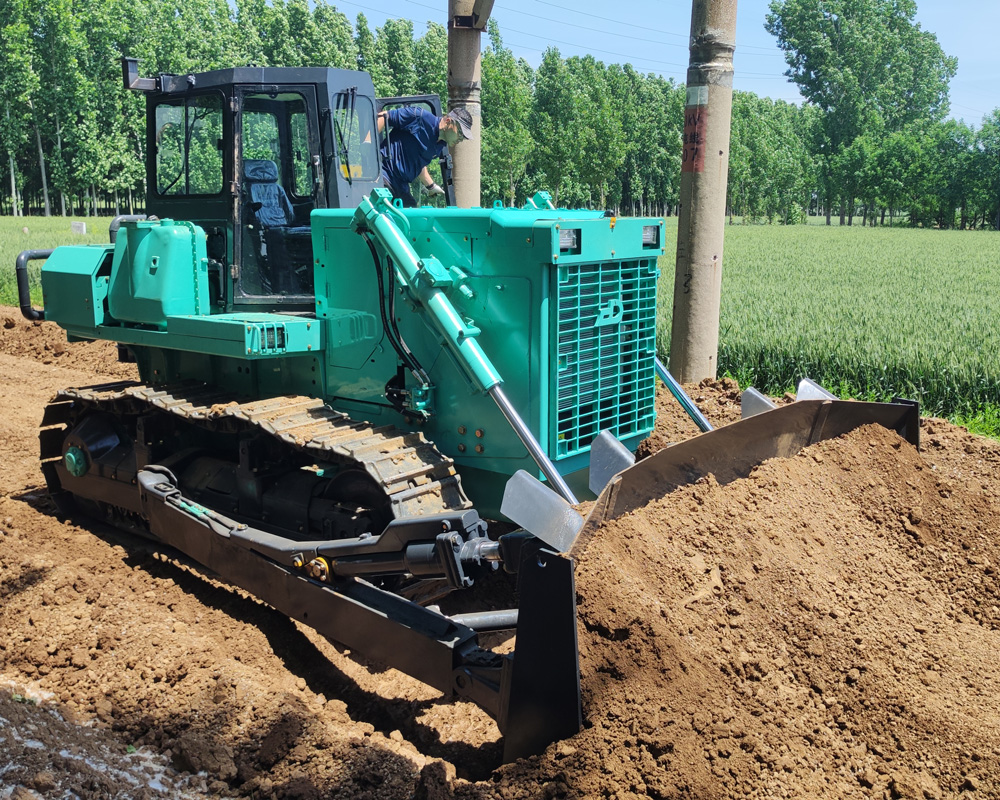
These configurations correspond to temperature management and high-voltage safety monitoring and can serve as reference items for on-site assessment, but they cannot replace verification for a specific environment. If the project is in a severe cold, high-humidity, dusty or salt-spray environment, the protection rating, heat dissipation capability and maintenance requirements should be confirmed with the supplier rather than drawing conclusions solely from configuration names.
Checklist recommended before procurement
| Check item | Content to confirm | Status of data basis |
|---|---|---|
| On-site power supply | Fast-charging power, distribution capacity, access points | Whole machine supports 2×250A DC fast charging; site capacity to be verified |
| Recharging arrangements | Shift gaps, charging points, supervision responsibilities | Data does not provide charging time or range; on-site calculation required |
| Operation matching | Material, pushing distance, attachment requirements | Power and hydraulic parameters available; productivity and working-condition adaptability data lacking |
| Environmental protection | Temperature, dust, humidity, salt spray | Thermal management and high-voltage safety configurations available; specific protection rating to be confirmed |
| Maintenance conditions | High-voltage system service capability, spare parts and training | Data mentions modular design; maintenance arrangements to be confirmed with supplier |
Applicable boundaries and matters still to be confirmed
According to the data, this model is positioned as zero-emission equipment for urban municipal construction, environmental protection projects, green mining and low-noise demolition projects. This positioning corresponds to scenarios that have environmental admission requirements and can organize fixed recharging. If the site cannot provide a stable power supply, or the operating intensity requires the equipment to run continuously for long periods while the recharging window is insufficient, then power supply upgrading or a recharging plan should be treated as a prerequisite topic rather than directly applying the shift pattern of diesel equipment.
The data does not provide battery capacity degradation, charging time, energy consumption per shift, actual fuel consumption comparison or payback period, so it cannot be used to promise a specific reduction in operating costs. When requesting quotations, it is recommended to provide the material type and volume, pushing distance, number of work faces and relocation frequency, shift duration, on-site power supply conditions, whether rippers or other attachments are needed, and the project's specific requirements for emissions and noise, so that the supplier can propose a matching plan based on the whole-machine data, and then verify whether charging facilities, maintenance training and spare parts supply are in place.