






















When assessing whether a machine is suitable for earthworks on slope sites, the key question is usually not how much it can dig on flat ground, but three things: can it travel up and down the slope empty and loaded, can it keep the body stable on the slope face, and will the tracks slip and slide when the slope is wet or soft. Data on traction, gradeability, ground pressure, and the travel system are the entry points for answering these questions. This article organizes the meaning of these fields according to the practical constraints of slope operations and uses verified data for a 21.2-tonne crawler excavator to illustrate application boundaries.
Four practical constraints of slope operations
The first is slope angle and slope length. Short steep slopes and long gentle slopes place different demands on equipment: the former tests gradeability, while the latter tests power and cooling during continuous travel. The second is slope surface material: dry hard soil, wet clay, and gravel surfaces have very different traction conditions, and on the same slope, whether the machine can actually climb depends on the contact state between tracks and ground. The third is operating posture: when the excavator swings on the slope face or extends the arm to dig, the center of gravity changes with the position of the work equipment, so flat-ground experience cannot be directly transferred to slopes. The fourth is site access: slope sites often come with narrow access roads, so transport dimensions and swing radius need to be checked together.
These questions cannot be answered by a single parameter. The data can provide equipment capability values under standard conditions; whether they can be realized on site also depends on slope surface conditions, operating method, and actual load.
What traction and gradeability each answer
Traction reflects how much force the travel system can push the entire machine with, usually marked in kN; gradeability reflects how much slope can be overcome under given conditions, often expressed as a percentage or angle. The two are related but not equivalent: traction is a measure of the undercarriage's output capability, while gradeability is the result of converting that capability on a slope, and is also affected by machine weight, traction conditions, and ground conditions.
Therefore, when seeing a gradeability value, it is necessary to clarify whether it is measured empty or loaded and under what traction conditions. When swinging with a load on the slope face or digging with the stick extended, the machine's center of gravity and track forces change, so the gradeability in the data cannot be directly equated with “being able to work in any posture on the slope.” This point needs separate confirmation in on-site assessment.

Ground pressure and slope stability
Ground pressure is directly related to track shoe width. The narrower the track shoes, the higher the ground pressure and the greater the risk of sinking on soft slope surfaces; conversely, wider track shoes can reduce ground pressure but also affect steering resistance and traction performance. If a slope site also has soft soil, backfill, or wet slippery conditions after rain, ground pressure is a condition that needs to be considered together with slope angle.
It should be noted that ground pressure is a static reference value; the actual force distribution during slope travel changes with posture and cannot be simply extrapolated from flat-ground values to slope performance.
Example: data for a 21.2-tonne crawler excavator
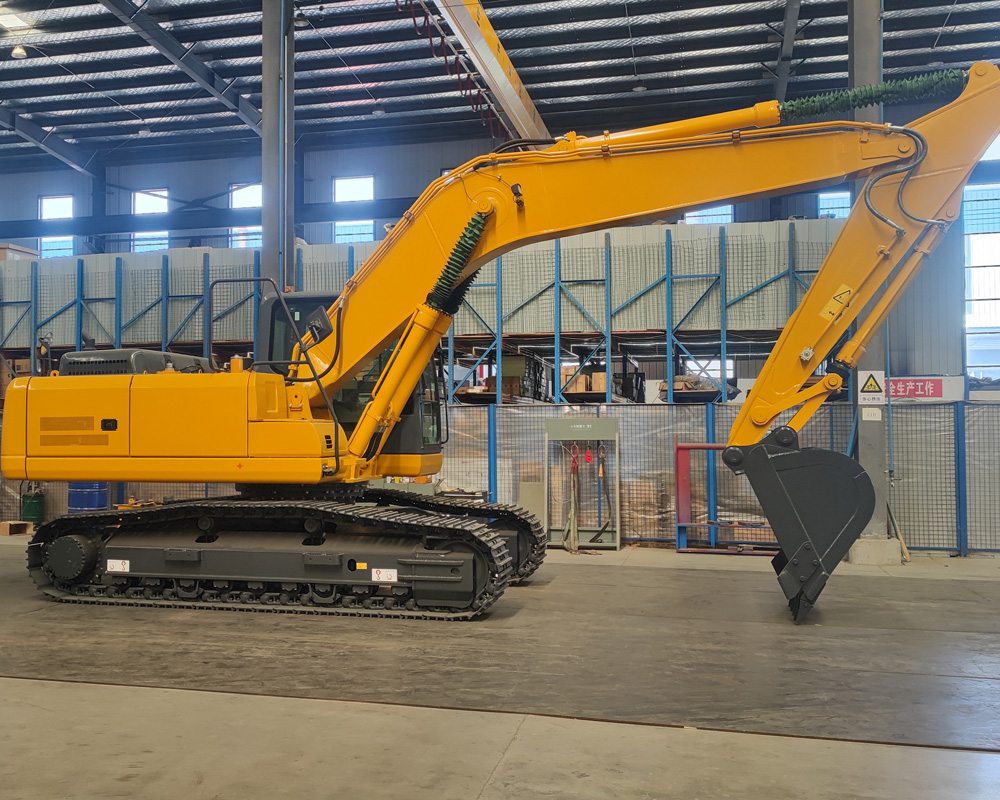
Taking the SH220 from the product data on this site as an example, this is a mid-size crawler excavator with an operating weight of 21,200 kg, equipped with a Cummins 6BTAA5.9 engine, rated power 133 kW, maximum torque 708 N·m, and a Linde variable dual piston pump hydraulic system. Its travel system uses variable displacement piston motors, with a maximum travel speed of 5.1 km/h (3.1 km/h in low range), traction of 214 kN, gradeability marked at 70% (35°), track shoe width of 600 mm, and ground pressure of 49.8 kPa.
Putting this set of data back into the requirements of slope operations, the correspondence can be described as follows:

- Traction 214 kN: This indicates that the undercarriage has a certain pushing capability, but whether it can be converted into slope traction depends on the actual contact conditions between tracks and ground; wet slippery clay slope surfaces need separate assessment.
- Gradeability 70% (35°): This is the capability limit given in the data; actual working slope angles should leave margin based on load, slope surface conditions, and operating method, and production tasks should not be arranged at the upper limit.
- Track shoes 600 mm, ground pressure 49.8 kPa: This is a medium-width configuration suitable for general earthwork slopes; if the slope surface is soft for long periods, it is necessary to recheck whether wider track shoes are more suitable.
- Two travel speed ranges: Site transfer and fine adjustment on slopes can use different ranges; during long-distance slope travel, attention should be paid to the load on the transmission system from continuous travel.
In addition, the machine has a maximum digging radius of 9,860 mm, maximum digging depth of 6,490 mm, maximum dumping height of 7,190 mm, bucket capacity of 1.06 m³, and bucket digging force of 146 kN. On slope sites, these working range parameters determine where on the slope face the equipment can complete digging and loading, and they need to be considered together with the slope layout rather than looking at numerical values alone.
Configuration check sequence for slope sites
If selection checks are organized around slope operations, the following sequence can be used:
- First determine the working slope angle and slope surface material state, distinguishing dry hard, wet slippery, and soft conditions.
- Then check the equipment gradeability and traction data, and clarify whether the test conditions for these values are close to the site.
- Next check ground pressure and track shoe width to assess the risk of sinking and traction loss on the slope.
- Then check the working range to confirm whether the equipment can cover the digging point and dumping point from its position on the slope.
- Finally check transport dimensions and access road conditions to avoid the equipment arriving on site but being unable to enter.
This sequence does not guarantee that any particular machine is suitable; it only relates data fields to site conditions and reduces the element of deciding by experience alone.
Situations requiring additional confirmation
There are several situations in slope operations where standard data alone cannot provide a conclusion: first, weak interlayers or backfill on the slope face, where ground pressure reference values are insufficient to judge stability; second, the need to swing and dump with a load on the slope face, where center of gravity changes exceed conventional assumptions; third, significantly reduced traction conditions on the slope during rainy seasons or freeze-thaw periods; fourth, slopes also used as transport passages, which need to be assessed together with vehicle traffic. These situations should be explained to the supplier before purchase, and the supplier should be asked to confirm the equipment's operating boundaries under such conditions, with on-site survey judgment if necessary.
In addition, the gradeability and traction in the data are product capability descriptions, not equivalent to safety operation permits. The actual permitted slope angle, travel posture, and anti-slip measures for slope operations should be based on the equipment manual and on-site safety management requirements.
Information to prepare before requesting a quote
For slope earthwork selection, the following information can be prepared when requesting a quote from the supplier to help them judge whether the configuration matches:
- Working slope angle range, slope length, and main slope surface material types;
- Whether the slope surface has soft soil, backfill, or standing water;
- Planned work tasks: pure excavation, excavation plus loading, or also site leveling;
- Daily work shifts and continuous operation duration;
- Access road width, turning conditions, and transport method;
- Specific requirements for track shoe width, work equipment, and bucket capacity;
- Power form and on-site fuel or power supply conditions.
Only when these conditions are clearly stated can the supplier provide configuration recommendations based on specific model data rather than just quoting a tonnage. The suitability judgment for slope sites ultimately rests on slope angle, material, posture, and access conditions; traction and gradeability are just one set of fields that need to be understood.