






















The difficulty of small-site leveling often lies not in whether the machine can push, but in whether it can turn around after entering, whether it can hold its ground, and whether it can leave the site smoothly when finished. For local leveling in factory areas, farmland improvement and small-scale municipal earthwork backfilling, such tasks have limited area and many boundaries. Once the equipment size exceeds the work area, or the ground pressure does not match the ground bearing capacity, the cost of subsequent adjustments will be greater than the machine-shift hours saved.
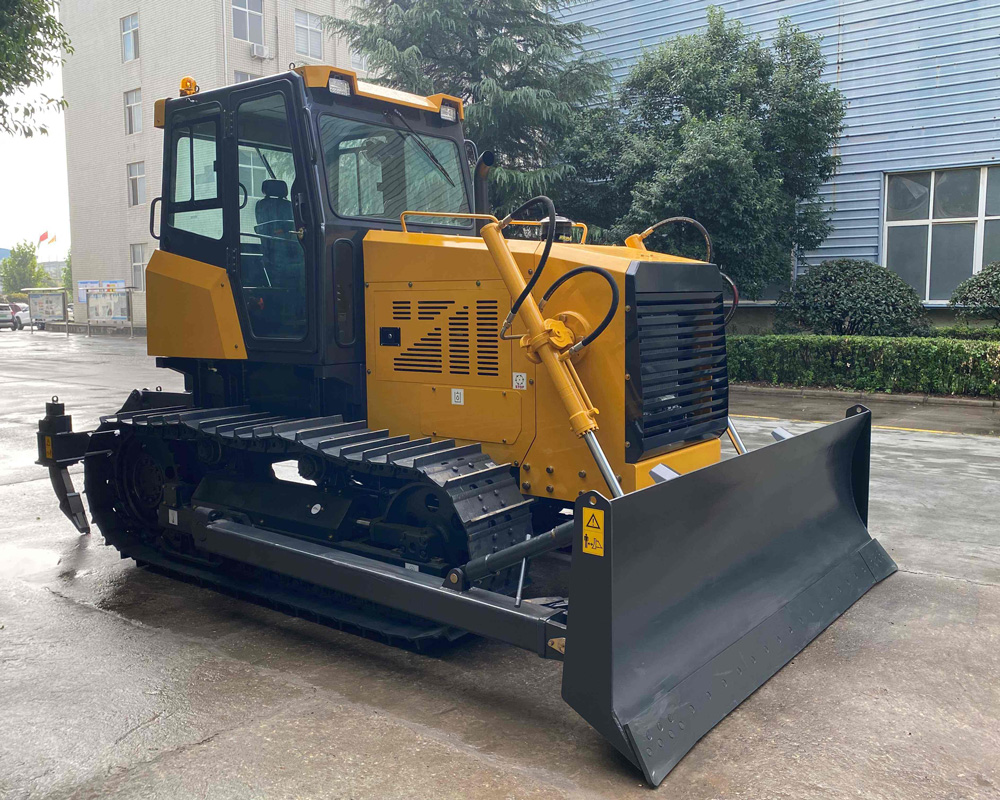
Therefore, the question of "what operating conditions to check for a small bulldozer" essentially means first sorting out the site constraints clearly, then checking them against the machine data. Below, using the verified parameters of a small crawler dozer with an operating weight of 10000 kg and rated power of 81 kW (125 HP) as an example, the corresponding relationships are explained item by item. It should first be noted that these parameters indicate what conditions the equipment can meet; they do not mean it is suitable for all small sites. Actual suitability still depends on on-site verification.
Step 1: Can the site accommodate the machine body and turning?
The first constraint on a small site is usually the overall dimensions. This machine measures 4400×2960×3030 mm, with a body width close to 3 meters. The combination of work area width, access routes, turning radius and stockpile areas determines whether it can complete U-turns and back-and-forth pushing within the site.
For factory areas or farmland plots with limited area, it is recommended to measure the following items first and then compare them with the overall dimensions:

- The clear width of the narrowest access route, and whether there are walls, pipelines or stockpiles on either side;
- The minimum side length of the area to be leveled, to determine whether the machine can complete an effective pushing stroke rather than reversing frequently;
- The parking and maintenance position, and whether space around the machine body is reserved;
- Height and weight limits of bridges and culverts along the relocation route.
If the side length of the work area is significantly less than the machine length plus the effective pushing distance, even if the overall dimensions allow entry, operating efficiency will be consumed by frequent direction changes. In this case, splitting the task into sections or using a smaller-class machine should be considered. The data does not provide a recommended minimum work area, so this must be judged on site.
Step 2: Do ground bearing capacity and ground pressure match?
Another common risk on small sites is complex ground conditions: backfill soil, soft soil after rain, and farmland topsoil. This machine has a track shoe width of 450 mm and a ground pressure of 54.4 kPa. Ground pressure is an important basis for judging passability on soft foundations, but it is only a nominal value under specific conditions; actual sinking also depends on soil moisture content, compaction state and operating method.
The data does not provide parameters for wetland-type or widened track configurations, so it cannot be inferred from this that the model is suitable for extremely soft ground such as swamps or paddy fields. If the site is an area with long-term standing water or very low bearing capacity, this should be treated as an item to be confirmed: check with the supplier whether wider track shoe options are available, or adjust the operating season and work sequence.
Step 3: How much drawbar pull and blade capacity does the pushing task require?
The core action of site leveling is pushing soil from high ground to low ground and spreading it flat. This machine has a maximum drawbar pull of 95 kN, a blade size of 2960×960 mm, a maximum lift height of 830 mm and a maximum digging depth of 350 mm. These figures help determine whether the cutting depth and soil volume per pushing pass match the task volume.

Note that the blade width is close to the machine width, so the width of the soil windrow formed during pushing is limited by the blade; a digging depth of 350 mm means it is more suitable for surface leveling and short-distance pushing rather than deep excavation or large-area stripping. The data also mentions optional straight, curved and coal blades, as well as fixed ripping equipment or a three-shank ripper. Different materials require different blade forms: the requirements for blade shape differ between pushing loose material and cutting hard compacted soil, and the specific selection should be confirmed with the material description at the time of purchase.
Step 4: Are relocation and shift arrangements realistic?
Small-site projects often involve many scattered points, with frequent equipment entry and exit. This machine uses a 4F+2R mechanical transmission, with forward speeds of 2.6–10.4 km/h and reverse speeds of 3.7–6.7 km/h. Travel speed determines the pace of on-site maneuvering and short-distance relocation, but road relocation still requires flatbed transport. The data does not provide transport weight distribution or loading methods, so this must be calculated separately based on actual machine weight and transport vehicle conditions.
Regarding shifts, the data gives engine rated power of 81 kW/2300 r/min, maximum torque of 400 N·m and fuel consumption of ≤242 g/km·h. The fuel consumption figure can serve as one input for fuel cost estimation, but actual consumption is related to load factor, working conditions and operating method, and cannot be directly converted into a fixed fuel consumption per shift.
Organize the conditions into a checklist
The table below places the above requirements alongside the corresponding items in the data for item-by-item checking. The "Data Basis" column lists only verified content, while the "To Be Confirmed" column lists information that needs to be supplemented on site or by the supplier.
| Operating Condition | Data Basis | Items to Be Confirmed |
|---|---|---|
| Work area dimensions | Overall dimensions 4400×2960×3030 mm | Minimum clear access width, available pushing stroke length |
| Ground bearing | Track shoe width 450 mm, ground pressure 54.4 kPa | Soil moisture content, availability of widened track options |
| Pushing capability | Maximum drawbar pull 95 kN, blade 2960×960 mm | Material hardness, pushing volume per shift |
| Cutting and spreading | Lift height 830 mm, digging depth 350 mm | Whether a ripper is needed, blade form selection |
| Relocation and travel | 4F+2R, forward 2.6–10.4 km/h | Flatbed truck tonnage, loading and unloading site conditions |
| Fuel cost | 81 kW/2300 r/min, fuel consumption ≤242 g/km·h | Actual load factor and fuel consumption per shift |
What else should be clarified with the supplier before purchase
Based on the above analysis, inquiries should focus on items that can change the selection conclusion, rather than merely comparing power figures:
- Material type and state: whether it is loose soil, backfill soil, clay or gravelly mixed material, and whether a ripper is needed;
- Work volume and schedule: the pushing area or volume to be completed per shift, which determines whether the equipment class is sufficient;
- Site and transport: access route dimensions, ground bearing capacity, relocation distance and transport vehicle conditions;
- Shifts and power: daily operating hours, refueling or energy replenishment arrangements;
- Key configurations: blade form, track shoe width, whether rear attachments are needed, and the supply status of these options.
The data for this 10-ton-class small crawler dozer supports the following judgment: for small-site tasks where the machine dimensions allow entry, ground bearing capacity is acceptable, and the work is mainly surface leveling and short-distance pushing, its dimensions, blade and drawbar pull parameters meet the corresponding conditions. However, passability on soft foundations, cutting capability in hard material and actual per-shift efficiency are not supported by the data and cannot be used as selection conclusions. Filling in these items to be confirmed is more meaningful than deciding on a model first.