






















A common problem on earthwork sites is not the lack of an excavator, but one machine being assigned to excavate, stockpile, and load trucks at the same time, resulting in poor performance on both ends: dig too deep, and the swing radius cannot reach the truck bed; focus only on loading, and face advancement falls behind. How to allocate the work focus is essentially asking whether the machine's working range, bucket capacity, and travel conditions can cover both processes simultaneously. Below, using public data for a 21-ton crawler excavator as a reference, the focus allocation is broken down into verifiable conditions.
Three things that affect focus allocation
Excavation and truck loading are not completely independent processes; they share the same work equipment and travel chassis. Which side the focus leans toward affects three types of site conditions:
- Positional relationship between the working face and the transport truck: whether the excavator stands at the pit edge to dump into the truck bed, or needs to move between the excavation face and the loading area.
- Ease of excavating the material: conventional earthwork versus mixed rock and hard soil have different cutting force requirements, directly affecting the time structure of a single cycle.
- Transfer and travel arrangements: when the working face advances, whether the excavator needs to travel on its own; travel distance and frequency determine the share of power and travel components in the shift.
If any of these three items is not settled, looking only at bucket capacity or power is insufficient to judge which side the focus should be on.
What the data for this 21-ton machine can answer
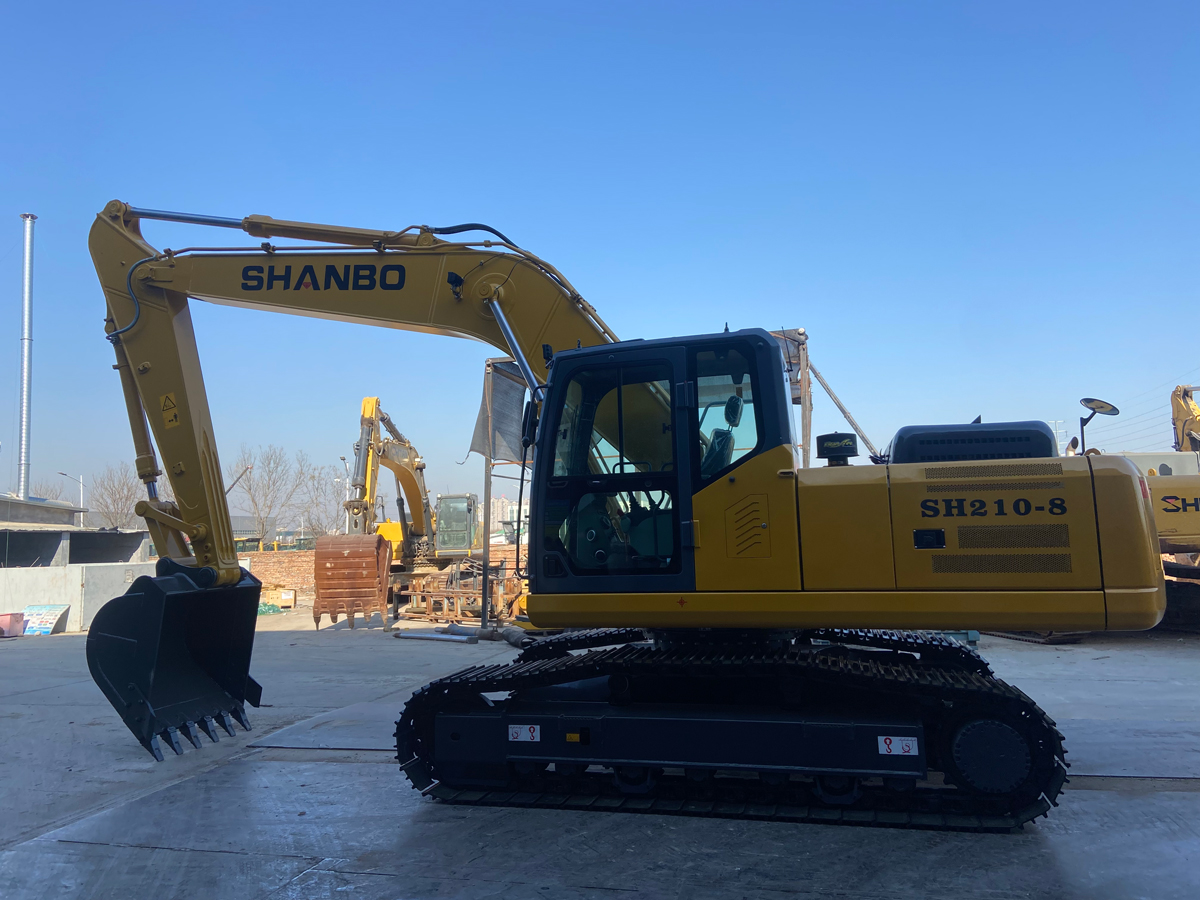
This model is publicly listed as a 21-ton crawler excavator, equipped with a 1.0 m³ bucket, engine power options of 129 kW or 153 kW, hydraulic system pressure 34.3 MPa, dual pump flow 2×231.7 L/min, digging force 126/134 kN, maximum digging depth 6350 mm, maximum digging radius 9700 mm, maximum digging height 10600 mm, and gradeability ≥70%. These fields, mapped to focus allocation, can be divided into two groups.

| Focus bias | Related fields | Explanation |
|---|---|---|
| Loading-oriented | Bucket capacity 1.0 m³, digging force 126/134 kN, dual pump flow | Bucket capacity and hydraulic output together determine the loading rhythm within a cycle, but the matching truck bed capacity must be confirmed on site |
| Excavation-oriented | Max digging depth 6350 mm, max digging radius 9700 mm, max digging height 10600 mm | Working range determines whether both the excavation face and dumping point can be covered; beyond the range, the machine must be moved |
| Transfer capability shared by both | Gradeability ≥70%, rated speed 28-35 km/h | The data gives travel capability; whether frequent transfer is actually possible also depends on site roads and load-bearing capacity |
It should be noted that the dual pump hydraulic flow and digging force come from the same data source; they are different aspects of the same hydraulic system and cannot be used to infer a fixed loading efficiency. The data does not provide cycle time, fuel consumption, or output per unit time, and this article does not make estimates.
When loading-oriented, check the transport link first
If transport trucks are sufficient and the excavation face is relatively fixed, focusing on loading is a common organization method. At this point, whether the 1.0 m³ bucket capacity matches the truck bed is the first issue to settle. If the bed is too small, there are many dumping cycles and frequent waiting; if the bed is too large, the fill factor per bucket is low, which also affects rhythm. The data does not give a suitable truck bed range; this item must be checked truck by truck against transport parameters before inquiry or site entry.
The second item to check is dumping height and swing radius. The maximum digging height of 10600 mm and maximum digging radius of 9700 mm describe the theoretical coverage of the work equipment; in actual loading, safety clearance and swing space must also be reserved. If the transport truck is parked on a slope or in a narrow passage, the theoretical radius may not directly translate into a usable dumping position, and on-site layout confirmation is needed.
When excavation-oriented, working range and ground conditions are the main line
When face advancement takes priority over transport turnover, the focus should be on excavation coverage. The maximum digging depth of 6350 mm determines how deep one stop position can dig; beyond this depth, layered excavation or machine movement is required. The maximum digging radius of 9700 mm relates to whether material can be delivered to a temporary stockpile without moving the chassis.

Ground conditions cannot be omitted in this type of arrangement. The digging force of 126/134 kN corresponds to the configuration marked in the data; when encountering hard soil, mixed rock, or cemented layers, whether loosening treatment is needed before excavation is not concluded in the data and should be confirmed by trial digging with actual material before site entry. Gradeability ≥70% is a marked value; slope work also involves ground bearing and whole-machine stability, and this single item cannot be used to judge usability on arbitrary slopes.
Suggested sequence when the two focuses are mixed
Most earthwork sites are not purely excavation or purely loading, but alternate according to face advancement. A more reliable verification sequence is:
- First determine the matching relationship between transport trucks and bucket capacity, then determine the excavator's stop position at the loading bay;
- Calculate layering and blocking of the excavation face based on maximum digging depth and radius to avoid frequent machine movement;
- Convert the number of machine moves into the shift schedule and compare with the 28-35 km/h travel capability and ≥70% gradeability condition;
- Finally confirm whether site roads, ground bearing, and access routes can support whole-machine transport and transfer.
The rationale for this sequence is: loading matching and working range are hard constraints; eliminating infeasible combinations first and then discussing rhythm arrangements is easier than fixing the machine first and then modifying the site.
Parts not covered by the data that require on-site confirmation
This data provides operating weight 21 tons, bucket 1.0 m³, power options, hydraulic parameters, and working range, but the following items have no basis and cannot be concluded from it:
- Loading volume per unit time or shift output: the data has no cycle time or measured data;
- Fuel consumption and operating costs: not provided in the data;
- Suitable transport truck tonnage and bed capacity range: not provided in the data;
- Excavation capability in special ground such as hard rock or water-bearing soft soil: no corresponding configuration is given in the data;
- Specific site slope, bearing capacity, and transport dimension limits: require project-specific measurement.
In addition, expressions such as "in stock," "ships in 1 to 7 days," and "core components warranted for 1 year" appearing in the data are supply and service information unrelated to work focus allocation; they should be verified separately during procurement and are not used as capability basis in this article.
Site information recommended to prepare before inquiry
Only by clearly explaining the focus allocation can targeted answers be obtained during inquiry. It is recommended to prepare: material type and approximate proportions, excavation depth and working face dimensions, transport truck bed capacity and quantity, site slope and road width, average daily shifts and transfer frequency, and whether coordinated operations such as breaking or loosening are needed. Regarding work equipment, state the bucket use and whether other attachments are needed; regarding transport, state the whole-machine entry route and height/width limits; regarding configuration, state power version preference and local service conditions.
If the above conditions are not yet complete, first list items to be confirmed under two assumptions—"loading-oriented, excavation-assisted" or "excavation-oriented, loading-assisted"—and then adjust according to facts, rather than locking in a specific model first.