






















A common difficulty in asphalt surface compaction is not “how big a roller to buy,” but that when layer thickness changes, the site no longer knows whether the original rolling plan still holds. Thin layers risk over-vibration, while thick layers risk insufficient compaction, and mix type, paving temperature, underlying layer conditions and number of passes all affect the result. Directly converting target layer thickness into a single equipment parameter is not rigorous. A more workable approach is to first break down the equipment requirements of the compaction operation, then compare them item by item with the equipment data.
Below, following the idea of “requirement breakdown,” the asphalt surface compaction target is broken into several verifiable equipment conditions, and verified data for a 13-ton tandem vibratory roller is used to explain the corresponding relationships. This article does not involve specific project cases, and whether the equipment is suitable still needs to be confirmed in combination with test sections and site conditions.
First breakdown: layer thickness determines the compaction energy requirement, not a single parameter
The thicker the target layer, the greater the depth to which compaction energy must be transmitted, but this does not mean that higher linear load or centrifugal force is always better. Asphalt surfaces must also maintain surface smoothness, avoid aggregate crushing and prevent excessive vibration. Therefore, layer thickness first affects:
- How vibratory compaction and static compaction are combined;
- Whether a larger or smaller amplitude should be selected;
- How the number of passes and speed are organized;
- Whether the equipment's operating weight and linear load are sufficient to reach the target density within a reasonable number of passes.
These conditions constrain one another. Selecting equipment based only on thickness can easily overlook mix type and the temperature window; looking only at tonnage can easily overlook the effect of frequency, amplitude and working width on rolling organization.

Second breakdown: convert the thickness target into four equipment conditions
1. Linear load and operating weight
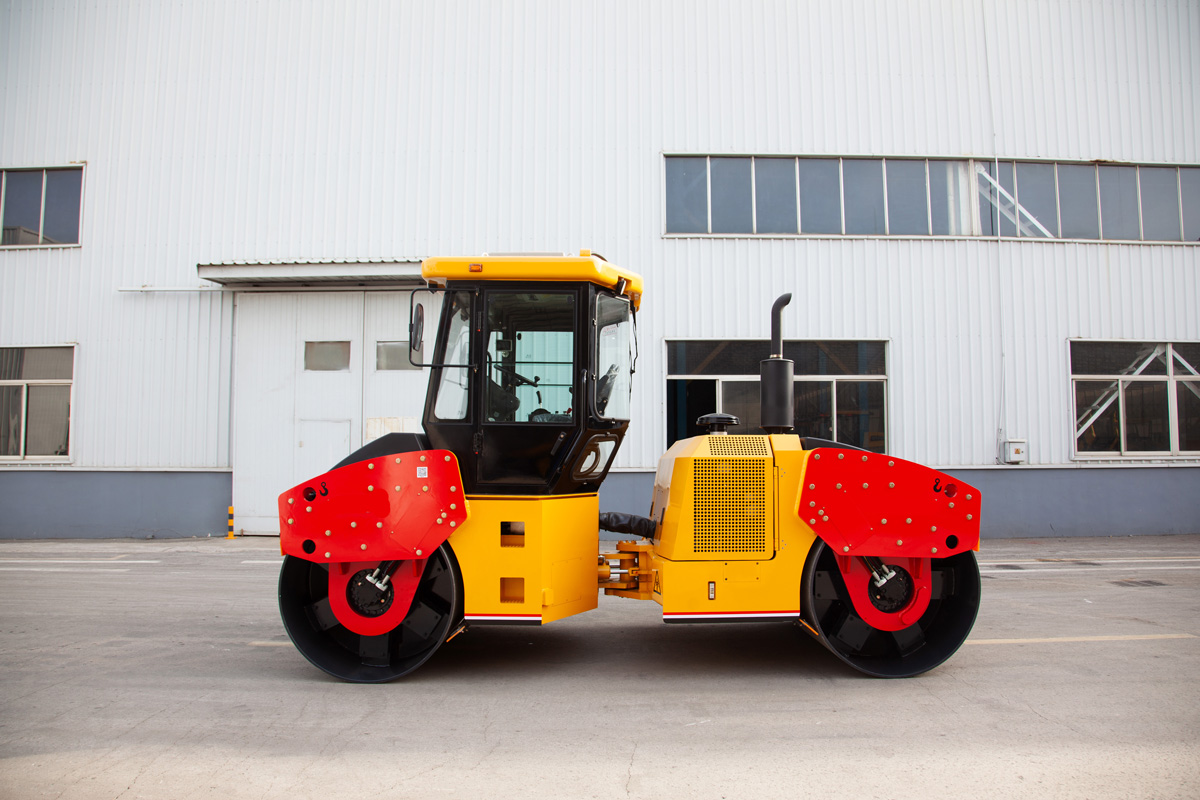
Linear load reflects the static pressure applied per unit width of the drum and is related to operating weight and drum width. For thicker layers or coarser mixes, sufficient static linear load helps provide basic compaction capability in addition to vibration. Taking the D136HF associated with this article as an example, its operating weight is 13,000 kg, and the static linear loads of the front and rear drums are both 299 N/cm. This set of data can be used to judge whether the equipment falls within the static compaction capability range expected by the project, but whether it can meet the target density still must be verified by test sections.
2. Centrifugal force combined with frequency and amplitude
The energy for vibratory compaction mainly comes from centrifugal force, while frequency and amplitude determine the vibration form and material response. The D136HF has a maximum centrifugal force of 150 kN, dual frequencies of 42/50 Hz, and dual amplitudes of 0.88/0.4 mm. The data gives centrifugal force as 150×2/95×2 kN, indicating that different frequency or amplitude settings correspond to different centrifugal force outputs. For thin layers or sensitive mixes, the lower amplitude setting deserves more attention; for thicker layers, it is necessary to check whether the centrifugal force at the higher amplitude setting matches the target. The data does not provide a correspondence table dividing settings by thickness, so the specific combination of settings must be determined according to mix design and test sections.
3. Drum width and working width
Drum width affects the coverage width of a single pass and the overlap arrangement. The D136HF drum width is 2,130 mm. Layer thickness itself does not directly determine drum width, but the working surface width, paver width and rolling overlap plan affect the number of machines and travel routes. A narrow working surface with wide drums may limit maneuverability, while a wide working surface with narrow drums increases the number of passes and the difficulty of overlap control.

4. Travel speed and gradeability
Asphalt rolling requires a relatively stable travel speed, and speed fluctuations affect rolling uniformity. The D136HF travel speed is 0–12 km/h, and gradeability is 30%. The data does not give a recommended rolling speed range. Actual speed should be determined in combination with paving speed, number of passes and the mix temperature window, and the maximum speed cannot be used directly to infer construction speed.
Third breakdown: work stages corresponding to the tandem drum structure
A tandem vibratory roller has drums at both front and rear and is suitable for some stages of the initial, intermediate and final rolling organization of asphalt surfaces. Compared with single-drum equipment, tandem rollers have clear use scenarios for surface smoothness and uniform compaction of asphalt layers, but which stage they undertake and whether vibration or static compaction is used still depend on the construction plan. The D136HF data mentions an integrated wet multi-disc braking system, crab steering function and electronically controlled water spray. These configurations correspond respectively to site requirements such as reliable braking under heavy load, parallel movement at edges and in narrow spaces, and water spray uniformity, but it cannot be inferred from this that the machine is suitable for all asphalt layer thicknesses.
| Target layer condition | Corresponding equipment condition | Verified D136HF data | Still to be confirmed |
|---|---|---|---|
| Thicker layers require basic compaction energy | Operating weight, static linear load | 13,000 kg; 299/299 N/cm | Number of passes and test section results corresponding to target density |
| Vibration energy matches material response | Centrifugal force, frequency, amplitude | 150 kN; 42/50 Hz; 0.88/0.4 mm | Combination plans for different settings and mix types |
| Working surface coverage and overlap | Drum width | 2,130 mm | Paving width and overlap arrangement |
| Continuous rolling organization | Travel speed, gradeability | 0–12 km/h; 30% | Recommended rolling speed and site longitudinal slope |
What these data can support and what conclusions they cannot support
From the verified data, the tonnage, linear load and centrifugal force of the D136HF fall within the range of heavy tandem vibratory rollers, and the data also clearly states that it is suitable for highway asphalt paving, municipal roads and airport runway compaction. This provides a candidate machine that can be compared for plans involving “thicker layers, wider working surfaces and the need for tandem vibratory compaction.” However, the data does not provide the following items, and conclusions cannot be drawn on the reader's behalf:
- Recommended amplitude settings and number of rolling passes for different layer thicknesses;
- Compaction density or air void results for specific mix types;
- Specific travel speed matched to paver speed;
- Number of machines required under the target schedule.
These all need to be determined through test sections, mix design data and site organization. If the project mainly involves thin overlays or small-area patching, whether the maneuverability and energy output of 13-ton-class equipment are suitable should also be checked separately and cannot be judged from this article alone.
Data items recommended for verification before purchase or mobilization
After converting the layer target into equipment conditions, the following checklist can be used to confirm items one by one before inquiry and mobilization:
- Target layer thickness range, mix type and design compaction requirements;
- Paving width, working surface width, and turning and edge compaction requirements;
- Whether drum width, linear load, centrifugal force, frequency and amplitude settings cover the expected working conditions;
- Site support conditions such as the water spray system, braking form and operator visibility;
- Transport dimensions and access road restrictions; the D136HF overall dimensions are 4,920×2,300×3,200 mm;
- Shift refueling arrangements corresponding to engine power of 119 kW and fuel tank capacity of 200 L;
- Rolling speed, amplitude use conditions and maintenance inspection requirements in the manual.
Among these, the correspondence between amplitude settings and layer thickness, the recommended rolling speed range, and the compaction effect under specific mixes must all be based on the product manual, test section data and site technical plan. The data in this article is insufficient to give fixed combinations. It is recommended that the above conditions be submitted to the supplier before purchase and confirmed in writing item by item.